

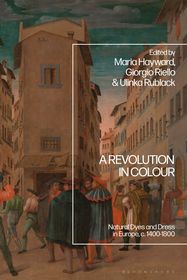
A Revolution in Colour
Natural Dyes and Dress in Europe, c. 1400-1800
-
GET 18% OFF
- Publisher's listprice GBP 28.99
-
13 088 Ft (12 465 Ft + 5% VAT)
The price is estimated because at the time of ordering we do not know what conversion rates will apply to HUF / product currency when the book arrives. In case HUF is weaker, the price increases slightly, in case HUF is stronger, the price goes lower slightly.
- Discount 18% (cc. 2 356 Ft off)
- Discounted price 10 732 Ft (10 221 Ft + 5% VAT)
- Discount is valid until: 31 August 2026
10 732 Ft

Availability
Estimated delivery time: In stock at the publisher, but not at Prospero's office. Delivery time approx. 3-5 weeks.
Not in stock at Prospero.
Why don't you give exact delivery time?
Delivery time is estimated on our previous experiences. We give estimations only, because we order from outside Hungary, and the delivery time mainly depends on how quickly the publisher supplies the book. Faster or slower deliveries both happen, but we do our best to supply as quickly as possible.
Product details:
- Publisher Bloomsbury Publishing (UK)
- Date of Publication 30 April 2026
- ISBN 9781350405660
- Binding Paperback
- No. of pages280 pages
- Size 232x154x20 mm
- Weight 580 g
- Language
- Illustrations 50 colour illus 793
Categories
Short description:
A highly illustrated examination of the history of colour through its interrelation with dress in Europe in the period from 1400 to 1800.
MoreLong description:
This major volume aims to re-colour the European world of dress, c.1300-1800. New dyes created one of the most important visual experiences of the period, yet their story has been side-lined by a focus on visual experiences shaped by the high arts. Meanwhile, theatrical productions and period films still abound with broad assumptions about the growing dominance of black clothing for elites during the period, while ordinary people are imagined having worn coarse greys and bleached garments. This volume presents clear evidence that even the clothing of the middle classes could be much more expensive than paintings, and that coloured clothing and accessories were ubiquitous across society.
Contributors shed new light on the economic, environmental, and cultural dimensions of colour in dress. The range of dyes expanded considerably in the sixteenth and seventeenth centuries, drawing on Asian and Mediterranean knowledge, new collections of recipes, and the greater diversity of plants available through New World trade. Working creatively with organic plant, animal, and mineral materials to make colours involved considerable knowledge, pleasure and skill. The creation of colour through dyes thus reveals a whole range of global agricultural and craft technologies that can inspire future material worlds and transforms our understanding of Europe???s cultural heritage.
Table of Contents:
List of Illustrations
Editors' Introduction
1. The Arrival of the Crimson Dyeing Technique in Italy in the Late Fourteenth Century Luca Mol??? (University of Warwick, UK)
2. The Woad We Have Lost? The Changing Supply Networks of Tuscan dye Businesses between the Local and the Global, 1450-1650 Stephanie Lietzel (Harvard University, USA)
3. Crimson Dyes and the Law in Renaissance Italy Lisa Monnas and Jo Kirby (both Independent Scholars, UK)
4. The Limits of Global Trade: Cochineal and Indigo in the Pre-modern Period Giorgio Riello (European University Institute, Italy)
5. A Dyeing Art: Reconstructing Rosetti's Plictho Sophie Pitman (Aalto University, Finland)
6. The Colourful Language of Dyeing Black Sven Dupr??? (University of Utrecht, The Netherlands) and Natalia Ortegasaez (Antwerp, The Netherlands)
7. Re-Colouring Renaissance Dress: Matth???us Schwarz of Augsburg Ulinka Rublack (Cambridge University, UK)
8. Creating colour in the Stuart Royal Wardrobes, 1566-1701 Maria Hayward (University of Southampton, UK)
9. Innovations and Imitations of Fashion: Colour and Novelty in Early Modern Italian Dress Paula Hohti Erichsen (Aalto University, Finland)
10. French Indigo Trade from Marseille to Levant Marguerite Martin (IDHES - Universit??? Paris I Panth???on Sorbonne, France)
11. Dyes and Dyeing in the Business of Indienne in the Eighteenth Century Kim Siebenh???ner (Historisches Institut, Jena, Germany)
12. Identifying Different Pathways to Historical Colour for Scientific Analysis Anita Quye (University of Glasgow, UK)
Conclusion: The Cost of Colour: Colonial Networks and Embodied Histories Beverly Lemire (University of Alberta, Canada)
Index

