

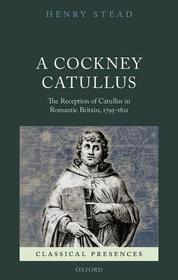
A Cockney Catullus
The Reception of Catullus in Romantic Britain, 1795-1821
Series: Classical Presences;
- Publisher's listprice GBP 145.00
-
65 467 Ft (62 350 Ft + 5% VAT)
The price is estimated because at the time of ordering we do not know what conversion rates will apply to HUF / product currency when the book arrives. In case HUF is weaker, the price increases slightly, in case HUF is stronger, the price goes lower slightly.
- Discount 10% (cc. 6 546 Ft off)
- Discounted price 58 921 Ft (56 115 Ft + 5% VAT)
Subcribe now and take benefit of a favourable price.
Subscribe
65 467 Ft

Availability
printed on demand
Why don't you give exact delivery time?
Delivery time is estimated on our previous experiences. We give estimations only, because we order from outside Hungary, and the delivery time mainly depends on how quickly the publisher supplies the book. Faster or slower deliveries both happen, but we do our best to supply as quickly as possible.
Product details:
- Publisher OUP Oxford
- Date of Publication 5 November 2015
- ISBN 9780198744887
- Binding Hardback
- No. of pages368 pages
- Size 222x154x26 mm
- Weight 578 g
- Language English
- Illustrations 29 black and white illustrations 0
Categories
Short description:
A Cockney Catullus traces the reception history of the Roman poet Catullus in Romantic-era Britain, identifying the influence of his poetry in the work of numerous Romantic-era literary and political figures, including Byron, Keats, Wordsworth, Coleridge, Hunt, Canning, Brougham, and Gifford.
MoreLong description:
Catullus, one of the most Hellenizing, scandalous, and emotionally expressive of the Roman poets, burst onto the British cultural scene during the Romantic era. It was not until this socially, politically, and culturally explosive epoch, with its mania for all things Greek, that Catullus' work was first fully translated into English and played a key role in the countercultural and commercially driven classicism of the time. Previously marginalized on the traditional eighteenth-century curriculum as a charming but debauched minor love poet, Catullus was discovered as a major poetic voice in the late Georgian era by reformist emulators-especially in the so-called Cockney School-and won widespread respect. In this volume, Henry Stead pioneers a new way of understanding the key role Catullus played in shaping Romanticism by examining major literary engagements with Catullus, from John Nott of Bristol's pioneering book-length bilingual edition (1795), to George Lamb's polished verse translation (1821). He identifies the influence of Catullus' poetry in the work of numerous Romantic-era literary and political figures, including Byron, Keats, Wordsworth, Coleridge, Hunt, Canning, Brougham, and Gifford, demonstrating the degree of its cultural penetration.
[This is] a valuable contribution to the field, for its combination of robust historical research and nuanced close readings offers an important revaluation of Catullan influence in the Romantic period. Stead's own close engagement with Catullus' Latin texts in relation to their Romantic translations and allusions provides thought-provoking readings of the Romantics, reminding us what can be learned by considering the choices poets make in adapting other work.
Table of Contents:
Acknowledgements
List of Illustrations
List of Abbreviations
Select Timeline of Catullan Engagement
Introduction
Catullus Unchained: The Translations of John Nott & George Lamb
Catullus 64 in Translation and Allusion
i. Translating 64: C.A. Elton and Frank Sayers
ii. Symbolic Allusion: T.L. Peacock, Leigh Hunt, and Keats
Non-Cockney Responses to Catullus
i. W.S. Landor, Wordsworth, Thomas Moore, and Lord Byron
ii. The Anti-Jacobinical Catullus
Catullus The Reformer: Leigh Hunt's Reception
Keats's Catullan Samphire
Conclusion
Appendix
Select Bibliography
Index

