

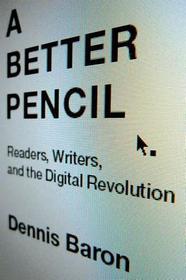
A Better Pencil
Readers, Writers, and the Digital Revolution
- Publisher's listprice GBP 24.49
-
11 057 Ft (10 530 Ft + 5% VAT)
The price is estimated because at the time of ordering we do not know what conversion rates will apply to HUF / product currency when the book arrives. In case HUF is weaker, the price increases slightly, in case HUF is stronger, the price goes lower slightly.
- Discount 10% (cc. 1 106 Ft off)
- Discounted price 9 951 Ft (9 477 Ft + 5% VAT)
Subcribe now and take benefit of a favourable price.
Subscribe
11 057 Ft

Availability
printed on demand
Why don't you give exact delivery time?
Delivery time is estimated on our previous experiences. We give estimations only, because we order from outside Hungary, and the delivery time mainly depends on how quickly the publisher supplies the book. Faster or slower deliveries both happen, but we do our best to supply as quickly as possible.
Product details:
- Publisher OUP USA
- Date of Publication 18 October 2012
- ISBN 9780199914005
- Binding Paperback
- No. of pages280 pages
- Size 226x142x15 mm
- Weight 376 g
- Language English 0
Categories
Short description:
A Better Pencil puts our complex, still-evolving hate-love relationship with computers and the internet into perspective, describing how the digital revolution influences our reading and writing practices, and how the latest technologies differ from what came before.
MoreLong description:
Computers, now the writer's tool of choice, are still blamed by skeptics for a variety of ills, from speeding writing up to the point of recklessness, to complicating or trivializing the writing process, to destroying the English language itself.
A Better Pencil puts our complex, still-evolving hate-love relationship with computers and the internet into perspective, describing how the digital revolution influences our reading and writing practices, and how the latest technologies differ from what came before. The book explores our use of computers as writing tools in light of the history of communication technology, a history of how we love, fear, and actually use our writing technologies--not just computers, but also typewriters, pencils, and clay tablets. Dennis Baron shows that virtually all writing implements--and even writing itself--were greeted at first with anxiety and outrage: the printing press disrupted the "almost spiritual connection" between the writer and the page; the typewriter was "impersonal and noisy" and would "destroy the art of handwriting." Both pencils and computers were created for tasks that had nothing to do with writing. Pencils, crafted by woodworkers for marking up their boards, were quickly repurposed by writers and artists. The computer crunched numbers, not words, until writers saw it as the next writing machine. Baron also explores the new genres that the computer has launched: email, the instant message, the web page, the blog, social-networking pages like MySpace and Facebook, and communally-generated texts like Wikipedia and the Urban Dictionary, not to mention YouTube.
Here then is a fascinating history of our tangled dealings with a wide range of writing instruments, from ancient papyrus to the modern laptop. With dozens of illustrations and many colorful anecdotes, the book will enthrall anyone interested in language, literacy, or writing.
Makes good use of illustrations and offers many specific recent examples of digital writing; the historical development of pencils, typewriters and other technology provides a solid backdrop for Baron's points about the changes wrought by the move from pencils to pixels.
Table of Contents:
Preface: Technologies of the Word
Introduction
1. TeknoFear
2. Thoreau's Pencil
3. National Handwriting Day
4. Writing on Clay
5. When WordStar Was King
6. Trusting the Text
7. Writing on Screen
8. Everyone's an Author
9. A Space of One's Own
10. The Dark Side of the Web
11. From Pixels to Pencils
Works Cited

