

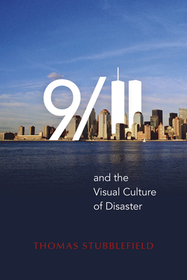
9/11 and the Visual Culture of Disaster
- Publisher's listprice GBP 56.00
-
25 284 Ft (24 080 Ft + 5% VAT)
The price is estimated because at the time of ordering we do not know what conversion rates will apply to HUF / product currency when the book arrives. In case HUF is weaker, the price increases slightly, in case HUF is stronger, the price goes lower slightly.
- Discount 20% (cc. 5 057 Ft off)
- Discounted price 20 227 Ft (19 264 Ft + 5% VAT)
- Discount is valid until: 30 June 2026
Subcribe now and take benefit of a favourable price.
Subscribe
25 284 Ft

Availability
Estimated delivery time: In stock at the publisher, but not at Prospero's office. Delivery time approx. 3-5 weeks.
Not in stock at Prospero.
Why don't you give exact delivery time?
Delivery time is estimated on our previous experiences. We give estimations only, because we order from outside Hungary, and the delivery time mainly depends on how quickly the publisher supplies the book. Faster or slower deliveries both happen, but we do our best to supply as quickly as possible.
Product details:
- Publisher Indiana University Press
- Date of Publication 17 December 2014
- Number of Volumes Print PDF
- ISBN 9780253015495
- Binding Hardback
- No. of pages246 pages
- Size 229x152 mm
- Weight 517 g
- Language English
- Illustrations 39 b&w illus. 0
Categories
Long description:
"
The day the towers fell, indelible images of plummeting rubble, fire, and falling bodies were imprinted in the memories of people around the world. Images that were caught in the media loop after the disaster and coverage of the attack, its aftermath, and the wars that followed reflected a pervasive tendency to treat these tragic events as spectacle. Though the collapse of the World Trade Center was ""the most photographed disaster in history,"" it failed to yield a single noteworthy image of carnage. Thomas Stubblefield argues that the absence within these spectacular images is the paradox of 9/11 visual culture, which foregrounds the visual experience as it obscures the event in absence, erasure, and invisibility. From the spectral presence of the Tribute in Light to Art Spiegelman's nearly blank New Yorker cover, and from the elimination of the Twin Towers from television shows and films to the monumental cavities of Michael Arad's 9/11 memorial, the void became the visual shorthand for the incident. By examining configurations of invisibility and erasure across the media of photography, film, monuments, graphic novels, and digital representation, Stubblefield interprets the post-9/11 presence of absence as the reaffirmation of national identity that implicitly laid the groundwork for the impending invasions of Iraq and Afghanistan.
" MoreTable of Contents:
Acknowledgments
Introduction: Spectacle and Its Other
1. From Latent to Live: Disaster Photography after the Digital Turn
2. Origins of Affect: The Falling Body and Other Symptoms of Cinema
3. Remembering-Images: Empty Cities, Machinic Vision, and the Post-9/11 Imaginary
4. Lights, Camera, Iconoclasm: How Do Monuments Die and Live to Tell about It?
5. The Failure of the Failure of Images: The Crisis of the Unrepresentable from the Graphic Novel to the 9/11 Memorial
Conclusion
Notes
Bibliography
Index

