

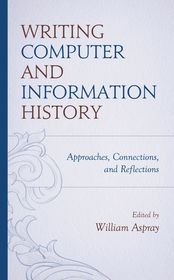
Writing Computer and Information History
Approaches, Connections, and Reflections
-
18% KEDVEZMÉNY?
- Kiadói listaár GBP 28.99
-
13 088 Ft (12 465 Ft + 5% áfa)
Az ár azért becsült, mert a rendelés pillanatában nem lehet pontosan tudni, hogy a beérkezéskor milyen lesz a forint árfolyama az adott termék eredeti devizájához képest. Ha a forint romlana, kissé többet, ha javulna, kissé kevesebbet kell majd fizetnie.
- Kedvezmény(ek) 18% (kb. 2 356 Ft)
- Kedvezményes ár 10 732 Ft (10 221 Ft + 5% áfa)
- A kedvezmény érvényes eddig: 2026. augusztus 31.
10 732 Ft

Beszerezhetőség
Még nem jelent meg, de rendelhető. A megjelenéstől számított néhány héten belül megérkezik.
Why don't you give exact delivery time?
A beszerzés időigényét az eddigi tapasztalatokra alapozva adjuk meg. Azért becsült, mert a terméket külföldről hozzuk be, így a kiadó kiszolgálásának pillanatnyi gyorsaságától is függ. A megadottnál gyorsabb és lassabb szállítás is elképzelhető, de mindent megteszünk, hogy Ön a lehető leghamarabb jusson hozzá a termékhez.
A termék adatai:
- Kiadó Bloomsbury Publishing (UK)
- Megjelenés dátuma 2026. szeptember 17.
- ISBN 9798216555780
- Kötéstípus Puhakötés
- Terjedelem514 oldal
- Méret 234.95x155.575 mm
- Nyelv
- Illusztrációk 13 Tables, 11 BW Photos 700
Kategóriák
Rövid leírás:
A meta-historical book about the research and writing of these types of history.
TöbbHosszú leírás:
This is not a book about the history of computing or the history of information. Instead, it is a meta-historical book about the research and writing of these types of history.
The formal presentation of historical research in the form of a publication often hides the process by which the topic was selected, boundaries were drawn, evidence was selected, analytic approach was chosen and applied, results were presented, how this work fits into a larger body of scholarship, the implicit goals and biases of the author, and many other similar issues. This process of learning about the various ways to carry out computer history or information history can be enriched by this collection of reflective essays by experienced scholars, discussing the craft that they practice.
This is a book that concerns both computer history and information history. The first scholarship in computer history by professionally trained scholars began to appear in the 1970s, so we are approaching a half century of research and publication in this area. The field has generated numerous pieces of exemplary scholarship from various perspectives such as intellectual history of individual technologies, business histories of firms, economic histories of market sectors, externalist histories of funding and professionalization, and so on.
However, the field continues to evolve, especially as computing and communication technologies have drawn together in the form of the Internet and social media; and with them a new set of scholars is participating, drawn not only from the history of science and technology, but also from the communication and media studies fields. Powerful theories, approaches, and frameworks are being increasingly drawn more widely from both the humanities and the social sciences to inform the practice of computer history. The scholars in this volume look at what's happened, what's happening now, and where historical scholarship in these disciplines is headed.
Tartalomjegyzék:
Preface
Part I. The Master Narratives
1. Historians and the Information Turn in History, Toni Weller
2. Writing the Big Story, Thomas Haigh
Part II. Creating a New Story of Information History
3. Writing Information History Using New Frameworks, Theories, and Approaches, James Cortada
4. Writing Information History from the Perspective of Rhetorical Genre Theory, Laura Skouvig
5. An i for an I: Call and Response for the iSchools, Geoffrey Bowker and John Leslie King
Part III. Reshaping the Mature Story of Computing History
6. Writing the History of Computing: The First Half Century, David Gugerli and Daniela Zetti
7. Transformative Product Launches in Computing and Internet Markets: Origins and Archetypes, Shane Greenstein
8. Writing the Economic History of Computing, Daniel Garcia-Swartz and Martin Campbell-Kelly
9. Writing Law and Public Policy into Computing and Information History, Philip Doty and William Aspray
Part IV. Broadening Computing and Information History
10. Writing the History of Telecommunications and Data Networks, Valerie Schafer
11. Writing Data into the Histories of Computing and Information, Matthew Jones
12. Writing about Writing about Social Informatics: Opportunities and Challenges, Howard Rosenbaum
13. Writing Geography into the History of Computing, Communication, and Information, Gregory Downey
14. Traveling Across the Lands of History, Philosophy, and Practices of Computing: Confessions of a Nomad, Liesbeth De Mol
About the Editor
About the Contributors

