

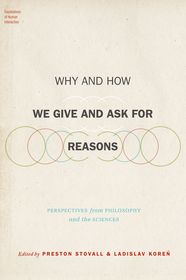
Why and How We Give and Ask for Reasons
Perspectives from Philosophy and the Sciences
Sorozatcím: Foundations of Human Interaction;
-
10% KEDVEZMÉNY?
- A kedvezmény csak az 'Értesítés a kedvenc témákról' hírlevelünk címzettjeinek rendeléseire érvényes.
- Kiadói listaár GBP 86.00
-
38 829 Ft (36 980 Ft + 5% áfa)
Az ár azért becsült, mert a rendelés pillanatában nem lehet pontosan tudni, hogy a beérkezéskor milyen lesz a forint árfolyama az adott termék eredeti devizájához képest. Ha a forint romlana, kissé többet, ha javulna, kissé kevesebbet kell majd fizetnie.
- Kedvezmény(ek) 10% (cc. 3 883 Ft off)
- Kedvezményes ár 34 946 Ft (33 282 Ft + 5% áfa)
Iratkozzon fel most és részesüljön kedvezőbb árainkból!
Feliratkozom
38 829 Ft

Beszerezhetőség
Becsült beszerzési idő: A Prosperónál jelenleg nincsen raktáron, de a kiadónál igen. Beszerzés kb. 3-5 hét..
A Prosperónál jelenleg nincsen raktáron.
Why don't you give exact delivery time?
A beszerzés időigényét az eddigi tapasztalatokra alapozva adjuk meg. Azért becsült, mert a terméket külföldről hozzuk be, így a kiadó kiszolgálásának pillanatnyi gyorsaságától is függ. A megadottnál gyorsabb és lassabb szállítás is elképzelhető, de mindent megteszünk, hogy Ön a lehető leghamarabb jusson hozzá a termékhez.
A termék adatai:
- Kiadó OUP USA
- Megjelenés dátuma 2026. január 16.
- ISBN 9780197745083
- Kötéstípus Keménykötés
- Terjedelem368 oldal
- Méret 239x164x35 mm
- Súly 640 g
- Nyelv angol
- Illusztrációk 7 b/w illustrations 655
Kategóriák
Rövid leírás:
The social practices and skills for giving, assessing, and responding to reasons play a key role in the constitution of uniquely human conceptual, epistemic, and deliberative powers. Although theorists in the past have articulated intriguing views on this topic, current research opens up new vistas that promise a deeper understanding of the way reason-seeking or -querying activities shape and scaffold the operations of human cognition. This volume offers resources for philosophers, cognitive scientists, developmental and comparative psychologists, and evolutionary anthropologists to continue this conversation.
TöbbHosszú leírás:
The social practices and skills for giving, assessing, and responding to reasons play a key role in the constitution of uniquely human conceptual, epistemic, and deliberative powers. It is thus of great interest to explore why and how humans give and ask for reasons. In addition, it is increasingly recognized that an adequate understanding of such questions calls for a multi-perspectival, often dialogical, cross-fertilizing and integrative approach. Current research at the interface of philosophy and the sciences is already yielding new data, explanations, and predictions concerning the origins, purposes, development, and consequences of human discursive practices and skills, but representative overviews of this research are still missing from the literature.
Why and How We Give and Ask for Reasons aims to fill this lacuna by bringing together new essays that approach the topic from integrative perspectives that promise to stimulate future research. The chapter authors include established figures in both philosophy and the sciences, as well as a number of younger scholars. The volume as a whole enables philosophers, cognitive scientists, developmental and comparative psychologists, and evolutionary anthropologists to deepen discussions on the reason-querying accounts of human cognition.
Interpersonal discourse might be conceived, not as the expression of, but as the origin of individual reasoning. Most of the papers in this collection defend some aspect of this conception. The remainder push back against the more extreme forms. The volume breaks new ground in this fundamental debate.
Tartalomjegyzék:
Introduction
Ladislav Koren
Part I: Social-Epistemological Perspectives
Chapter 1: The Social Practice of Giving and Asking for Reasons
Hilary Kornblith
Chapter 2: Commitment Coordination and the Social Function of Reason-Giving
Jeremy Randel Koons
Chapter 3: Second-Person Normativity
Glenda Satne
Part II: Logical Perspectives
Chapter 4: Reasoning, Reason Relations, and Semantic Content
Robert Brandom
Chapter 5: GOGAR and Logical Theories
Jaroslav Peregrin
Chapter 6: Reasons for Asking
Jared Millson and Mark Risjord
Chapter 7: Rejection as a Mental Act: Model-Theoretic and Proof-Theoretic Varieties
Preston Stovall
Part III: Developmental Perspectives
Chapter 8: Respect for Reasons in Human Development
David Moshman
Chapter 9: Reasoning and Trust: A Developmental Perspective
Bahar Köymen and Catarina Dutilh Novaes
Chapter 10: Objectivity and the Space of Reasons
Ladislav Koren
Part IV: Evolutionary-Comparative Perspectives
Chapter 11: Ways of Reasoning in Humans and Other Animals
Cathal O'Madagain
Chapter 12: The Evolution of Articulated Reasons: Reasoning as Discursive Niche Construction
Joseph Rouse
Chapter 13: Rationality and Reflection in Human and Non-Human Animals
Giacomo Melis
Chapter 14: A Functionalist Approach to Additive and Transformative Rationality
Yannick Kohl

