

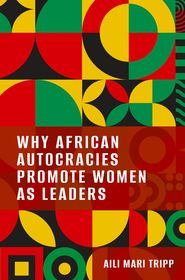
Why African Autocracies Promote Women as Leaders
-
10% KEDVEZMÉNY?
- A kedvezmény csak az 'Értesítés a kedvenc témákról' hírlevelünk címzettjeinek rendeléseire érvényes.
- Kiadói listaár GBP 19.99
-
9 025 Ft (8 595 Ft + 5% áfa)
Az ár azért becsült, mert a rendelés pillanatában nem lehet pontosan tudni, hogy a beérkezéskor milyen lesz a forint árfolyama az adott termék eredeti devizájához képest. Ha a forint romlana, kissé többet, ha javulna, kissé kevesebbet kell majd fizetnie.
- Kedvezmény(ek) 10% (cc. 903 Ft off)
- Kedvezményes ár 8 122 Ft (7 736 Ft + 5% áfa)
Iratkozzon fel most és részesüljön kedvezőbb árainkból!
Feliratkozom
9 025 Ft

Beszerezhetőség
Becsült beszerzési idő: A Prosperónál jelenleg nincsen raktáron, de a kiadónál igen. Beszerzés kb. 3-5 hét..
A Prosperónál jelenleg nincsen raktáron.
Why don't you give exact delivery time?
A beszerzés időigényét az eddigi tapasztalatokra alapozva adjuk meg. Azért becsült, mert a terméket külföldről hozzuk be, így a kiadó kiszolgálásának pillanatnyi gyorsaságától is függ. A megadottnál gyorsabb és lassabb szállítás is elképzelhető, de mindent megteszünk, hogy Ön a lehető leghamarabb jusson hozzá a termékhez.
A termék adatai:
- Kiadó OUP USA
- Megjelenés dátuma 2026. március 3.
- ISBN 9780197828977
- Kötéstípus Puhakötés
- Terjedelem336 oldal
- Méret 234x159x25 mm
- Súly 413 g
- Nyelv angol 684
Kategóriák
Rövid leírás:
Why African Autocracies Promote Women as Leaders explains how and why authoritarian countries promote women as leaders in Africa. The face of African politics has changed significantly since the mid-1990s as more women have entered politics in both democracies and autocracies. Women's movements and organizations have successfully lobbied for and won more leadership roles for women in the executive, legislature, and sub-national bodies.
TöbbHosszú leírás:
Why African Autocracies Promote Women as Leaders contrasts authoritarian countries with democracies in Africa to explain how and why autocracies promote women as leaders. The face of African politics has changed significantly since the mid-1990s as more women have entered politics in both democracies and autocracies. Women's movements and organizations have successfully lobbied for and won more leadership roles for women in the executive, legislature, and sub-national bodies. At the same time, in authoritarian countries this has created a conundrum: these successes in attaining leadership roles for women potentially end up strengthening the very regime that violates human and women's rights. These regimes instrumentalize women leaders and women's rights to enhance the longevity of an autocratic ruling party by increasing vote share, enhancing internal and external legitimacy, and softening their image after civil war, jihadist activity, or military rule. This occurred in the context of the shift from one-party to multiparty states, the end of major conflicts, and changing international gender norms in the 1990s. The study draws on cross-national research in Africa and over 188 in-depth interviews in Uganda, Rwanda, Zimbabwe, Mauritania, Morocco, and in two democracies, Namibia and Botswana.
TöbbTartalomjegyzék:
Part I. Overview
Preface
Introduction
Women Leaders and the Politics of Party Entrenchment
Part II. Domestic Dimensions of Authoritarian Strategies
Preserving Vote Share in Uganda
The Possibilities and Limits of Women's Activism for Rights in Zimbabwe
The Challenge of Militarism for Women's Political Representation in Mauritania
Part III. International Dimensions of Authoritarian Strategies
International Virtue Signaling and Women Leaders: The Case of Rwanda
Follow the Money: Economic Motivations for Advancing Women's Rights in Morocco
Democracy and Women's Leadership in Botswana
The Difference Democracy Makes: The Case of Namibia
Comparing Women's Leadership and Rights in African Democracies and Autocracies
Conclusions: Situating African Countries in Global Perspective

