

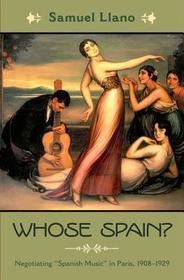
Whose Spain?
Negotiating Spanish Music in Paris, 1908-1929
Sorozatcím: Currents in Latin American and Iberian Music;
-
10% KEDVEZMÉNY?
- A kedvezmény csak az 'Értesítés a kedvenc témákról' hírlevelünk címzettjeinek rendeléseire érvényes.
- Kiadói listaár GBP 69.00
-
31 153 Ft (29 670 Ft + 5% áfa)
Az ár azért becsült, mert a rendelés pillanatában nem lehet pontosan tudni, hogy a beérkezéskor milyen lesz a forint árfolyama az adott termék eredeti devizájához képest. Ha a forint romlana, kissé többet, ha javulna, kissé kevesebbet kell majd fizetnie.
- Kedvezmény(ek) 10% (kb. 3 115 Ft)
- Kedvezményes ár 28 038 Ft (26 703 Ft + 5% áfa)
Iratkozzon fel most és részesüljön kedvezőbb árainkból!
Feliratkozom
31 153 Ft

Beszerezhetőség
Megrendelésre a kiadó utánnyomja a könyvet. Rendelhető, de a szokásosnál kicsit lassabban érkezik meg.
Why don't you give exact delivery time?
A beszerzés időigényét az eddigi tapasztalatokra alapozva adjuk meg. Azért becsült, mert a terméket külföldről hozzuk be, így a kiadó kiszolgálásának pillanatnyi gyorsaságától is függ. A megadottnál gyorsabb és lassabb szállítás is elképzelhető, de mindent megteszünk, hogy Ön a lehető leghamarabb jusson hozzá a termékhez.
A termék adatai:
- Kiadó OUP USA
- Megjelenés dátuma 2012. december 6.
- ISBN 9780199858460
- Kötéstípus Keménykötés
- Terjedelem312 oldal
- Méret 163x239x30 mm
- Súly 587 g
- Nyelv angol 0
Kategóriák
Rövid leírás:
In this book, Llano analyzes the socio-political discourses underpinning critical and musicological descriptions of 'Spanish music' at the beginning of the nineteenth century and the discourse's connection with French politics and culture of the era. Llano studies operas and other musical works for the stage as privileged sites for the production of Spanish musical identities, and ultimately demonstrates that definitions of 'French' and 'Spanish' music during this period were to some extent interdependent.
TöbbHosszú leírás:
From the very beginning of the nineteenth century, many elements of Spanish culture carried an air of 'exoticism' for the French-and nothing played more important of a role in shaping the French idea of Spain than the country's musical tradition. However, as Samuel Llano argues in Whose Spain?, perceptions and representations of Spanish musical identities changed in the early twentieth century, due to the emergence of the hispanistes. These specialists on Spanish music and culture, who wrote encyclopedic and 'scientific' articles on 'Spanish music,' strived to endow the world of Spanish music with a sense of authority and knowledge. Yet, the writings of those hispanistes and other music critics showed a highly sensationalist attitude, aimed at describing 'Spanish music' in a way that was instrumental to the interests of French musicians. At the same time, the Spanish fought to articulate their own identities through the creation and performance of new musical works.
In this book, Llano analyzes the socio-political discourses underpinning critical and musicological descriptions of 'Spanish music' and the discourse's connection with French politics and culture. He also studies operas and other musical works for the stage as privileged sites for the production of Spanish musical identities, given the enhanced possibilities of performance for cultural and critical engagement. The study covers the period 1908 to 1929, when representations of 'Spanish music' in the writings of the hispaniste Henri Collet and other French musicians underwent several transformations, mostly sparked by the need to reformulate French identity during and after the First World War. Ultimately, Llano demonstrates that definitions of 'French' and 'Spanish' music were to some extent interdependent, and that the public performances of these pieces even helped the musical community in France to begein to reformulate their notions of 'Spanish music' and identity.
In Whose Spain?, Llano invites his readers to question their assumptions about the meaning and identity of Spanish music during this crucial period. In response, he offers an original and substantial work of genuine scholarship, that will provoke and inspire future studies of the forces of exoticism and nationalism that contributed to the creation of a new Spanish music for the twentieth century.
Tartalomjegyzék:
Table of Contents
Foreword
Introduction
Part I: "Spanish music" as propaganda
Chapter 1: "Spanish music" as allied propaganda
Chapter 2: "Spanish music" as Catholic propaganda
Part II: Negotiating French and Spanish music
Chapter 3: Citizens or Savages?: The Spaniards in Raoul Laparra's La jota (1911)
Chapter 4: Manuel de Falla's La vie brève (1914) and notions of "Spanish music"
Part III: Building the Postwar order
Chapter 5: Domesticating Difference?: Carmen and the "French" canon in the 1920s
Chapter 6: Showcasing Spain at the Opéra Comique: The homage to Falla (1928)
Conclusions
Bibliography

