

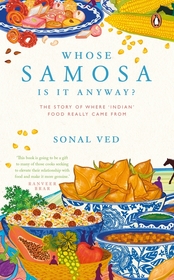
Whose Samosa is it Anyway?
The Story of Where 'Indian' Food Really Came From
-
10% KEDVEZMÉNY?
- A kedvezmény csak az 'Értesítés a kedvenc témákról' hírlevelünk címzettjeinek rendeléseire érvényes.
- Kiadói listaár GBP 13.99
-
6 683 Ft (6 365 Ft + 5% áfa)
Az ár azért becsült, mert a rendelés pillanatában nem lehet pontosan tudni, hogy a beérkezéskor milyen lesz a forint árfolyama az adott termék eredeti devizájához képest. Ha a forint romlana, kissé többet, ha javulna, kissé kevesebbet kell majd fizetnie.
- Kedvezmény(ek) 10% (cc. 668 Ft off)
- Kedvezményes ár 6 015 Ft (5 729 Ft + 5% áfa)
Iratkozzon fel most és részesüljön kedvezőbb árainkból!
Feliratkozom
6 683 Ft

Beszerezhetőség
Becsült beszerzési idő: A Prosperónál jelenleg nincsen raktáron, de a kiadónál igen. Beszerzés kb. 3-5 hét..
A Prosperónál jelenleg nincsen raktáron.
Why don't you give exact delivery time?
A beszerzés időigényét az eddigi tapasztalatokra alapozva adjuk meg. Azért becsült, mert a terméket külföldről hozzuk be, így a kiadó kiszolgálásának pillanatnyi gyorsaságától is függ. A megadottnál gyorsabb és lassabb szállítás is elképzelhető, de mindent megteszünk, hogy Ön a lehető leghamarabb jusson hozzá a termékhez.
A termék adatai:
- Kiadó India Penguin
- Megjelenés dátuma 2023. szeptember 26.
- Kötetek száma Trade Paperback
- ISBN 9780143460060
- Kötéstípus Puhakötés
- Terjedelem256 oldal
- Méret 228x127x12 mm
- Súly 299 g
- Nyelv angol 448
Kategóriák
Hosszú leírás:
Did the European traders come to India before the Arab conquerors?
Can you say cinnamon is an Indian spice even though it first grew in Sri Lanka on the Indian subcontinent?
Accompany Sonal Ved on a journey of taste through the various timelines across the Indian subcontinent. We go from the banks of the Indus in 1900 bc to the great kingdoms of the north many centuries later; from the time of the Mauryans to when the Mughal Sultanate reigned supreme. Meet the Europeans merchants desperate to trade in Indian treasures, be it the deep-blue indigo or the pricey pepper. On this trip discover answers to such questions as What are the origins of chutney or of the fruit punch, and how are they connected to India? Who taught us how to make ladi pav and kebabs, and how did the Burmese khow suey land up on the wedding menus of Marwaris? The author takes us through the food history and traditions from the mountains in Kashmir to the backwaters of Kanyakumari; from the ports of the Bay of Bengal to the shores of the Arabian Sea, where traders and travelers arrived from the world over. And, finally, we find out whose samosa it truly is . . .
"The genius of India has always been its ability to take global traditions and influences and turn them into something uniquely Indian. Indian cuisine is the best example of India's ability to take the international and make it national. Sonal shows us, in this marvellous book, how India created one of the world's best cuisines through absorption and assimilation." Vir Sanghvi, journalist and author
Tartalomjegyzék:
Introduction ix
1 The Indus Valley 1
2 The Impact of Religion 23
3 Indian Royalty 55
4 Traders and Conquerors 117
5 Conclusion 155
Acknowledgements 179
References 181

