

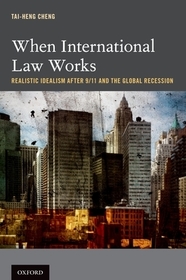
When International Law Works
Realistic Idealism After 9/11 and the Global Recession
-
10% KEDVEZMÉNY?
- A kedvezmény csak az 'Értesítés a kedvenc témákról' hírlevelünk címzettjeinek rendeléseire érvényes.
- Kiadói listaár GBP 97.00
-
43 795 Ft (41 710 Ft + 5% áfa)
Az ár azért becsült, mert a rendelés pillanatában nem lehet pontosan tudni, hogy a beérkezéskor milyen lesz a forint árfolyama az adott termék eredeti devizájához képest. Ha a forint romlana, kissé többet, ha javulna, kissé kevesebbet kell majd fizetnie.
- Kedvezmény(ek) 10% (cc. 4 380 Ft off)
- Kedvezményes ár 39 416 Ft (37 539 Ft + 5% áfa)
Iratkozzon fel most és részesüljön kedvezőbb árainkból!
Feliratkozom
43 795 Ft

Beszerezhetőség
Megrendelésre a kiadó utánnyomja a könyvet. Rendelhető, de a szokásosnál kicsit lassabban érkezik meg.
Why don't you give exact delivery time?
A beszerzés időigényét az eddigi tapasztalatokra alapozva adjuk meg. Azért becsült, mert a terméket külföldről hozzuk be, így a kiadó kiszolgálásának pillanatnyi gyorsaságától is függ. A megadottnál gyorsabb és lassabb szállítás is elképzelhető, de mindent megteszünk, hogy Ön a lehető leghamarabb jusson hozzá a termékhez.
A termék adatai:
- Kiadó OUP USA
- Megjelenés dátuma 2012. február 16.
- ISBN 9780195370171
- Kötéstípus Keménykötés
- Terjedelem364 oldal
- Méret 163x236x27 mm
- Súly 658 g
- Nyelv angol 0
Kategóriák
Rövid leírás:
When International Law Works stands to change the way that governments and scholars look at this contentious topic. In this seminal work, Professor Tai-Heng Cheng presents a new framework that nations should consider when they confront an international problem that implicates the often competing interests of their own communities and the global legal order. To demonstrate how his new proposal for approaching international law would work in a real crisis, Cheng provides numerous case studies from contemporary history. By thus combining theory with practice, When International Law Works gives policymakers, academics, and students 'real world' guidance on how to face new global problems.
TöbbHosszú leírás:
When International Law Works stands to change the way states and scholars look at this contentious topic. In this seminal work, Professor Tai-Heng Cheng addresses the current international law debates and transcends them. Responding to influential statements on international law by such scholars as Goldsmith, Posner, O'Connell, and Guzman, Cheng presents a new framework that decisionmakers should consider when they confront an international problem that implicates the often competing policies and interests of their own communities and global order. Instead of advocating for or against international law as legitimate or binding, as many commentators do, Cheng adknowledges both its shortcomings while presenting a practical means of deciding whether compliance in a given circumstance is beneficial, moral, or necessary. In this manner Cheng shows how it is possible for decisionmakers to take international law and its limitations seriously without actually needing to determine whether or not international law is "law."
To demonstrate how his new proposal for approaching international law would work in a real crisis, Cheng provides numerous case studies from contemporary history that test his theory. Ranging topically from the current global economic crisis to the West's war on Islamist terrorism, these detailed and demonstrative case studies set this book apart from similar works of international legal scholarship.
By combining theory with practice, When International Law Works gives lawyers, judges, policymakers, academics and students 'real world' guidance on how to face new global problems. In doing so, this new book challenges readers to rethink the role of law in an increasingly crisis-driven world.
The book opens a door to thinking further about how international law plays a significant role in the 21st century. ... Cheng shows his academic courage by bravely confronting tough issues, and makes frank and honest comments about them.
Tartalomjegyzék:
Chapter One: Confronting Anxieties About International Law
I. The Relevance and Irrelevance of Law
II. Contemporary Debates
III. Thesis
A. The Central Case
B. Effectiveness
C. Legitimacy
IV. Terms
V. Outline of Inquiry
VI. Conclusion
Chapter Two: The Politics of Theorizing
I. A Historical Survey
II. Antiquity
III. Middle Ages
IV. Early Modernism
V. Late Modernism
VI. Post-Modernism
VII. Choices in Theorizing
VIII. Political and Normative Values in Theorizing
IX. Conclusion
Chapter Three: Legalism and Morality
I. Framing the Inquiry
II. Choices
III. Legalism
A. The UN Security Council
B. International Court of Justice
C. Conclusions About Legalism
IV. The Morality of International Law
A. Basic Values
B. Moral Obligations
C. Realist Critiques
D. Liberal Critique
E. Legal Obligations
V. Guidance to Officials
A. Morality
B. Institutional Functions
C. Effectiveness
D. The Indeterminacy Paradox
VI. Conclusion
Chapter Four: Judges
I. Theory
A. Judicial Functions
B. General Morality
C. Specific Morality
D. Effectiveness
II. Praxis
A. The Pedra Branca Case
1. Legalism
2. Morality
3. Effectiveness
B. The Nicaragua Case
1. Legalism
a. Provisional Measures
b. El Salvador's Intervention
c. Decision on Jurisdiction
d. Merits
2. Effectiveness
3. Morality
4. Feedback Loops
C. The Avena Case
1. Legalism
2. Effectiveness
3. Morality
4. Feedback Loops
III. Conclusion
Chapter Five: Arbitrators
I. Theory
A. Arbitral Functions
B. General Morality
C. Specific Morality
D. Effectiveness
II. Praxis.
A. United States-Stainless Steel (Mexico), Implementing Award
B. Loewen Group, Inc. v. United States of America
C. CMS Gas Transmission Co. v. Argentine Republic, Decision on Annulment
III. Conclusion
Chapter Six: Regulators
I. Theory
II. Praxis
A. The Global Financial Crisis
B Responses and Decisions of Regulators
C. The Financial Stability Board
D. Guidance for Regulators
III. Conclusion
Chapter Seven: Legal Advisors
I. Theory
A. The Legal Advisor's Functions
B. General Morality
C. Specific Morality
D. Interests and Effectiveness
II. Praxis
A. Abu Ghraib Prison
B. Waterboarding
1. Factual Assumptions
2. International Legal Prescriptions
3. The Interrogation Memoranda
4. General Morality
5. Specific Morality
6. Guidance to Advisors
7. Alternative Scenarios
III. Conclusion
Chapter Eight: Officials
I. Theory
II. Praxis
A. The 1990 Gulf War
1. Specific Morality
2. General Morality and Effectiveness
3. Feedback Loops
B. NATO Bombing of the Federal Republic of Yugoslavia
1 General Morality
2. Specific Morality
3. Feedback Loops
C. The 2003 Invasion of Iraq
1. General Morality
2. Specific Morality
3. Feedback Loops
III. Conclusion
Chapter Nine: Law Beyond Laws
I. Reframing Debates
II. Situating Among Theories
III. Results from Case Studies
IV. Conclusion

