

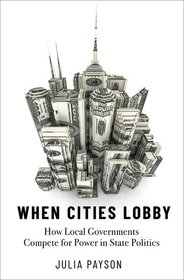
When Cities Lobby
How Local Governments Compete for Power in State Politics
-
10% KEDVEZMÉNY?
- A kedvezmény csak az 'Értesítés a kedvenc témákról' hírlevelünk címzettjeinek rendeléseire érvényes.
- Kiadói listaár GBP 26.99
-
12 185 Ft (11 605 Ft + 5% áfa)
Az ár azért becsült, mert a rendelés pillanatában nem lehet pontosan tudni, hogy a beérkezéskor milyen lesz a forint árfolyama az adott termék eredeti devizájához képest. Ha a forint romlana, kissé többet, ha javulna, kissé kevesebbet kell majd fizetnie.
- Kedvezmény(ek) 10% (kb. 1 218 Ft)
- Kedvezményes ár 10 967 Ft (10 445 Ft + 5% áfa)
Iratkozzon fel most és részesüljön kedvezőbb árainkból!
Feliratkozom
12 185 Ft

Beszerezhetőség
A kiadó fontolgatja a könyv utánnyomását, de bizonytalan, hogy ez mikor következik be.
Why don't you give exact delivery time?
A beszerzés időigényét az eddigi tapasztalatokra alapozva adjuk meg. Azért becsült, mert a terméket külföldről hozzuk be, így a kiadó kiszolgálásának pillanatnyi gyorsaságától is függ. A megadottnál gyorsabb és lassabb szállítás is elképzelhető, de mindent megteszünk, hogy Ön a lehető leghamarabb jusson hozzá a termékhez.
A termék adatai:
- Kiadó OUP USA
- Megjelenés dátuma 2022. március 31.
- ISBN 9780197615270
- Kötéstípus Puhakötés
- Terjedelem208 oldal
- Méret 156x236x14 mm
- Súly 299 g
- Nyelv angol 0
Kategóriák
Rövid leírás:
When Cities Lobby tells the story of what happens when local officials rely on professional lobbyists to represent their interests in state government. In a political environment characterized by intense urban-rural polarization and growing hostility between cities and state legislatures, lobbying has emerged as an important tool to amplify urban and progressive voices. But high-income suburbs have also figured out how to strategically use lobbyists to secure state funding. When Cities Lobby highlights the costs and benefits of intergovernmental advocacy and explores the consequences for representation and democratic policymaking in the 21st century.
TöbbHosszú leírás:
In a political environment characterized by intense urban-rural polarization and growing hostility between cities and state legislatures, When Cities Lobby explores how local officials use lobbyists to compete for power in state politics.
When Cities Lobby tells the story of what happens when city officials rely on professional lobbyists to represent their interests in state government. In a political environment characterized by intense urban-rural polarization and growing hostility between cities and state legislatures, the ability to lobby offers a powerful tool for city leaders seeking to amplify their voices in state politics. The cities that lobby at the highest rates include large urban centers that have historically faced obstacles to effective representation in our federal system, and, increasingly, blue-leaning cities engaged in preemption battles against Republican-led legislatures. But high-income places have also figured out how to strategically use lobbyists, and these communities have become particularly adept at lobbying to secure additional grant money and shift state funding in a direction that favors them. How did we end up with a system where political officials in different levels of government often choose to pay lobbyists to facilitate communication between them, and are the potential benefits worth the costs? Author Julia Payson demonstrates that the answer is deeply rooted in both the nature of the federal system and the evolution of the professional lobbying industry. While some states have recently debated measures to restrict lobbying by local governments, these efforts will likely do more harm than good in the absence of structural reforms to the lobbying industry more broadly.
The book offers political science, public policy, and public administration students an informative outlook on the process of resource allocation and power struggles in the American case study, and its consequences on political decision making. Hence, the target audience for this book is both practitioners and academicians.
Tartalomjegyzék:
1 - Introduction
2 - The State of Local Lobbying
2.1 - Using Disclosure Data to Document Local Influence
2.2 - Targeting the State vs. Federal Government
2.3 - Who Advocates for Cities?
2.4 - Where Cities Lobby
2.5 - What Cities Want
2.6 - Allocating Lobbying Effort: Evidence from Florida
2.7 - Banding Together or Going It Alone? The Role of Municipal Leagues
2.8 - Discussion
3 - How City Lobbyists Bridge Representational Gaps
3.1 - Why Do Organized Interests Lobby?
3.2 - How Local Governments Are Different
3.3 - Predicting Lobbying Across Cities
3.4 - Too Much Representation? Redistricting and Lobbying
3.5 - Partisan Mismatches and City Lobbying
3.6 - The Unique Challenges of Conservative Representation
3.7 - District-Based or Collective Representation? Evidence From Missouri
3.8 - Discussion
4 - Exploring Municipal Mobilization Across States
4.1 - What We Know About Variation in State-Level Lobbying
4.2 - Political Geography and Municipal Lobbying
4.3 - Lobbying in Response to Institutional Complexity
4.4 - The Political Environment
4.5 - State Transfers to Cities Increases Lobbying-And Vice Versa
4.6 - Current Policy Debates
4.7 - Discussion
5 - Who Gets What? City Lobbying And State Transfers
5.1 - Is Lobbying a Good Investment for Cities?
5.2 - Using State Transfers to Estimate The Returns Lobbying
5.3 - Lobbying Increases State Funding
5.4 - Funding Follows Lobbying (Not Vice Versa)
5.5 - Why Lobbying Benefits Rich Cities
5.6 - Discussion
6 - City vs. State: Power, Policy, and Preemption
6.1 - How Lobbying Shapes The Distribution of State Funding
6.2 - Case Studies: Cities and State Preemption
6.3 - The Rise of State Preemption
6.4 - How Cities Are Responding
6.5 - What Do City Lobbying Efforts Against Preemption Look Like?
6.6 - Discussion
7 - Conclusion: Why Cities Lobby and Why It Matters
7.1 - Conservative Critiques of Municipal Lobbying
7.2 - Does Municipal Lobbying Exacerbate Inequality?
7.3 - Intergovernmental Lobbying and Democratic Representation
7.4 - The View From Above and Below
7.5 - Prospects For Reform
8 Appendices
Bibliography

