

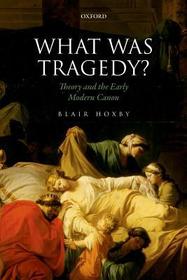
What Was Tragedy?
Theory and the Early Modern Canon
-
10% KEDVEZMÉNY?
- A kedvezmény csak az 'Értesítés a kedvenc témákról' hírlevelünk címzettjeinek rendeléseire érvényes.
- Kiadói listaár GBP 47.49
-
22 688 Ft (21 607 Ft + 5% áfa)
Az ár azért becsült, mert a rendelés pillanatában nem lehet pontosan tudni, hogy a beérkezéskor milyen lesz a forint árfolyama az adott termék eredeti devizájához képest. Ha a forint romlana, kissé többet, ha javulna, kissé kevesebbet kell majd fizetnie.
- Kedvezmény(ek) 10% (cc. 2 269 Ft off)
- Kedvezményes ár 20 419 Ft (19 446 Ft + 5% áfa)
Iratkozzon fel most és részesüljön kedvezőbb árainkból!
Feliratkozom
22 688 Ft

Beszerezhetőség
Megrendelésre a kiadó utánnyomja a könyvet. Rendelhető, de a szokásosnál kicsit lassabban érkezik meg.
Why don't you give exact delivery time?
A beszerzés időigényét az eddigi tapasztalatokra alapozva adjuk meg. Azért becsült, mert a terméket külföldről hozzuk be, így a kiadó kiszolgálásának pillanatnyi gyorsaságától is függ. A megadottnál gyorsabb és lassabb szállítás is elképzelhető, de mindent megteszünk, hogy Ön a lehető leghamarabb jusson hozzá a termékhez.
A termék adatai:
- Kiadó OUP Oxford
- Megjelenés dátuma 2017. április 27.
- ISBN 9780198810599
- Kötéstípus Puhakötés
- Terjedelem376 oldal
- Méret 234x155x20 mm
- Súly 574 g
- Nyelv angol
- Illusztrációk Numerous black-and-white halftones 0
Kategóriák
Rövid leírás:
What was Tragedy reconstructs the early modern poetics of tragedy with which practicing dramatists worked. In doing so, it not only illuminates recognized masterpieces but also encourages readers to explore a rich repertoire of tragic drama previously relegated to obscurity only because we lacked the language to interpret it.
TöbbHosszú leírás:
Twentieth century critics have definite ideas about tragedy. They maintain that in a true tragedy, fate must feel the resistance of the tragic hero's moral freedom before finally crushing him, thus generating our ambivalent sense of terrible waste coupled with spiritual consolation. Yet far from being a timeless truth, this account of tragedy only emerged in the wake of the French Revolution.
What Was Tragedy? demonstrates that this account of the tragic, which has been hegemonic from the early nineteenth century to the present despite all the twists and turns of critical fashion in the twentieth century, obscured an earlier poetics of tragedy that evolved from 1515 to 1795. By reconstructing that poetics, Blair Hoxby makes sense of plays that are "merely pathetic, not truly tragic," of operas with happy endings, of Christian tragedies, and of other plays that advertised themselves as tragedies to early modern audiences and yet have subsequently been denied the palm of tragedy by critics. In doing so, Hoxby not only illuminates masterpieces by Shakespeare, Calderón, Corneille, Racine, Milton, and Mozart, he also revivifies a vast repertoire of tragic drama and opera that has been relegated to obscurity by critical developments since 1800. He suggests how many of these plays might be reclaimed as living works of theater. And by reconstructing a lost conception of tragedy both ancient and modern, he illuminates the hidden assumptions and peculiar blind-spots of the idealist critical tradition that runs from Schelling, Schlegel, and Hegel, through Wagner, Nietzsche, and Freud, up to modern post-structuralism.
What Was Tragedy? reflects recent interest in reception studies, as some of its chapters diligently consider the performance history and success of a variety of theatrical texts, some now forgotten (as is the case of Stefonio's Crispus), some relegated to a secondary position within the corpus of extremely canonical authors (as is the case of Shakespeare's Antony and Cleopatra).
Tartalomjegyzék:
The Philosophy of the Tragic and the Poetics of Tragedy
Our Tragic Culture
An Early Modern Poetics of Tragedy
The World We Have Lost
Simple Pathetic Tragedy
Operatic Discoveries
Counter-Reformation Tragedy
History as Tragedy, Tragedy as Design
Bibliography

