
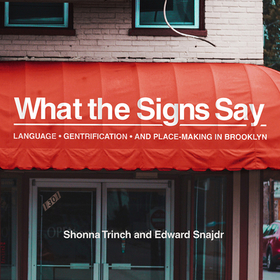
What the Signs Say – Language, Gentrification, and Place–Making in Brooklyn
Language, Gentrification, and Place-making in Brooklyn
-
10% KEDVEZMÉNY?
- A kedvezmény csak az 'Értesítés a kedvenc témákról' hírlevelünk címzettjeinek rendeléseire érvényes.
- Kiadói listaár GBP 80.00
-
38 220 Ft (36 400 Ft + 5% áfa)
Az ár azért becsült, mert a rendelés pillanatában nem lehet pontosan tudni, hogy a beérkezéskor milyen lesz a forint árfolyama az adott termék eredeti devizájához képest. Ha a forint romlana, kissé többet, ha javulna, kissé kevesebbet kell majd fizetnie.
- Kedvezmény(ek) 10% (cc. 3 822 Ft off)
- Kedvezményes ár 34 398 Ft (32 760 Ft + 5% áfa)
Iratkozzon fel most és részesüljön kedvezőbb árainkból!
Feliratkozom
38 220 Ft
Beszerezhetőség
Még nem jelent meg, de rendelhető. A megjelenéstől számított néhány héten belül megérkezik.
Why don't you give exact delivery time?
A beszerzés időigényét az eddigi tapasztalatokra alapozva adjuk meg. Azért becsült, mert a terméket külföldről hozzuk be, így a kiadó kiszolgálásának pillanatnyi gyorsaságától is függ. A megadottnál gyorsabb és lassabb szállítás is elképzelhető, de mindent megteszünk, hogy Ön a lehető leghamarabb jusson hozzá a termékhez.
A termék adatai:
- Kiadó University of Chicago Press
- Megjelenés dátuma 2026. március 25.
- Kötetek száma Hardback
- ISBN 9780826522771
- Kötéstípus Keménykötés
- Terjedelem314 oldal
- Méret 203x203x30 mm
- Súly 1940 g
- Nyelv angol
- Illusztrációk 69 700
Kategóriák
Rövid leírás:
Although we may not think we notice them, storefronts and their signage are meaningful, and the impact they have on people is significant. What the Signs Say argues that the public language of storefronts is a key component to the creation of the place known as Brooklyn, New York.
TöbbHosszú leírás:
Although we may not think we notice them, storefronts and their signage are meaningful, and the impact they have on people is significant. What the Signs Say argues that the public language of storefronts is a key component to the creation of the place known as Brooklyn, New York. Using a sample of more than two thousand storefronts and over a decade of ethnographic observation and interviews, the study charts two very different types of local Brooklyn retail signage. The unique and consistent features of many words, large lettering, and repetition that make up Old School signage both mark and produce an inclusive and open place. In contrast, the linguistic elements of New School signage, such as brevity and wordplay, signal not only the arrival of gentrification, but also the remaking of Brooklyn as distinctive and exclusive.
Shonna Trinch and Edward Snajdr, a sociolinguist and an anthropologist respectively, show how the beliefs and ideas that people take as truths about language and its speakers are deployed in these different sign types. They also present in-depth ethnographic case studies that reveal how gentrification and corporate redevelopment in Brooklyn are intimately connected to public communication, literacy practices, the transformation of motherhood and gender roles, notions of historical preservation, urban planning, and systems of privilege. Far from peripheral or irrelevant, shop signs say loud and clear that language displayed in public always matters.