

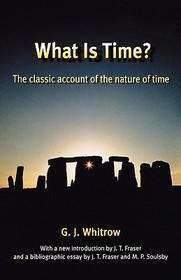
What is Time?
The classic account of the nature of time
-
10% KEDVEZMÉNY?
- A kedvezmény csak az 'Értesítés a kedvenc témákról' hírlevelünk címzettjeinek rendeléseire érvényes.
- Kiadói listaár GBP 16.49
-
7 878 Ft (7 502 Ft + 5% áfa)
Az ár azért becsült, mert a rendelés pillanatában nem lehet pontosan tudni, hogy a beérkezéskor milyen lesz a forint árfolyama az adott termék eredeti devizájához képest. Ha a forint romlana, kissé többet, ha javulna, kissé kevesebbet kell majd fizetnie.
- Kedvezmény(ek) 10% (cc. 788 Ft off)
- Kedvezményes ár 7 089 Ft (6 752 Ft + 5% áfa)
Iratkozzon fel most és részesüljön kedvezőbb árainkból!
Feliratkozom
7 878 Ft

Beszerezhetőség
Megrendelésre a kiadó utánnyomja a könyvet. Rendelhető, de a szokásosnál kicsit lassabban érkezik meg.
Why don't you give exact delivery time?
A beszerzés időigényét az eddigi tapasztalatokra alapozva adjuk meg. Azért becsült, mert a terméket külföldről hozzuk be, így a kiadó kiszolgálásának pillanatnyi gyorsaságától is függ. A megadottnál gyorsabb és lassabb szállítás is elképzelhető, de mindent megteszünk, hogy Ön a lehető leghamarabb jusson hozzá a termékhez.
A termék adatai:
- Kiadás sorszáma New ed
- Kiadó OUP Oxford
- Megjelenés dátuma 2003. december 11.
- ISBN 9780198607816
- Kötéstípus Puhakötés
- Terjedelem186 oldal
- Méret 195x128x12 mm
- Súly 160 g
- Nyelv angol
- Illusztrációk numerous line drawings/ tables 0
Kategóriák
Rövid leírás:
In What is Time?, Professor Whitrow takes us on a good-humoured and wide-ranging tour of the thing that clocks keep (more or less). He discusses how our ideas of time originated; how far they are inborn in plants and animals; how time has been measured, from sundial and hourglass to the caesium clock, and whether time possesses a beginning, a direction, and an end. He coaxes the diffident layman to contemplate with pleasure the differences between cyclic, linear, biological, cosmic, and space-time, and he provides frequent diversions into fascinating topics such as the Mayan calendar, the migration of birds, the dances of bees, precognition, and the short, crowded lives of mu-mesons, particles produced by cosmic-ray showers that exist for just two millionths of a second.
TöbbHosszú leírás:
G. J. Whitrow (1912-2000) begins this classic exploration of the nature of time with a story about a Russian poet, visiting London before the First World War. The poet's English was not too good and when he asked a man in the street, 'Please, what is time?' he received the response, 'But that's a philosophical question. Why ask me?'.
Starting from this simple anecdote, Professor Whitrow takes us on a good-humoured and wide-ranging tour of the thing that clocks keep (more or less). He discusses how our ideas of time originated; how far they are inborn in plants and animals; how time has been measured, from sundial and hourglass to the caesium clock, and whether time possesses a beginning, a direction, and an end. He coaxes the diffident layman to contemplate with pleasure the differences between cyclic, linear, biological, cosmic, and space-time, and he provides frequent diversions into fascinating topics such as the Mayan calendar, the migration of birds, the dances of bees, precognition, and the short, crowded lives of mu-mesons, particles produced by cosmic-ray showers that exist for just two millionths of a second.
This reissue of the classic and authoritative What is Time? includes a new introduction by Dr J. T. Fraser, founder of the International Society for the Study of Time, and a bibliographic essay by Dr Fraser and Professor M. P. Soulsby of the Pennsylvania State University.
Tartalomjegyzék:
Introduction
The Origin of Our Idea of Time
Time and Ourselves
Biological Clocks
The Measurement of Time
Time and Relativity
Time, Gravitation and the Universe
The Origin and Arrow of Time
The Significance of Time
Appendix: Temporal Order in Special Relativity
Bibliography
Index

