

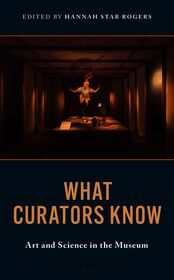
What Curators Know
Art and Science in the Museum
-
18% KEDVEZMÉNY?
- Kiadói listaár GBP 95.00
-
42 892 Ft (40 850 Ft + 5% áfa)
Az ár azért becsült, mert a rendelés pillanatában nem lehet pontosan tudni, hogy a beérkezéskor milyen lesz a forint árfolyama az adott termék eredeti devizájához képest. Ha a forint romlana, kissé többet, ha javulna, kissé kevesebbet kell majd fizetnie.
- Kedvezmény(ek) 18% (kb. 7 720 Ft)
- Kedvezményes ár 35 172 Ft (33 497 Ft + 5% áfa)
- A kedvezmény érvényes eddig: 2026. október 31.
35 172 Ft

Beszerezhetőség
Még nem jelent meg, de rendelhető. A megjelenéstől számított néhány héten belül megérkezik.
Why don't you give exact delivery time?
A beszerzés időigényét az eddigi tapasztalatokra alapozva adjuk meg. Azért becsült, mert a terméket külföldről hozzuk be, így a kiadó kiszolgálásának pillanatnyi gyorsaságától is függ. A megadottnál gyorsabb és lassabb szállítás is elképzelhető, de mindent megteszünk, hogy Ön a lehető leghamarabb jusson hozzá a termékhez.
A termék adatai:
- Kiadó Bloomsbury Publishing (UK)
- Megjelenés dátuma 2026. augusztus 6.
- ISBN 9798765162088
- Kötéstípus Keménykötés
- Terjedelem488 oldal
- Méret 232x158x38 mm
- Súly 840 g
- Nyelv
- Illusztrációk 33 bw illustrations; 2 tables 700
Kategóriák
Rövid leírás:
A singular collection of essays that provide an interdisciplinary look at curatorial practice in the context of Sciences Technology Studies.
TöbbHosszú leírás:
This book argues for the role of curators as knowledge-makers across a number of fields. While the focus is on multidisciplinary curators, particularly those who work with combinations of science, technology, and art, it also points toward the history of curation to tease out the ways that multidisciplinary work has always been part of the collector's, and later, the curator's role, functionally integrating curatorial and interdisciplinary studies. This novel application of Art, Science, and Technology Studies (ASTS) ideas to curatorial studies is timely because it reaches beyond the analysis of the use of images by scientists or the ways art may be employed to improve the public understanding of science to offer a much-needed explanation of how actors position their work as art or science, considering the persistence of overlapping practices used in both communities. By providing an interdisciplinary look at curatorial practice in the context of the ASTS idea of knowledge-making, this book will be singular in the field.
What Curators Know will appeal to scholars of ASTS, the history of art, the history of science, museology, and visual culture as well as museum professionals, curators, and policymakers. The book engages literature in the contemporary arts, digital culture, computing history, medical humanities, media arts, museum studies, natural history, and political and public art. Practitioners working in curatorial or curatorial-adjacent professions, as well as administrators with art and science interests, will also find the text useful.
Tartalomjegyzék:
"
Preface
Foreword: Eating Vegan Ortolan with Bruno Latour
Michael John Gorman
Acknowledgements
Introduction: What Do Curators Know?
Hannah Star Rogers
Chapter 1: Actor-Network-Theory as Curatorial Method: An STS Framework for Trans-Disciplinary Curation
Kristin D. Hussey
Chapter 2: Engaged Curatorial Practice as STS-Oriented Mode of Inquiry
Bilge Hasdemir
Chapter 3: Beyond the Display: Why Minor Gestures Matter in Curating Research Exhibitions Anne Julie Arnfred
Chapter 4: Boundaries and Imaginaries: STS and Curating Technoscientific Arts
Rodrigo Guzman-Serrano
Chapter 5: Curating Media as Scientific Objects
Geoffrey Belknap and Georgina Grant
Chapter 6: STS in Practice at the Computer History Museum
Hansen Hsu
Chapter 7: The Missing Museum: Curating the PostNatural Blindspot
Rich Pell and Gil Olivera
Chapter 8: Curating Hinterland: Reassembling Invisible Work in Art / Science Practices
Morten S---ndergaard
Chapter 9: Curating Health Complexity at Medical Museion: The Exhibition as Medium and Process for Sharing an STS Sensibility
Louise Whiteley and Adam Bencard
Chapter 10: Curating ""from an STS Perspective"": Co-Creator, Counter-Expert, and Collider
Makoto Takahashi
Chapter 11: Curating for Controversy: Crearation, Overidentification, Objektinstruments and Pop Sloganeering as Art-Based Strategies for Critical Controversy Studies
Sophia Efstathiou and Alexandra Murray-Leslie
Chapter 12: Life Eternal: A Case of the Importance of Trusting Museum Visitors
Clara ---hlvik
Chapter 13: ""Curating AI"" or How to Exhibit a Controversy
Chris Salter
Index
About the Editor
About the Authors

