

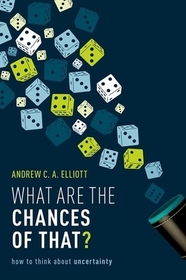
What are the Chances of That?
How to Think About Uncertainty
-
10% KEDVEZMÉNY?
- A kedvezmény csak az 'Értesítés a kedvenc témákról' hírlevelünk címzettjeinek rendeléseire érvényes.
- Kiadói listaár GBP 32.49
-
15 522 Ft (14 782 Ft + 5% áfa)
Az ár azért becsült, mert a rendelés pillanatában nem lehet pontosan tudni, hogy a beérkezéskor milyen lesz a forint árfolyama az adott termék eredeti devizájához képest. Ha a forint romlana, kissé többet, ha javulna, kissé kevesebbet kell majd fizetnie.
- Kedvezmény(ek) 10% (cc. 1 552 Ft off)
- Kedvezményes ár 13 969 Ft (13 304 Ft + 5% áfa)
Iratkozzon fel most és részesüljön kedvezőbb árainkból!
Feliratkozom
15 522 Ft

Beszerezhetőség
Becsült beszerzési idő: A Prosperónál jelenleg nincsen raktáron, de a kiadónál igen. Beszerzés kb. 3-5 hét..
A Prosperónál jelenleg nincsen raktáron.
Why don't you give exact delivery time?
A beszerzés időigényét az eddigi tapasztalatokra alapozva adjuk meg. Azért becsült, mert a terméket külföldről hozzuk be, így a kiadó kiszolgálásának pillanatnyi gyorsaságától is függ. A megadottnál gyorsabb és lassabb szállítás is elképzelhető, de mindent megteszünk, hogy Ön a lehető leghamarabb jusson hozzá a termékhez.
A termék adatai:
- Kiadó OUP Oxford
- Megjelenés dátuma 2021. augusztus 2.
- ISBN 9780198869023
- Kötéstípus Keménykötés
- Terjedelem384 oldal
- Méret 240x165x23 mm
- Súly 796 g
- Nyelv angol 134
Kategóriák
Rövid leírás:
What are the Chances of That? discusses chance and the importance of understanding how it affects our lives. It goes beyond a mathematical approach to the subject, showing how our thinking about chance and uncertainty has been shaped by history and culture, and only relatively recently by the mathematical theory of probability.
TöbbHosszú leírás:
Chance fills every day of our lives and affects every decision we make.
Yet, for something woven so closely into the fabric of our being, we are not very good at thinking about uncertainty and risk. In this lively and engaging book, Andrew C. A. Elliott asks why this is so. He picks at the threads and, in showing how our world is built on probability rather than certainty, he identifies five obstacles to thinking about uncertainty that confuse us time after time.
Elliott takes us into the casino, but this is not an invitation to gamble. He looks at financial markets, but this is not a guide to investment. There's discussion of health, but this is not a medical book. He touches on genetics and evolution, and music-making, and writing, because chance is at work there too. Entering many different fields, What are the Chances of That? is always following the trail of chance and randomness. One purpose of the book is to go cross-country, to show that there are connected ways of thinking that disrespect boundaries and cut across the domains of finance, and gambling, and genetics, and public health, and creativity. Through it, one visits the vantage points that give a broad view of the landscape and sees how these different areas of life and knowledge are connected - through chance.
What are the Chances of That? discusses chance and the importance of understanding how it affects our lives. It goes beyond a mathematical approach to the subject, showing how our thinking about chance and uncertainty has been shaped by history and culture, and only relatively recently by the mathematical theory of probability. In considering how we think about uncertainty, Elliott proposes five “dualities” that encapsulate many of the ambiguities that arise.
There can be no doubt that Elliott delivers on his promise of going cross-country: his latest book is a veritable cornucopia of all things probability, touching on such diverse areas as gambling, performing arts, population health, crime, finance, evolution and genetics, and meteorology....Elliott is an entertaining writer.
Tartalomjegyzék:
Pure Chance
The Roll of the Dice
Reckoning the Chances
Random Thoughts
Patterns of Probability
Life Chances
Isn't that a coincidence?
What Luck!
Taking a Gamble
Danger of Death
What's There to Worry About?
Happy Accidents
Chance Discoveries
Mixing it Up
A Chance to Live
Random Technology
Taking Charge of Chance
The Weight of Evidence
Clarity from Chaos
Sharing the Risk
Shaping the Risk
What's Coming Next
Last Chance
See Also
Acknowledgements

