

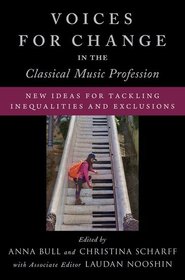
Voices for Change in the Classical Music Profession
New Ideas for Tackling Inequalities and Exclusions
-
10% KEDVEZMÉNY?
- A kedvezmény csak az 'Értesítés a kedvenc témákról' hírlevelünk címzettjeinek rendeléseire érvényes.
- Kiadói listaár GBP 112.50
-
50 793 Ft (48 375 Ft + 5% áfa)
Az ár azért becsült, mert a rendelés pillanatában nem lehet pontosan tudni, hogy a beérkezéskor milyen lesz a forint árfolyama az adott termék eredeti devizájához képest. Ha a forint romlana, kissé többet, ha javulna, kissé kevesebbet kell majd fizetnie.
- Kedvezmény(ek) 10% (kb. 5 079 Ft)
- Kedvezményes ár 45 714 Ft (43 538 Ft + 5% áfa)
Iratkozzon fel most és részesüljön kedvezőbb árainkból!
Feliratkozom
50 793 Ft

Beszerezhetőség
Megrendelésre a kiadó utánnyomja a könyvet. Rendelhető, de a szokásosnál kicsit lassabban érkezik meg.
Why don't you give exact delivery time?
A beszerzés időigényét az eddigi tapasztalatokra alapozva adjuk meg. Azért becsült, mert a terméket külföldről hozzuk be, így a kiadó kiszolgálásának pillanatnyi gyorsaságától is függ. A megadottnál gyorsabb és lassabb szállítás is elképzelhető, de mindent megteszünk, hogy Ön a lehető leghamarabb jusson hozzá a termékhez.
A termék adatai:
- Kiadó OUP USA
- Megjelenés dátuma 2023. május 4.
- ISBN 9780197601211
- Kötéstípus Keménykötés
- Terjedelem368 oldal
- Méret 235x156x25 mm
- Súly 649 g
- Nyelv angol 284
Kategóriák
Rövid leírás:
Voices for Change in the Classical Music Profession lays the groundwork for empirically-founded, theoretically-informed, and practice-based approaches to tackling inequalities in the classical music profession.
TöbbHosszú leírás:
How is the classical music industry responding to the challenges of
MeToo, Black Lives Matter, and other social justice movements? Is increasing attention to equity and diversity in the classical music profession over recent years leading to systemic change? In this book, scholars, activists and musicians from countries across Europe and North America analyze inequalities in the classical music profession and introduce strategies for making change. Exploring racism, class and gender inequalities, disability representation, "authenticity", changing the canon, and neoliberalism, the book brings together analyses from academics alongside contributions from musicians and industry leaders working in the classical music industry who reflect on issues of diversity and share insights and best practices.
Themes of the book include institutional legacies and possibilities for change; racial, classed and gendered inequalities and marginalised voices; and strategies for activism, whether reflective practices, informal networks, or larger organisations leading change. The book also discusses questions such as whether musical change is necessary for social change in classical music, and how activists can acknowledge structural inequalities whilst holding on to the possibility of change. Opening up the interdisciplinary field of "classical music studies," this book lays the groundwork for empirically-founded, theoretically-informed, and practice-based approaches to tackling inequalities in the classical music profession. As such, it will be a significant point of reference for musicians, students, classical music administrators, policy-makers, teachers, and academics -- and anyone else who wants to make classical music more inclusive.
Tartalomjegyzék:
Introduction
Anna Bull and Christina Scharff
PART I THE MAKING OF CLASSICAL MUSICIANS
Class and Gender Inequalities in the Recruitment of Classical Musicians: Reflections on the Case of Italian Music Conservatoires
Clementina Casula
The Role of Music Conservatoires in the Making of Classical Music Careers
Rainer Prokop and Rosa Reitsamer
Social Inclusion in Contemporary British Conservatoires: Alumni Perspectives
Jennie Joy Porton
Inside Looking In: Strategies to Counteract Misconduct in Artistic Teaching within Higher Music Education
David-Emil Wickström
PART II PROBLEMATIZING INSTITUTIONAL CHANGE
(Un)settling Institutional Hegemony: Challenges of Diversity Strategies in the "Western" Classical Music Sector
Kristina Kolbe
"To Share Music with Children": The LA Phil and Neoliberal Philanthropy in Inglewood
Mina Yang
A Critical Perspective on Diversity and Inclusion in US Classical Music Discourse
Marianna Ritchey
Staging a Loose Canon: Scripture, Tradition, and Embedded Exclusion in Opera Production
Caitlin Vincent
Disability Representation in Opera
Charlotte Armstrong
PART III MARGINALIZED VOICES
Gender and Class: An Account of a Female Percussionist in the Classical Music Industry
Beth Higham-Edwards
Making Space for Disability and Music to Interact: An Interview with Composer Oliver Vibrans
Oliver Vibrans
Black on the Podium: An Interview with Conductor Brandon Keith Brown
Brandon Keith Brown
Creolization, Mixing, and Plurality: An Interview with Composer Hannah Kendall
Hannah Kendall
PART IV RACIAL INEQUALITIES
The New "Yellow Peril" in "Western" European Symphony Orchestras
Maiko Kawabata
Irreconcilable Senses of Belonging: Transnational Japanese Artists in the Quest for Authenticity in the World of Classical Music
Beata M. Kowalczyk
[Re- ]training Classical Musicians Toward Polymusicality and Hybridization: An Interview with Jon Silpayamanant
Jon Silpayamanant
Inclusion and Diversity in the Early Music Scene in the US: A Conversation with Patricia Ann Neely
Patricia Ann Neely
On Leaving Classical Music: An Interview with Anthony Gray
Anthony Gray
PART V ACTIVISM STARTING WITH THE SELF
(Dis)orient Yourself!: Disrupting White Ontologies in Classical Music
Eleanor Ryan
Everyday Bridges: A View from the Field
Cayenna Ponchione-Bailey
Illuminating Women's Music: Exploring the Canonic Ethos behind the Illuminate Women's Music Concert Series
Angela Elizabeth Slater
Changing Classical Music from the Inside: An Interview with Chi- chi Nwanoku
Chi-chi Nwanoku
PART VI ACTIVISM: BUILDING NETWORKS FOR CHANGE
(Un)Silencing Blacktivism in Opera: An Interview with Quodesia Johnson about the Letter to the Opera Field from Black Administrators
Antonio C. Cuyler
Reflecting on the Work of Gender Relations in New Music: Institutional Critique and Activist Strategies
Brandon Farnsworth and Rosanna Lovell
Addressing Inequalities in the Music Industry before, during, and after COVID- 19: The Campaigning Work of the UK's Independent Society of Musicians
Deborah Annetts, Vick Bain, Chris Collins, Vinota Karunasaagarar, and Dr. Kathryn Williams
"A Community of 30,000 Musicians behind You": An Interview with John Shortell from the UK Musicians' Union
John Shortell
Afterword
Gillian Moore
Discussion Questions for Teachers, Students, Reading Groups, and Industry Leaders
References
Index

