

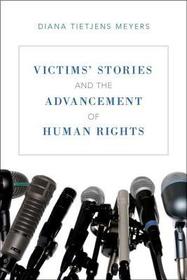
Victims' Stories and the Advancement of Human Rights
-
10% KEDVEZMÉNY?
- A kedvezmény csak az 'Értesítés a kedvenc témákról' hírlevelünk címzettjeinek rendeléseire érvényes.
- Kiadói listaár GBP 37.99
-
17 152 Ft (16 335 Ft + 5% áfa)
Az ár azért becsült, mert a rendelés pillanatában nem lehet pontosan tudni, hogy a beérkezéskor milyen lesz a forint árfolyama az adott termék eredeti devizájához képest. Ha a forint romlana, kissé többet, ha javulna, kissé kevesebbet kell majd fizetnie.
- Kedvezmény(ek) 10% (kb. 1 715 Ft)
- Kedvezményes ár 15 437 Ft (14 702 Ft + 5% áfa)
Iratkozzon fel most és részesüljön kedvezőbb árainkból!
Feliratkozom
17 152 Ft

Beszerezhetőség
Megrendelésre a kiadó utánnyomja a könyvet. Rendelhető, de a szokásosnál kicsit lassabban érkezik meg.
Why don't you give exact delivery time?
A beszerzés időigényét az eddigi tapasztalatokra alapozva adjuk meg. Azért becsült, mert a terméket külföldről hozzuk be, így a kiadó kiszolgálásának pillanatnyi gyorsaságától is függ. A megadottnál gyorsabb és lassabb szállítás is elképzelhető, de mindent megteszünk, hogy Ön a lehető leghamarabb jusson hozzá a termékhez.
A termék adatai:
- Kiadó OUP USA
- Megjelenés dátuma 2016. május 5.
- ISBN 9780199930401
- Kötéstípus Puhakötés
- Terjedelem280 oldal
- Méret 208x137x20 mm
- Súly 272 g
- Nyelv angol 0
Kategóriák
Rövid leírás:
Victim's Stories and the Advancement of Human Rights addresses questions suggested by the worldwide persistence of human rights abuse and the prevalence of appeals to victims' stories in human rights campaigns, truth commissions, and international criminal tribunals.
TöbbHosszú leírás:
Victim's Stories and the Advancement of Human Rights takes on a set of questions suggested by the worldwide persistence of human rights abuse and the prevalence of victims' stories in human rights campaigns, truth commissions, and international criminal tribunals: What conceptions of victims are presumed in contemporary human rights discourse? How do conventional narrative templates fail victims of human rights abuse and resist raising novel human rights issues? What is empathy, and how can victims frame their stories to overcome empathetic obstacles and promote commitment to human rights? How can victims' stories be used ethically in the service of human rights?
The book addresses these concerns by analyzing the rhetorical resources for and constraints on victims' ability to articulate their stories and by clarifying how their stories can contribute to enlarged understandings of human rights protections and deepened commitments to realizing human rights. It theorizes the normative content that victims' stories can convey and the bearing of that normative content on human rights. Throughout the book, published victims' stories-including stories of torture, slavery, genocide, rape in wartime, and child soldiering-are analyzed in conjunction with philosophical arguments. This book mobilizes philosophical theory to illuminate victims' stories and appeals to victims' stories to enrich the philosophy of human rights.
The strength of Meyers's account is that it begins and ends in experience. It does not, first, take formal or theoretical human-rights standards and try to "fit" them into the experience of victims. Rather, she takes victims' experiences, as told in their own voices, and sees how human-rights norms both account for and fail to account for their stories. Indeed, her work lays the groundwork for hearing victims' stories in terms as close to their own as might be possible.
Tartalomjegyzék:
Acknowledgments
Introduction
Chapter 1: Two Victim Paradigms and the Problem of "Impure " Victims
1. Two Victim Paradigms
A. The Pathetic Victim Paradigm
B. The Heroic Victim Paradigm
2. Controversial - "Impure " - Victims
A. Trafficked Sex Workers
B. Death Row Inmates
3. Parameters of Innocence
A. Getting Real about Innocence
B. The Victim Paradigms Revisited
C. Reconceiving the Innocence of Victims
4. Reclaiming Victim Discourse
Chapter 2: Narrative Structures, Narratives of Abuse, And Human Rights
1. The Amsterdam/Bruner Account of Narrative
2. Narrative Regimentation, Social Exclusion, and Truth Forfeiture
3. Hayden White's Account of Narrative and Closure
4. Spelman's Account of Normativity in a Victim's Story
5. Strejilevich's Skepticism about Normativity in Victims' Stories
6. Varieties of Moral Closure
7. Moral Closure without Moral Resolution
Chapter 3: Learning from Victims' Stories: The Promise and Problems of Emotional Understanding
1. Narrative Artifice: Arbitrary and Non-Rational?
2. Affective Intelligence and Moral Understanding
3. Scenes from a Child Soldier's Story
4. Imaginative Resistance to a Child Soldier's Story
5. Emotionally Understanding a Child Soldier's Story
6. Humanitarianism, Human Rights, and Affective Understanding
Chapter 4: Empathy and the Meanings of Human Rights in Human Lives
1. Peter Goldie's Critique of Empathy
2. A Conception of Empathy for Moral Philosophy
3. Why Empathy Is (Isn't) a Moral Power
A. Empathy and Altruistic Action
B. Empathy and Moral Understanding
4. Empathy, Embodiment, and Suffering
5. A Woman in Berlin Eight Weeks in the Conquered City
6. Empathy, Victims' Stories, and Human Rights
Chapter 5: The Ethics and Politics of Putting Victims' Stories to Work
1. The Problem of Victim Derogation and Blaming
2. The Ethics of Using Victims' Stories to Promote Human Rights
A. Aid and Research Projects
B. Justice Projects
3. Ethical Politics: Civil Society and Advancing Human Rights
A. Ethical Practices Within Human Rights Groups
B. Ethical Relations Among Human Rights NGOs
4. Concluding Reflections
References
Index

