

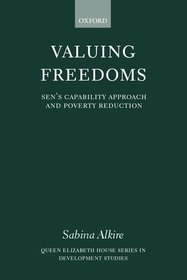
Valuing Freedoms
Sen's Capability Approach and Poverty Reduction
-
10% KEDVEZMÉNY?
- A kedvezmény csak az 'Értesítés a kedvenc témákról' hírlevelünk címzettjeinek rendeléseire érvényes.
- Kiadói listaár GBP 60.00
-
27 090 Ft (25 800 Ft + 5% áfa)
Az ár azért becsült, mert a rendelés pillanatában nem lehet pontosan tudni, hogy a beérkezéskor milyen lesz a forint árfolyama az adott termék eredeti devizájához képest. Ha a forint romlana, kissé többet, ha javulna, kissé kevesebbet kell majd fizetnie.
- Kedvezmény(ek) 10% (kb. 2 709 Ft)
- Kedvezményes ár 24 381 Ft (23 220 Ft + 5% áfa)
Iratkozzon fel most és részesüljön kedvezőbb árainkból!
Feliratkozom
27 090 Ft

Beszerezhetőség
Megrendelésre a kiadó utánnyomja a könyvet. Rendelhető, de a szokásosnál kicsit lassabban érkezik meg.
Why don't you give exact delivery time?
A beszerzés időigényét az eddigi tapasztalatokra alapozva adjuk meg. Azért becsült, mert a terméket külföldről hozzuk be, így a kiadó kiszolgálásának pillanatnyi gyorsaságától is függ. A megadottnál gyorsabb és lassabb szállítás is elképzelhető, de mindent megteszünk, hogy Ön a lehető leghamarabb jusson hozzá a termékhez.
A termék adatai:
- Kiadó OUP Oxford
- Megjelenés dátuma 2002. március 21.
- ISBN 9780199245796
- Kötéstípus Keménykötés
- Terjedelem356 oldal
- Méret 241x162x24 mm
- Súly 664 g
- Nyelv angol 0
Kategóriák
Rövid leírás:
Sabina Alkire shows how Nobel Prize-winning economist Amartya Sen's capability approach can be coherently---and practically---put to work in poverty reduction activities so that the voices and values of the poor matter. This provides economists, philosophers, theologians, and development practitioners with a way forward that addresses both theoretical and practical challenges.
TöbbHosszú leírás:
Alkire examines how Nobel Prize-winning economist Amartya Sen's capability approach can be coherently-and practically-put to work in participatory poverty reduction activities. Sen argues that economic development should expand 'valuable' capabilities. Alkire probes how we identify what is valuable.
Sen deliberately left the capability approach 'incomplete' in order to ensure its relevance to persons and cultures with different understandings of the good. Part I proposes a framework for identifying valuable capabilities that retains this 'fundamental' incompleteness and space for individual and cultural diversity. Drawing on the work of John Finnis and others, Alkire addresses foundational issues regarding the identification and pursuit of 'valuable' dimensions of human development based in practical reason, then observes that much of the criticism of development arises from negative impacts on social or cultural/religious dimensions that are also deeply valued by the poor. Part I closes with a four-part 'operational definition' of basic capability that bridges 'basic needs', participation, and informed consent.
Part II proposes an alternative participatory method for systematically identifying valued changes in participants' capability sets. Three case studies of women's income generation activities in Pakistan---goat-rearing, adult literacy, and rose cultivation---contrast economic cost-benefit analysis of each activity with capability analysis.
... essential reading for anyone who wants to take the capability approach forward, and it will certainly become a reference point for much future work in this area.
Tartalomjegyzék:
INTRODUCTION: CAPABILITY AND VALUATION
POVERTY AND HUMAN DEVELOPMENT
RANGE INFORMATION AND PROCESS
PARTICIPATION AND CULTURE
BASIC NEEDS AND BASIC CAPABILITIES
ASSESSING CAPABILITY CHANGE
THREE CASE STUDIES

