

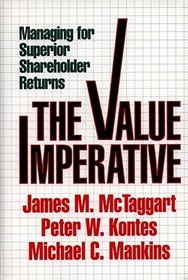
Value Imperative
Managing for Superior Shareholder Returns
-
20% KEDVEZMÉNY?
- Kiadói listaár GBP 36.99
-
16 700 Ft (15 905 Ft + 5% áfa)
Az ár azért becsült, mert a rendelés pillanatában nem lehet pontosan tudni, hogy a beérkezéskor milyen lesz a forint árfolyama az adott termék eredeti devizájához képest. Ha a forint romlana, kissé többet, ha javulna, kissé kevesebbet kell majd fizetnie.
- Kedvezmény(ek) 20% (cc. 3 340 Ft off)
- Kedvezményes ár 13 360 Ft (12 724 Ft + 5% áfa)
- A kedvezmény érvényes eddig: 2026. augusztus 31.
13 360 Ft

Beszerezhetőség
Bizonytalan ideig nincs raktáron a kiadónál, rendelése nem javasolt.
Why don't you give exact delivery time?
A beszerzés időigényét az eddigi tapasztalatokra alapozva adjuk meg. Azért becsült, mert a terméket külföldről hozzuk be, így a kiadó kiszolgálásának pillanatnyi gyorsaságától is függ. A megadottnál gyorsabb és lassabb szállítás is elképzelhető, de mindent megteszünk, hogy Ön a lehető leghamarabb jusson hozzá a termékhez.
A termék adatai:
- Kiadó Free Press
- Megjelenés dátuma 1994. március 28.
- Kötetek száma Hardback
- ISBN 9780029206706
- Kötéstípus Keménykötés
- Terjedelem367 oldal
- Méret 234x155x33 mm
- Súly 540 g
- Nyelv angol 0
Kategóriák
Hosszú leírás:
Moving beyond the strategies that managers have employed to create shareholder value -- now the standard for business performance -- management experts James McTaggart, Peter Kontes, and Michael Mankins reveal their powerful new framework for the systematic, day-to-day management of shareholder value. The authors attack head-on the fundamental weaknesses in current management practices, namely, the stranglehold that budgeting has over strategic planning and the lack of imagination in management plans that prevents real changes and consequences. They provide a systematic approach to "value based management" that eliminates these weaknesses, offering proven strategies for managing large, complex companies to consistently produce superior results for stockholders.
Building on more than 16 years of consulting experience with many of the largest and best-known companies in North America, Europe, and Australia, the authors delineate the fundamental principles of value creation, as well as the primary obstacles. Starting with the principle that "cash flows drive value," McTaggart, Kontes, and Mankins show how to create a single governing objective that will enable managers to make decisions most likely to increase the company's competitive, organizational, and financial strength. Building on the objective of maximizing shareholder value, they outline the value based management framework that directly links a company's strategies and organization to its value in capital markets. Using real-world examples, they describe how to develop business and corporate strategies that substantially improve competitive position and increase market value, often within only two to five years. And as most large companies lack the internal processes necessary to manage for value on a sustained basis, the authors show managers how to build the five key processes that are institutional value drivers: governance, strategic planning, resource allocation, performance management, and top management compensation. Mastering these capabilities is fundamental to the ongoing, consistent creation of shareholder value over time.
All companies, the authors argue, inherently possess an enormous potential to create higher value for their shareholders. With hundreds of examples of companies that have successfully employed the beliefs, principles, and practices of value based management, this book shows general managers how to generate superior returns and realize their business's full value potential.
4) that can cause both customer satisfaction and shareholder value to increase or decrease simultaneously. In these cases, clearly, there would be no conflict of interest between the two groups. However, there are also strategies (characterized by arrows
Tartalomjegyzék:
1 and
Több
