

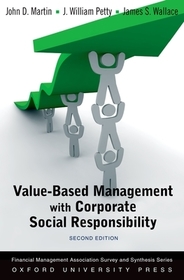
Value Based Management with Corporate Social Responsibility
Sorozatcím: Financial Management Association Survey and Synthesis;
-
10% KEDVEZMÉNY?
- A kedvezmény csak az 'Értesítés a kedvenc témákról' hírlevelünk címzettjeinek rendeléseire érvényes.
- Kiadói listaár GBP 92.00
-
41 538 Ft (39 560 Ft + 5% áfa)
Az ár azért becsült, mert a rendelés pillanatában nem lehet pontosan tudni, hogy a beérkezéskor milyen lesz a forint árfolyama az adott termék eredeti devizájához képest. Ha a forint romlana, kissé többet, ha javulna, kissé kevesebbet kell majd fizetnie.
- Kedvezmény(ek) 10% (cc. 4 154 Ft off)
- Kedvezményes ár 37 384 Ft (35 604 Ft + 5% áfa)
Iratkozzon fel most és részesüljön kedvezőbb árainkból!
Feliratkozom
41 538 Ft

Beszerezhetőség
Megrendelésre a kiadó utánnyomja a könyvet. Rendelhető, de a szokásosnál kicsit lassabban érkezik meg.
Why don't you give exact delivery time?
A beszerzés időigényét az eddigi tapasztalatokra alapozva adjuk meg. Azért becsült, mert a terméket külföldről hozzuk be, így a kiadó kiszolgálásának pillanatnyi gyorsaságától is függ. A megadottnál gyorsabb és lassabb szállítás is elképzelhető, de mindent megteszünk, hogy Ön a lehető leghamarabb jusson hozzá a termékhez.
A termék adatai:
- Kiadás sorszáma 2
- Kiadó OUP USA
- Megjelenés dátuma 2009. augusztus 27.
- ISBN 9780195340389
- Kötéstípus Keménykötés
- Terjedelem208 oldal
- Méret 152x236x20 mm
- Súly 488 g
- Nyelv angol
- Illusztrációk tables and figures 0
Kategóriák
Rövid leírás:
The current financial crisis has caused many of us to question the motives and actions that drive the business world, even the basic notion that firms should be run so as to maximize shareholder value has come under increasing scrutiny. Very simply, the failures of some of our nation's most venerable financial institutions has called into question the very premise of Value based Management (VBM). Moreover, lavish CEO compensation coming a time when rank and file employees, suppliers and other stakeholders of these corporations are suffering has produced public outrage. In this book the authors provide an up-to-date look at Value Based Management and find that the underlying concept is as sound today as ever.
TöbbHosszú leírás:
As the first decade of the 21st century winds down we have seen a sea change in society's attitudes toward finance. The 1990s can best be described as the decade of shareholder supremacy, with each firm trying to outdo the other in their allegiance to shareholder value creation, or as it came to be known, Value Based Management (VBM). Nobody seemed to question this culture as the rising firm valuations translated into vast wealth creation for so many. Three significant economic events have defined the last decade and reshaped how the public feels about an unbridled devotion to VBM. (i) The dot.com bubble in 2000, (ii) the infamous accounting scandals of 2001, and (iii) the collapse of the credit markets in 2007-2008. In all three of these events the CEOs are portrayed as reckless and greedy. Wall Street has gone from an object of our admiration to an object of scorn. The first edition of this book, Value Based management: The Corporate Response to the Shareholder Revolution was written to help explain the underpinnings of value based management. At the time of its publication, few questioned whether the concept was the proper thing to do. Instead, the debate was focused on how to implement a VBM program. With this second edition of the book, the authors look at VBM after having seen it through good times and bad. It is not their intent to play the blame game or point fingers. Nor is it their intent to provide an impassioned defense of VBM. Instead they provide an academic appraisal of VBM, where is has been, where it is now, and where they see it going.
With this edition, Martin, Petty, and Wallace continue to push the envelope on corporate valuation, governance, and social responsibility. With today's economic challenges, considering the interests of all stakeholders is paramount to the success of the firm. Maximizing shareholder value in isolation is no longer socially acceptable. The authors get it right with thought provoking theories on value-based management that is supported by extensive empirical evidence and practical applications.
Tartalomjegyzék:
Part I: Value Based Management, Corporate Social Responsibility, and the Purpose of the Corporation
The Purpose of a Corporation
The Elements of Value based Management
The Need to Measure What You Want to Manage
Part II: The Finer Details of Value based Management and Corporate Social Responsibility
Free Cash Flow Valuation-The Foundation of Value Based Management
Pick a Name, Any Name: Economic Profit, Residual Income, or Economic Value Added
Corporate Social Responsibility-Putting the S in Value(s)-Based Management
Part III: VBM Applications
Project Evaluation Using the New Metrics
Incentive Compensation-What You Measure and Reward is What Gets Done! Part IV: Lessons We Have Learned
Lessons Learned
Epilogue: Where We Are Now
Endnotes

