

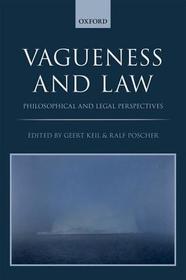
Vagueness and Law
Philosophical and Legal Perspectives
-
10% KEDVEZMÉNY?
- A kedvezmény csak az 'Értesítés a kedvenc témákról' hírlevelünk címzettjeinek rendeléseire érvényes.
- Kiadói listaár GBP 102.50
-
48 969 Ft (46 637 Ft + 5% áfa)
Az ár azért becsült, mert a rendelés pillanatában nem lehet pontosan tudni, hogy a beérkezéskor milyen lesz a forint árfolyama az adott termék eredeti devizájához képest. Ha a forint romlana, kissé többet, ha javulna, kissé kevesebbet kell majd fizetnie.
- Kedvezmény(ek) 10% (cc. 4 897 Ft off)
- Kedvezményes ár 44 072 Ft (41 973 Ft + 5% áfa)
Iratkozzon fel most és részesüljön kedvezőbb árainkból!
Feliratkozom
48 969 Ft

Beszerezhetőség
Megrendelésre a kiadó utánnyomja a könyvet. Rendelhető, de a szokásosnál kicsit lassabban érkezik meg.
Why don't you give exact delivery time?
A beszerzés időigényét az eddigi tapasztalatokra alapozva adjuk meg. Azért becsült, mert a terméket külföldről hozzuk be, így a kiadó kiszolgálásának pillanatnyi gyorsaságától is függ. A megadottnál gyorsabb és lassabb szállítás is elképzelhető, de mindent megteszünk, hogy Ön a lehető leghamarabb jusson hozzá a termékhez.
A termék adatai:
- Kiadó OUP Oxford
- Megjelenés dátuma 2016. december 8.
- ISBN 9780198782889
- Kötéstípus Keménykötés
- Terjedelem350 oldal
- Méret 239x176x26 mm
- Súly 684 g
- Nyelv angol 0
Kategóriák
Rövid leírás:
Bringing together leading scholars working on the topic of vagueness in philosophy and in law, this book fosters a dialogue between philosophers and legal scholars by examining how philosophers conceive vagueness in law from their theoretical perspective and how legal theorists make use of philosophical theories of vagueness.
TöbbHosszú leírás:
Vague expressions are omnipresent in natural language. As such, their use in legal texts is virtually inevitable. If a law contains vague terms, the question whether it applies to a particular case often lacks a clear answer. One of the fundamental pillars of the rule of law is legal certainty. The determinacy of the law enables people to use it as a guide and places judges in the position to decide impartially. Vagueness poses a threat to these ideals. In borderline cases, the law seems to be indeterminate and thus incapable of serving its core rule of law value.
In the philosophy of language, vagueness has become one of the hottest topics of the last two decades. Linguists and philosophers have investigated what distinguishes "soritical " vagueness from other kinds of linguistic indeterminacy, such as ambiguity, generality, open texture, and family resemblance concepts. There is a vast literature that discusses the logical, semantic, pragmatic, and epistemic aspects of these phenomena. Legal theory has hitherto paid little attention to the differences between the various kinds of linguistic indeterminacy that are grouped under the heading of "vagueness ", let alone to the various theories that try to account for these phenomena.
Bringing together leading scholars working on the topic of vagueness in philosophy and in law, this book fosters a dialogue between philosophers and legal scholars by examining how philosophers conceive vagueness in law from their theoretical perspective and how legal theorists make use of philosophical theories of vagueness. The chapters of the book are organized into three parts. The first part addresses the import of different theories of vagueness for the law, referring to a wide range of theories from supervaluationist to contextualist and semantic realist accounts in order to address the question of whether the law can learn from engaging with philosophical discussions of vagueness. The second part of the book examines different vagueness phenomena. The contributions in part 2 suggest that the greater awareness to different vagueness phenomena can make lawyers aware of specific issues and solutions so far overlooked. The third part deals with the pragmatic aspects of vagueness in law, providing answers to the question of how to deal with vagueness in law and with the professional, political, moral, and ethical issues such vagueness gives rise to.
...each chapter is eminently readable and worthy of thoughtful consideration. I found it to be fascinating and it opened up new pathways in how I consider legislation. The chapters are filled with interesting theoretical and practical examples on the use, abuse and interpretation of legislation. For anyone with an interest in legislation, it should make us stop and consider, in a more profound way, how vagueness is affecting our endeavours.
Tartalomjegyzék:
Introduction
Part I: Theories of Vagueness and Their Impact on Jurisprudence
Philosophical and Jurisprudential Issues of Vagueness
Vagueness in Law: Placing the Blame Where It's Due
An Intentionalist Account of Vagueness: A Legal Perspective
Can Legal Practice Adjudicate Between Theories of Vagueness?
Semantics, Metaphysics, and Objectivity in the Law
Part II: Vagueness Phenomena in Law
Pragmatic Vagueness in Statutory Law
Second-Order Vagueness in the Law
The Non-Conservativeness of Legal Definitions
The Role of Vagueness and Context Sensitivity in Legal Interpretation
Part III: Dealing with Vagueness in Law
Why It Is So Difficult to Resolve Vagueness in Legal Interpretation
Vagueness and Political Choice in Law
Non-Epistemic Uncertainty and the Problem of Legal Line-Drawing
Smoothing Vague Laws
How Vagueness Makes Judges Lie
Clarity, Thoughtfulness, and the Rule of Law

