

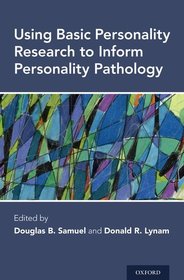
Using Basic Personality Research to Inform Personality Pathology
-
10% KEDVEZMÉNY?
- A kedvezmény csak az 'Értesítés a kedvenc témákról' hírlevelünk címzettjeinek rendeléseire érvényes.
- Kiadói listaár GBP 68.00
-
30 702 Ft (29 240 Ft + 5% áfa)
Az ár azért becsült, mert a rendelés pillanatában nem lehet pontosan tudni, hogy a beérkezéskor milyen lesz a forint árfolyama az adott termék eredeti devizájához képest. Ha a forint romlana, kissé többet, ha javulna, kissé kevesebbet kell majd fizetnie.
- Kedvezmény(ek) 10% (kb. 3 070 Ft)
- Kedvezményes ár 27 632 Ft (26 316 Ft + 5% áfa)
Iratkozzon fel most és részesüljön kedvezőbb árainkból!
Feliratkozom
30 702 Ft

Beszerezhetőség
Megrendelésre a kiadó utánnyomja a könyvet. Rendelhető, de a szokásosnál kicsit lassabban érkezik meg.
Why don't you give exact delivery time?
A beszerzés időigényét az eddigi tapasztalatokra alapozva adjuk meg. Azért becsült, mert a terméket külföldről hozzuk be, így a kiadó kiszolgálásának pillanatnyi gyorsaságától is függ. A megadottnál gyorsabb és lassabb szállítás is elképzelhető, de mindent megteszünk, hogy Ön a lehető leghamarabb jusson hozzá a termékhez.
A termék adatai:
- Kiadó OUP USA
- Megjelenés dátuma 2019. április 11.
- ISBN 9780190227074
- Kötéstípus Keménykötés
- Terjedelem288 oldal
- Méret 155x236x27 mm
- Súly 544 g
- Nyelv angol 0
Kategóriák
Rövid leírás:
Using Basic Personality Research to Inform the Personality Disorders will present the work of prominent thinkers at the intersections of social, personality, developmental, and clinical psychology to consider theoretical and empirical issues relevant to how basic personality research can inform the scientific understanding of personality pathology. Surveying cutting-edge research on the science of basic personality and demonstrating how these ideas and methods can be applied to the conceptualization of pathology, the book first provides a historical overview, followed by an account of the current state of the personality disorder literature.
TöbbHosszú leírás:
Personality pathology, which is characterized by a pervasive, maladaptive, and inflexible pattern of thoughts, emotions, and behaviors, has long been considered a set of categories that are distinct from each other and from "normal" personality. Research over the past three decades, however, has challenged that assumed separation, and instead suggests that abnormal personality is merely a maladaptive extension of the same features that describe the personalities of all humans.
Using Basic Personality Research to Inform the Personality Disorders will present the work of prominent thinkers at the intersections of social, personality, developmental, and clinical psychology to consider theoretical and empirical issues relevant to how basic personality research can inform the scientific understanding of personality pathology. Surveying cutting-edge research on the science of basic personality and demonstrating how these ideas and methods can be applied to the conceptualization of pathology, the book first provides a historical overview, followed by an account of the current state of the personality disorder literature. Ensuing chapters highlight critical issues in the assessment and conceptualization of personality, its development across the life course, and biological underpinnings. These chapters are valuable primers on the basic science of personality, from specific genes to complex social interactions. Furthermore, each chapter aims not only to elucidate current understandings of personality, but to demonstrate its direct application to clinical diagnosis and conceptualization. Using Basic Personality Research to Inform the Personality Disorders is the first edited volume to present such diverse perspectives across biological, developmental, clinical, and social psychology from leading researchers in basic and disordered personality, and will be of interest to a broad range of students, scientists, and practitioners.
As this impressive book demonstrates, reality is much more complex and empirically interesting than this simple dichotomy suggests. Personality researchers drawn to normative personality or personality pathology, including those with clinical orientations, should read this book. Graduate students in personality and related fields, as well as very advanced undergraduates, will also benefit from this work's insights.
Tartalomjegyzék:
About the Editors
Contributors
Section I: Introduction to Personality Disorders
Chapter 1. Historical Overview of Personality Disorders
Thomas A. Widiger
Chapter 2. The Current State of Personality Disorders through the Lens of PDTRT
Carl W. Lejuez, Alexis Matusiewicz, Nadia Bounoua, & James Soldinger
Chapter 3. Personality Disorders as Collections of Traits
Joshua D. Miller
Section II: Assessment Methods and Issues
Chapter 4. Using Basic Personality Process Models to Inform the Personality Disorders: Core Momentary Stressor-Symptom Contingencies as Basic Etiology
William Fleeson, R. Michael Furr, Malek Mneimne, & Elizabeth Mayfield Arnold
Chapter 5. The Interpersonal Situation: Integrating Personality Assessment, Case Formulation, and Intervention
Christopher J. Hopwood, Aaron L. Pincus, Aidan G. C. Wright
Chapter 6. Personality Dysfunction and Trait Extremity: Conceptually, but not Empirically Distinct?
Lee Anna Clark, Elizabeth J. Daly, Stephanie Larew, Hallie Nuzum, Thomas Kingsbury, Jaime L. Shapiro, Xia Allen, & Eunyoe Ro
Section III: Development Across the Life Course
Chapter 7. The Principles of Personality Trait Development and their Relation to Psychopathology
Brent W. Roberts & Rodica I. Damian
Chapter 8. Advances in Child Personality Research and Relevance for Personality Pathology
Jennifer L. Tackett, Kathleen W. Reardon, Kathrin Herzhoff, & Shauna C. Kushner
Chapter 9. The Prevalence, Stability, and Impact of Personality Pathology in Later Life: Preliminary Findings from the SPAN Study.
Thomas F. Oltmanns & Steve Balsis
Section IV: Biological Bases of Personality
Chapter 10. Personality as Adaptation: Perspectives from Nonhuman Primates
John P. Capitanio & William A. Mason
Chapter 11. Molecular Trait Psychology: Advancing the Field by Moving from Gene-Hunting to Tool-Making
Turhan Canli
Index

