

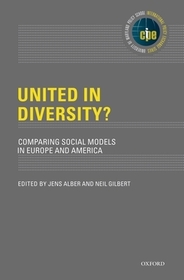
United in Diversity?
Comparing Social Models in Europe and America
Sorozatcím: International Policy Exchange Series;
-
10% KEDVEZMÉNY?
- A kedvezmény csak az 'Értesítés a kedvenc témákról' hírlevelünk címzettjeinek rendeléseire érvényes.
- Kiadói listaár GBP 62.00
-
27 993 Ft (26 660 Ft + 5% áfa)
Az ár azért becsült, mert a rendelés pillanatában nem lehet pontosan tudni, hogy a beérkezéskor milyen lesz a forint árfolyama az adott termék eredeti devizájához képest. Ha a forint romlana, kissé többet, ha javulna, kissé kevesebbet kell majd fizetnie.
- Kedvezmény(ek) 10% (cc. 2 799 Ft off)
- Kedvezményes ár 25 194 Ft (23 994 Ft + 5% áfa)
Iratkozzon fel most és részesüljön kedvezőbb árainkból!
Feliratkozom
27 993 Ft

Beszerezhetőség
Megrendelésre a kiadó utánnyomja a könyvet. Rendelhető, de a szokásosnál kicsit lassabban érkezik meg.
Why don't you give exact delivery time?
A beszerzés időigényét az eddigi tapasztalatokra alapozva adjuk meg. Azért becsült, mert a terméket külföldről hozzuk be, így a kiadó kiszolgálásának pillanatnyi gyorsaságától is függ. A megadottnál gyorsabb és lassabb szállítás is elképzelhető, de mindent megteszünk, hogy Ön a lehető leghamarabb jusson hozzá a termékhez.
A termék adatai:
- Kiadó OUP USA
- Megjelenés dátuma 2009. október 22.
- ISBN 9780195376630
- Kötéstípus Keménykötés
- Terjedelem464 oldal
- Méret 155x236x33 mm
- Súly 774 g
- Nyelv angol
- Illusztrációk numerous tables and figures 0
Kategóriák
Rövid leírás:
This book systematically analyzes how much European countries and the U.S. have in common and how much variation we find within the enlarged E.U. in central spheres of socio-economic and political life.
TöbbHosszú leírás:
Since the advent of the European Union, politicians have increasingly emphasized the notion of a European social model as an alternative to the American form of market capitalism, which is seen as promoting economic growth without regard for solidarity and social progress. As this political discourse has advanced, social scientists and academic policy analysts have raised questions concerning the extent to which the E.U. and U.S. social models exist outside the minds of diplomats and politicians seeking to stitch together a common identity. How much unity is there still within Europe after the Eastern enlargements have considerably increased economic and cultural diversity? To whatever extent one might discern a distinct set of commonalities that represent the core of a European approach, how different are the European characteristics of social, economic, and political life from those of America?
Addressing these issues, this book systematically analyzes how much European countries and the United States have in common and how much variation we find within the enlarged European Union in eight central spheres of socio-economic and political life: employment, equality/mobility, educational opportunity, integration of immigrants, democratic functioning, political participation, rights to welfare, and levels of public spending. Drawing on empirical analyses by U.S. and European scholars who represent multi-disciplinary backgrounds, each of these topics is put under scrutiny. The results of this study illuminate points of convergence and divergence as seen from the perspectives of scholars from both sides of the Atlantic.
[This book] can be read with profit by experts as well as those with a general interest in the subject.
Tartalomjegyzék:
Introduction
Jens Alber and Neil Gilbert
Part I: State: Structure and Policy
Section I. Democratic Functioning
Democratic Quality in America and Europe. Stein Ringen
Liberalism and Democracy in America Today. John Samples
Section II. Political Integration
The Inequality of Electoral Participation in Europe and America and the Politically Integrative Functions of the Welfare State. Jens Alber and Ulrich Kohler
Income Inequality and Participation in United States Elections.Michael P. McDonald
Section III. Patterns of Public Expenditure
Patterns of State Expenditure in Europe and America. Francis G. Castles
Comparative Analyses of Stateness and State Action: What Can We Learn From Patterns of Expenditure? Neil Gilbert
Section IV. Citizenship and Welfare
Concepts and Practices of Social Citizenship in Europe: The Case of Poverty and Income Support for the Poor. Chiara Saraceno
The New American Model of Work-Conditioned Public Support. Rebecca M. Blank
Part 2: Society: Conditions and Outcomes
Section V. The Goal of Full Employment
Welfare and Employment: a European Dilemma? Werner Eichhorst and Anton Hemerijck
Fulfilling the Ballyhoo of a Peak Economy? The US Economic Model. Richard B. Freeman
Section VI. Inequality and Mobility
Egalitarianism versus Economic Dynamics? An Empirical Assessment of the Friedman Conjecture. Markus Gangl
Are United States Inequality and Mobility Trends in the European Union's Future? Richard V. Burkhauser and Kenneth A. Couch
Section VII. Educational Opportunity
Education in Europe and the Lisbon Benchmarks Jutta Allmendinger, Christian Ebner, and Rita Nikolai
The U.S. Educational System: Can it be a Model for Europe? Patricia Maloney and Karl Ulrich Mayer
Section VIII. Immigrant Integration
Different Countries, Different Groups, Same Mechanisms? The Structural Assimilation of the Second Generation in Europe (D, F, GB) and the U.S. Frank Kalter and Nadia Granato
Immigration and Nativism in the United States and Europe: Demography and Globalization versus the Nation-State. Charles Hirschman, Anthony Daniel Perez
Section IX Conclusion
The Epistemology of Comparative Analyses: What Do We Know? Jens Alber, Neil Gilbert

