

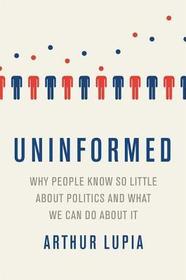
Uninformed Why People Seem to Know So Little about Politics and What We Can Do about It
A Scientific Perspective on Information, Knowledge, and Competence
-
10% KEDVEZMÉNY?
- A kedvezmény csak az 'Értesítés a kedvenc témákról' hírlevelünk címzettjeinek rendeléseire érvényes.
- Kiadói listaár GBP 34.99
-
15 797 Ft (15 045 Ft + 5% áfa)
Az ár azért becsült, mert a rendelés pillanatában nem lehet pontosan tudni, hogy a beérkezéskor milyen lesz a forint árfolyama az adott termék eredeti devizájához képest. Ha a forint romlana, kissé többet, ha javulna, kissé kevesebbet kell majd fizetnie.
- Kedvezmény(ek) 10% (kb. 1 579 Ft)
- Kedvezményes ár 14 218 Ft (13 541 Ft + 5% áfa)
Iratkozzon fel most és részesüljön kedvezőbb árainkból!
Feliratkozom
15 797 Ft

Beszerezhetőség
Becsült beszerzési idő: A Prosperónál jelenleg nincsen raktáron, de a kiadónál igen. Beszerzés kb. 3-5 hét..
A Prosperónál jelenleg nincsen raktáron.
Why don't you give exact delivery time?
A beszerzés időigényét az eddigi tapasztalatokra alapozva adjuk meg. Azért becsült, mert a terméket külföldről hozzuk be, így a kiadó kiszolgálásának pillanatnyi gyorsaságától is függ. A megadottnál gyorsabb és lassabb szállítás is elképzelhető, de mindent megteszünk, hogy Ön a lehető leghamarabb jusson hozzá a termékhez.
A termék adatai:
- Kiadó OUP USA
- Megjelenés dátuma 2016. január 7.
- ISBN 9780190263720
- Kötéstípus Keménykötés
- Terjedelem358 oldal
- Méret 239x155x33 mm
- Súly 590 g
- Nyelv angol 0
Kategóriák
Rövid leírás:
In this capstone work, eminent political scientist Arthur Lupia synthesizes years of work with scientists and educators in all arenas to figure out how to increase issue competence among voters.
TöbbHosszú leírás:
Citizens appear to know very little about politics and government. Hundreds of surveys document millions of citizens answering thousands of political questions incorrectly. Given this state of affairs, it is not surprising that more knowledgeable people often deride the public for its ignorance and encourage them to stay out of politics.
As the eminent political scientist Arthur Lupia shows in this capstone work, there are more constructive responses. As he explains, expert critics of public ignorance fundamentally misunderstand the problem, and as a consequence propose unhelpful solutions to a genuinely serious problem. For instance, idea that simply providing people with more facts will make them more competent voters is erroneous. That is because most experts fail to understand how most people learn, and do not know how to determine what types of information are relevant to voters. Lupia has worked for years with scientists and educators in all arenas to figure out how to increase issue competence among voters in areas like climate change. He draws from these efforts and the latest research on educational efficacy to develop a battery of techniques that effectively convey to people information that they actually care. If we accept the idea that citizens sometimes lack the knowledge that they need to make competent political choices, that greater knowledge can improve decision making, and that experts and advocates are often mistaken about how people think and learn, then a prescription for improving political knowledge and civic competence emerges: we need to educate the educators. Lupia's ultimate purpose, therefore, extends beyond politics alone: to help educators of all kinds convey information that is of more value to more people.
Tartalomjegyzék:
Dedication
Acknowledgements
1. From Infinite Ignorance to Knowledge that Matters
2. Who Are the Educators and How Can We Help Them?
PART I: THE VALUE OF INFORMATION
3. Three Definitions
4. The Silver Bullet
5. The Logic of Competence
6. Lost in the Woods
7. Attracting Attention
8. Building Source Credibility
9. The Politics of Competence
10. Value Diversity and How to Manage It
11. Complexity and Framing
12. Political Roles: Who Needs to Know?
13. Costs and Benefits
PART II. HOW TO IMPROVE âPOLITICAL KNOWLEDGEâ
14. What We Know
15. Reading the Questions, Understanding the Answers
16. Political Knowledge Scales: Something Doesnât Add Up
17. Assessing Information Assessments
18. All in Good Measure
19. The Silver Lining
References

