

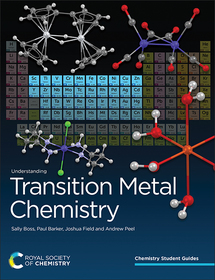
Understanding Transition Metal Chemistry
Sorozatcím: Chemistry Student Guides;
-
10% KEDVEZMÉNY?
- A kedvezmény csak az 'Értesítés a kedvenc témákról' hírlevelünk címzettjeinek rendeléseire érvényes.
- Kiadói listaár GBP 29.99
-
13 540 Ft (12 895 Ft + 5% áfa)
Az ár azért becsült, mert a rendelés pillanatában nem lehet pontosan tudni, hogy a beérkezéskor milyen lesz a forint árfolyama az adott termék eredeti devizájához képest. Ha a forint romlana, kissé többet, ha javulna, kissé kevesebbet kell majd fizetnie.
- Kedvezmény(ek) 10% (cc. 0 Ft off)
- Kedvezményes ár 12 186 Ft (11 606 Ft + 5% áfa)
Iratkozzon fel most és részesüljön kedvezőbb árainkból!
Feliratkozom
13 540 Ft

Beszerezhetőség
Még nem jelent meg, de rendelhető. A megjelenéstől számított néhány héten belül megérkezik.
Why don't you give exact delivery time?
A beszerzés időigényét az eddigi tapasztalatokra alapozva adjuk meg. Azért becsült, mert a terméket külföldről hozzuk be, így a kiadó kiszolgálásának pillanatnyi gyorsaságától is függ. A megadottnál gyorsabb és lassabb szállítás is elképzelhető, de mindent megteszünk, hogy Ön a lehető leghamarabb jusson hozzá a termékhez.
A termék adatai:
- Kiadás sorszáma 1
- Kiadó RSC
- Megjelenés dátuma 2026. október 30.
- ISBN 9781839164477
- Kötéstípus Puhakötés
- Terjedelem330 oldal
- Méret 246x189 mm
- Nyelv angol 700
Kategóriák
Rövid leírás:
Co-authored by lecturers and students with a tutorial style, this book provides a comprehensive grounding in first row transition metal chemistry.
TöbbHosszú leírás:
This book is part of the Chemistry Student Guides series and has been co-authored by lecturers and students from the Universities of Cambridge and Oxford and a structural scientist from the Cambridge Crystallographic Data Centre. The book provides a comprehensive grounding in first row transition metal chemistry.
Two topics that are central to transition metal chemistry are Coordination Chemistry and Organometallic Chemistry and these are commonly taught separately despite there being extensive overlap and sharing of key concepts. We think this somewhat artificial separation of topics makes it harder to appreciate the key chemical theories which underpin all transition metal chemistry. With that in mind, our aim in writing this book is to provide one text which builds your understanding of the structure, bonding and reactivity of all first-row transition metal compounds. We will introduce you to many of the fundamental principles of transition metal chemistry and explain the models which allow us to rationalise and predict the bonding and reactivity of these species. We hope that our approach will provide a broad perspective on this important segment of the periodic table and ultimately make the chemistry easier to understand.
Exploring the different perspectives of lecturers and students has been a big part of the writing process for this text. The story that we tell reflects this co-authorship. You will see that we adopt a tutorial style; text is interspersed with hints to help with your understanding and gently steer you away from common misconceptions. Additionally, the conceptual models presented are supported through experimental data using structures from the Cambridge Structural Database to give you a sense of the way transition metal compounds look in reality.
We hope the collaborative way that we have written this book makes it easier for you to absorb the ideas we present and to test your knowledge as it develops over the course of reading the chapters.
Good luck! We hope you enjoy getting to know the transition metals and becoming confident in the theories that underpin their chemistry.
TöbbTartalomjegyzék:
Transition Metals – Properties, Periodicity, Orbitals and Energy Levels
Common Ligands for Transition Metals
Bonding in Transition Metal Compounds: Part One
Bonding in Transition Metal Compounds: Part Two
The Spectrochemical Series
Electron Counting and the 18-electron Rule
Transition Metal Complexes with Aromatic Ligands
Redox Chemistry of Transition Metals
Transition Metal Complexes – Key Properties and Reactivities
Catalytic Reaction Steps
Catalytic Cycles

