

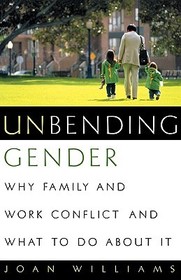
Unbending Gender
Why Family and Work Conflict and What To Do About It
-
10% KEDVEZMÉNY?
- A kedvezmény csak az 'Értesítés a kedvenc témákról' hírlevelünk címzettjeinek rendeléseire érvényes.
- Kiadói listaár GBP 19.99
-
9 025 Ft (8 595 Ft + 5% áfa)
Az ár azért becsült, mert a rendelés pillanatában nem lehet pontosan tudni, hogy a beérkezéskor milyen lesz a forint árfolyama az adott termék eredeti devizájához képest. Ha a forint romlana, kissé többet, ha javulna, kissé kevesebbet kell majd fizetnie.
- Kedvezmény(ek) 10% (kb. 903 Ft)
- Kedvezményes ár 8 122 Ft (7 736 Ft + 5% áfa)
Iratkozzon fel most és részesüljön kedvezőbb árainkból!
Feliratkozom
9 025 Ft

Beszerezhetőség
Megrendelésre a kiadó utánnyomja a könyvet. Rendelhető, de a szokásosnál kicsit lassabban érkezik meg.
Why don't you give exact delivery time?
A beszerzés időigényét az eddigi tapasztalatokra alapozva adjuk meg. Azért becsült, mert a terméket külföldről hozzuk be, így a kiadó kiszolgálásának pillanatnyi gyorsaságától is függ. A megadottnál gyorsabb és lassabb szállítás is elképzelhető, de mindent megteszünk, hogy Ön a lehető leghamarabb jusson hozzá a termékhez.
A termék adatai:
- Kiadó OUP USA
- Megjelenés dátuma 2001. szeptember 13.
- ISBN 9780195147148
- Kötéstípus Puhakötés
- Terjedelem352 oldal
- Méret 218x141x22 mm
- Súly 458 g
- Nyelv angol
- Illusztrációk 6 halftones 0
Kategóriák
Rövid leírás:
Unbending Gender proposes a family-friendly feminism, focusing on the work/family conflicts and pocketbook issues that dominate the everyday life of most women. It presents a new view of sex discrimination law that requires employers to stop designing "good" jobs around the traditional life patterns of men. It also argues that mothers should own half of fathers' wages after, as well as before, divorce, given that fathers' wage work relies on mothers' family work.
TöbbHosszú leírás:
In Unbending Gender, Joan Williams takes a hard look at the state of feminism in America. Concerned by what she finds--young women who flatly refuse to identify themselves as feminists and working-class and minority women who feel the movement hasn't addressed the issues that dominate their daily lives--she outlines a new vision of feminism that calls for workplaces focused on the needs of families and, in divorce cases, recognition of the value of family work and its impact on women's earning power.
Williams notes that good jobs in America are designed for the ideal employee, who works full-time and often overtime, with no career interruptions. Even today, most American mothers do not meet this ideal: a majority do not work full-time, and only a small fraction work overtime. Williams points out that women will never achieve equality until mothers do: she argues that employers need to implement parent-supportive policies--or face liability for sex discrimination. She also maintains that ideal-worker fathers are supported by a flow of family work from mothers, yet divorce courts treat the family wage as owned solely by the ideal worker. The result is the impoverishment of women and children, who comprise the bulk of the poor in the United States.
Unbending Gender questions the idea that women simply choose between staying at home with their children or going to work. Given the limited options that contemporary American culture allows them, mothers are forced to make compromises. Joan Williams' solution is an inclusive, family-friendly feminism that supports both mothers and fathers as caregivers and as workers.
"This book makes a notable contribution to the feminist literature for its eminently sensible, readable, and thoughtful look into the roots of women's disadvantage in market work...Highly recommended to readers who seek real explanations and solutions to labor market gender discrimination."--Choice

