

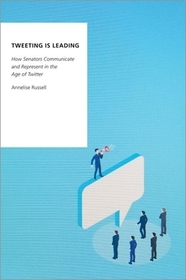
Tweeting is Leading
How Senators Communicate and Represent in the Age of Twitter
Sorozatcím: Oxford Studies in Digital Politics;
-
10% KEDVEZMÉNY?
- A kedvezmény csak az 'Értesítés a kedvenc témákról' hírlevelünk címzettjeinek rendeléseire érvényes.
- Kiadói listaár GBP 105.00
-
47 407 Ft (45 150 Ft + 5% áfa)
Az ár azért becsült, mert a rendelés pillanatában nem lehet pontosan tudni, hogy a beérkezéskor milyen lesz a forint árfolyama az adott termék eredeti devizájához képest. Ha a forint romlana, kissé többet, ha javulna, kissé kevesebbet kell majd fizetnie.
- Kedvezmény(ek) 10% (kb. 4 740 Ft)
- Kedvezményes ár 42 667 Ft (40 635 Ft + 5% áfa)
Iratkozzon fel most és részesüljön kedvezőbb árainkból!
Feliratkozom
47 407 Ft

Beszerezhetőség
Becsült beszerzési idő: A Prosperónál jelenleg nincsen raktáron, de a kiadónál igen. Beszerzés kb. 3-5 hét..
A Prosperónál jelenleg nincsen raktáron.
Why don't you give exact delivery time?
A beszerzés időigényét az eddigi tapasztalatokra alapozva adjuk meg. Azért becsült, mert a terméket külföldről hozzuk be, így a kiadó kiszolgálásának pillanatnyi gyorsaságától is függ. A megadottnál gyorsabb és lassabb szállítás is elképzelhető, de mindent megteszünk, hogy Ön a lehető leghamarabb jusson hozzá a termékhez.
A termék adatai:
- Kiadó OUP USA
- Megjelenés dátuma 2021. november 9.
- ISBN 9780197582268
- Kötéstípus Keménykötés
- Terjedelem288 oldal
- Méret 159x241x25 mm
- Súly 454 g
- Nyelv angol 236
Kategóriák
Rövid leírás:
Social media is changing the business of representation in the Senate. If you want to know what your senator is up to, you don't need a newspaper, just your phone. Drawing on a unique dataset of almost 200,000 senator tweets, Tweeting is Leading offers a critical analysis of senators' communication on Twitter, the individual and constituent forces that shape it, and the agendas that result.
TöbbHosszú leírás:
Social media is changing the business of representation in the Senate. If you want to know what your senator is up to, you don't need a newspaper, just your phone. Some senators are social media minimalists while others are digitally long-winded, but each senator has the ability to insert themselves into our daily digital routines and frame their political brand for a public audience.
Drawing on a unique dataset of almost 200,000 senator tweets, Tweeting is Leading offers a critical analysis of senators' communication on Twitter, the individual and constituent forces that shape it, and the agendas that result. The public priorities that senators communicate through social media--what Annelise Russell calls their rhetorical agenda--offer a necessary tool for understanding how senators link their carefully crafted public image with potential voters. The rhetorical agenda challenges what we know about representation, removing the institutional and political constraints on congressional communication and giving lawmakers a messaging platform where individual discretion is high, the relative costs are low, and someone is always watching. Tweeting is Leading emphasizes why representation on social media matters for understanding media norms and how lawmakers digitally build a political brand, showing empirically how senators self-constrain their communications to curate different styles of representation that match constituent expectations.
Russell demonstrates how legislators use the freedom of social media to present themselves in ways that reveal their priorities. Far from a homogeneous lot, members of the U.S. Senate in some cases take to Twitter to communicate their concern for local issues back home while others use it to engage in partisan combat in Washington. The three types of rhetorical styles that Russell identifies through a detailed analysis of tweets provide a useful window in the ways that legislators approach their jobs.
Tartalomjegyzék:
Dedication
Acknowledgements
Chapter 1: Introduction
Chapter 2: Rhetorical Agendas: A New Framework for Senate Representation
Chapter 3: Communicating Congressional Priorities in the Digital Age
Chapter 4: "Short, Not-so-Sweet, and to (Some) Point": Senate Tweets in 2013 and 2015
Chapter 5: Categorizing Senators' Tweets and Styles of Communication
Chapter 6: Putting Policy First: Building a Reputation as a Policy Wonk
Chapter 7: All Politics is Local: Senators Prioritize Constituent Service
Chapter 8: Partisan Agendas: Two Parties, Two Patterns of Partisan Rhetoric
Chapter 9: Prioritization and Representation: A Future for Social Media and Agenda-Setting
Appendix
References

