

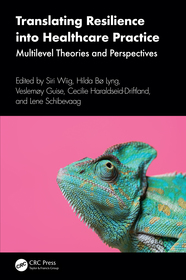
Translating Resilience into Healthcare Practice
Multilevel Theories and Perspectives
-
20% KEDVEZMÉNY?
- A kedvezmény csak az 'Értesítés a kedvenc témákról' hírlevelünk címzettjeinek rendeléseire érvényes.
- Kiadói listaár GBP 155.00
-
69 982 Ft (66 650 Ft + 5% áfa)
Az ár azért becsült, mert a rendelés pillanatában nem lehet pontosan tudni, hogy a beérkezéskor milyen lesz a forint árfolyama az adott termék eredeti devizájához képest. Ha a forint romlana, kissé többet, ha javulna, kissé kevesebbet kell majd fizetnie.
- Kedvezmény(ek) 20% (cc. 13 996 Ft off)
- Kedvezményes ár 55 986 Ft (53 320 Ft + 5% áfa)
- A kedvezmény érvényes eddig: 2026. június 30.
Iratkozzon fel most és részesüljön kedvezőbb árainkból!
Feliratkozom
62 984 Ft

Beszerezhetőség
Még nem jelent meg, de rendelhető. A megjelenéstől számított néhány héten belül megérkezik.
Why don't you give exact delivery time?
A beszerzés időigényét az eddigi tapasztalatokra alapozva adjuk meg. Azért becsült, mert a terméket külföldről hozzuk be, így a kiadó kiszolgálásának pillanatnyi gyorsaságától is függ. A megadottnál gyorsabb és lassabb szállítás is elképzelhető, de mindent megteszünk, hogy Ön a lehető leghamarabb jusson hozzá a termékhez.
A termék adatai:
- Kiadás sorszáma 1
- Kiadó CRC Press
- Megjelenés dátuma 2026. június 29.
- ISBN 9781032776989
- Kötéstípus Keménykötés
- Terjedelem306 oldal
- Méret 234x156 mm
- Nyelv angol
- Illusztrációk 19 Illustrations, black & white; 3 Halftones, black & white; 16 Line drawings, black & white; 9 Tables, black & white 700
Kategóriák
Rövid leírás:
Translating Resilience into Healthcare Practice is an essential read for researchers, educators, and professionals working in healthcare quality and safety, resilience engineering, human factors, medicine, nursing, and social care.
TöbbHosszú leírás:
Resilience in healthcare is more relevant than ever. Global health crises, increasing service complexity, resource constraints, shortages of qualified professionals, and rapid technological development all demand continuous adaptation from stakeholders at every level of the healthcare system. Amid these challenges, ensuring high-quality care requires a deeper understanding of how systems, teams, and individuals respond and adapt.
This book explores resilience as a multilevel phenomenon and positions adaptive capacity as the cornerstone of care quality. It expands the perspective of resilience beyond frontline staff to include patients and families, managers, teams, organizations, and policymakers as stakeholders in maintaining and improving healthcare quality. With its findings from the Resilience in Healthcare research program (RiH, 2018–2024), a large-scale international study, this book addresses knowledge gaps and real-world challenges. It presents a view of what enables resilient performance across healthcare systems and settings, from regulatory bodies and policy institutions to hospitals, primary care, nursing homes, and home care services. It provides the reader with examples, frameworks, and lessons learned that support cross-sector learning and practical implementation.
Translating Resilience into Healthcare Practice is an essential read for researchers, educators, and professionals working in healthcare quality and safety, resilience engineering, human factors, medicine, nursing, and social care.
- Presents resilience at the multilevel perspective as the main feature
- Highlights how user involvement in resilience is fundamental and investigates the theory and practice in this field where patients and stakeholders are cocreators of resilience
- Showcases leading resilience startegies in different contexts and countries that can lead to better safety practices
- Delivers resilience learning tools to translate resilience into practice
- Theorizes resilience and use of indicators to assess and operationalize how resilience in theory and practice will be offered
Tartalomjegyzék:
- Setting the scene - Status and challenges of the research on adaptive capacity and resilience in healthcare. 2. The CARE model: A research tool for understanding resilience. 3. The resilience journey from definitions to large scale research – how did we get there? 4. Articulating Resilience in Healthcare: Defining the Phenomena and Making Resilience Practical. 5. Building Resilient Team Performance: The Critical Role of Leadership"5: "Building resilient team performance: The critical role of leadership. 6. Measuring Resilience in Healthcare: Challenges and Opportunities. 7. Resilience and human factors – same, same but different. 8. Empowering healthcare professionals with resilience theory. 9. Don't throw the baby out with the bathwater- rethinking incident reporting through a resilient healthcare lens. 10. Patient and family involvement in resilient healthcare – why is it important to ensure high quality care? 11. A framework for mapping stakeholder involvement in resilient healthcare. 12. Next of kin involvement and perspectives of resilient and perspectives of healthcare. 13. The role of leaders as facilitators of resilience in healthcare – old wine in new bottles? 14. Understanding and co-creating resilience through multilevel stakeholder involvement: exemplars from transitional care. 15. Regulatory resilience – mission impossible? 16. Characteristics of resilience in the prehospital critical care setting 17. Characteristics of resilience in the interface between nursing home staff, general practitioners and hospitals. 18. Handling resilience in pandemic crisis in homecare in rural areas. 19. Characteristics of resilient performance in mental health care. 20. Enabling adaptive capacity in different types of hospital teams. 21. Using health technology to support resilient performance in hospital to home context. 22. Developing a framework for collaborative learning in resilient healthcare – the need for structures and planned processes. 23. Lessons learnt from the participatory design approach used for developing the Resilience in Healthcare learning tool. 24. Using Simulation to Leverage Resilience into Practice in Complex Adaptive Systems. 25. The role of pedagogical thinking and adaptive reflexive spaces in resilient healthcare research and practice. 26. Exploring the role of team, organisation, and system factors in adaptive capacity in hospital teams- results from an international cross-country study in Australia, England, Japan, the Netherlands, and Norway. 27. Using action research to promote resilient performance in the Netherlands. 28. The complex problems emerging from individual adaptive behaviour within its silos and possible strategies for solutions. 29. Experiences from supporting resilience in Australian emergency departments. 30. Integrating the micro, meso and macro levels for resilient healthcare: the role of built environment regulations. 31. Engaging citizens in societal resilience: experiences across Europe. 32. Patient safety as multilevel phenomenon, insights from other sectors. 33. Time for resilience in procured critical service? 34. Challenges and opportunities in designing and executing cross-country studies in resilient healthcare. 35. Concluding remarks – the future for research on resilience in healthcare.

