

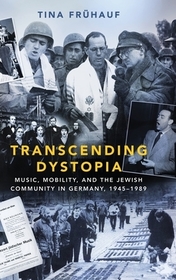
Transcending Dystopia
Music, Mobility, and the Jewish Community in Germany, 1945-1989
-
10% KEDVEZMÉNY?
- A kedvezmény csak az 'Értesítés a kedvenc témákról' hírlevelünk címzettjeinek rendeléseire érvényes.
- Kiadói listaár GBP 65.00
-
29 347 Ft (27 950 Ft + 5% áfa)
Az ár azért becsült, mert a rendelés pillanatában nem lehet pontosan tudni, hogy a beérkezéskor milyen lesz a forint árfolyama az adott termék eredeti devizájához képest. Ha a forint romlana, kissé többet, ha javulna, kissé kevesebbet kell majd fizetnie.
- Kedvezmény(ek) 10% (cc. 2 935 Ft off)
- Kedvezményes ár 26 413 Ft (25 155 Ft + 5% áfa)
Iratkozzon fel most és részesüljön kedvezőbb árainkból!
Feliratkozom
29 347 Ft

Beszerezhetőség
Becsült beszerzési idő: A Prosperónál jelenleg nincsen raktáron, de a kiadónál igen. Beszerzés kb. 3-5 hét..
A Prosperónál jelenleg nincsen raktáron.
Why don't you give exact delivery time?
A beszerzés időigényét az eddigi tapasztalatokra alapozva adjuk meg. Azért becsült, mert a terméket külföldről hozzuk be, így a kiadó kiszolgálásának pillanatnyi gyorsaságától is függ. A megadottnál gyorsabb és lassabb szállítás is elképzelhető, de mindent megteszünk, hogy Ön a lehető leghamarabb jusson hozzá a termékhez.
A termék adatai:
- Kiadó OUP USA
- Megjelenés dátuma 2021. március 31.
- ISBN 9780197532973
- Kötéstípus Keménykötés
- Terjedelem644 oldal
- Méret 157x236x45 mm
- Súly 1039 g
- Nyelv angol
- Illusztrációk 29 83
Kategóriák
Rövid leírás:
Transcending Dystopia tells the story of the remarkable revival of Jewish music in postwar and Cold War Germany. Covering a wide spectrum of musical activities and geographies across the country, this book provides a panoramic view on how music contributed to transformations within and beyond Jewish communities after the Holocaust.
TöbbHosszú leírás:
By the end of the Second World War, Germany was in ruins and its Jewish population so gravely diminished that a rich cultural life seemed unthinkable. And yet, as surviving Jews returned from hiding, the camps, and their exiles abroad, so did their music. Transcending Dystopia tells the story of the remarkable revival of Jewish musical activity that developed in postwar Germany against all odds. Author Tina Frühauf provides a kaleidoscopic panorama of musical practices in worship and social life across the country to illuminate how music contributed to transitions and transformations within and beyond Jewish communities in the aftermath of the Holocaust.
Drawing on newly unearthed sources from archives and private collections, this book covers a wide spectrum of musical activity-from its role in commemorations and community events to synagogue concerts and its presence on the radio-across the divided Germany until the Fall of the Wall in 1989. Frühauf's use of mobility as a conceptual framework reveals the myriad ways in which the reemergence of Jewish music in Germany was shaped by cultural transfer and exchange that often relied on the circulation of musicians, their ideas, and practices within and between communities. By illuminating the centrality of mobility to Jewish experiences and highlighting how postwar Jewish musical practices in Germany were defined by politics that reached across national borders to the United States and Israel, this pioneering study makes a major contribution to our understanding of Jewish life and culture in a transnational context.
Transcending Dystopia is a detailed historiography of Jewish music history based on extensive research into sources and, more recently, on interviews, particularly with regard to the aspects of mobility (in the spatial and cultural sense and that of cultural self-image) and identity. The book also touches on what could be called a musical histoire des mentalités.
Tartalomjegyzék:
On Transliteration and Translation, Spelling, and Names
Acknowledgements
Prologue: Moving Toward Silence
Introduction: Against All Odds--The Jewish Gemeinde as Sonic Community in an Age of Mobility
Part I: After the Rupture--The Interregnum and the Culture of Rebirth
Chapter 1: In the Midst of Rubble: Rebuilding a Musical Life in Berlin
Chapter 2: Out of the Depths: The Case of Munich and the South
Chapter 3: Communal Encounters--Frankfurt am Main and the North
Chapter 4: Remnants in the Soviet and French Zones and Beyond
Chapter 5: Remembering the Holocaust: Mourning and Celebration
Chapter 6: Disseminating Survival: Jews, Music, and the Media
Chapter 7: The End of Dystopia?
Part II: Music in Motion: The Jewish Communities in West Germany
Chapter 8: Returning and Leaving: Frankfurt in Flux
Chapter 9: Rebuilding with or without Organ
Chapter 10: Cantors on the Move
Chapter 11: Regenerating a Choral Music Culture
Chapter 12: Music in Social Life
Part III: The Presence of Absence: Jewish (Heritage) Music in East Germany
Chapter 13: Dystopia under Communism: The Communities in the Crossfire of Politics
Chapter 14: Werner Sander and the Formation of the Leipziger Synagogalchor
Chapter 15: Facing Cultural Stagnation: Musical Life after Sander
Chapter 16: "Making Antifascist Politics Visible"--Jewish Heritage Music and Cold War Politics
Chapter 17: The Leipziger Synagogalchor in the Service of State Propaganda
Chapter 18: Jewish Culture in Public Diplomacy, Memory Politics, and the Curious Case of Halle
Chapter 19: Projecting Utopia: Jewish Heritage Music Abroad
Chapter 20: The Politics of Commemoration and Reorientation
Part IV: Music as Vortex in Jewish Berlin
Chapter 21: The Establishment of the Jüdische Gemeinde von GroÃ-Berlin
Chapter 22: The Anniversary Year of 1971 and the Dawn of Détente
Chapter 23: The Rise of the Jüdische Gemeinde zu Berlin
Chapter 24: Deterioration and Recovery: The Jüdische Gemeinde Berlin, Hauptstadt der DDR
Chapter 25: Toward a New Communal Future: Parallel Sound Worlds and Rapprochement

