

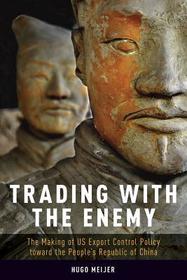
Trading with the Enemy
The Making of US Export Control Policy toward the People's Republic of China
-
10% KEDVEZMÉNY?
- A kedvezmény csak az 'Értesítés a kedvenc témákról' hírlevelünk címzettjeinek rendeléseire érvényes.
- Kiadói listaár GBP 45.49
-
20 538 Ft (19 560 Ft + 5% áfa)
Az ár azért becsült, mert a rendelés pillanatában nem lehet pontosan tudni, hogy a beérkezéskor milyen lesz a forint árfolyama az adott termék eredeti devizájához képest. Ha a forint romlana, kissé többet, ha javulna, kissé kevesebbet kell majd fizetnie.
- Kedvezmény(ek) 10% (cc. 2 054 Ft off)
- Kedvezményes ár 18 484 Ft (17 604 Ft + 5% áfa)
Iratkozzon fel most és részesüljön kedvezőbb árainkból!
Feliratkozom
20 538 Ft

Beszerezhetőség
Megrendelésre a kiadó utánnyomja a könyvet. Rendelhető, de a szokásosnál kicsit lassabban érkezik meg.
Why don't you give exact delivery time?
A beszerzés időigényét az eddigi tapasztalatokra alapozva adjuk meg. Azért becsült, mert a terméket külföldről hozzuk be, így a kiadó kiszolgálásának pillanatnyi gyorsaságától is függ. A megadottnál gyorsabb és lassabb szállítás is elképzelhető, de mindent megteszünk, hogy Ön a lehető leghamarabb jusson hozzá a termékhez.
A termék adatai:
- Kiadó OUP USA
- Megjelenés dátuma 2018. május 10.
- ISBN 9780190889173
- Kötéstípus Puhakötés
- Terjedelem416 oldal
- Méret 229x155x27 mm
- Súly 590 g
- Nyelv angol 0
Kategóriák
Rövid leírás:
In light of the intertwining logics of military competition and economic interdependence at play in US-China relations, Trading with the Enemy examines how the United States has balanced its potentially conflicting national security and economic interests in its relationship with the People's Republic of China (PRC).
TöbbHosszú leírás:
In light of the intertwining logics of military competition and economic interdependence at play in US-China relations, Trading with the Enemy examines how the United States has balanced its potentially conflicting national security and economic interests in its relationship with the People's Republic of China (PRC). To do so, Hugo Meijer investigates a strategically sensitive yet under-explored facet of US-China relations: the making of American export control policy on military-related technology transfers to China since 1979. Trading with the Enemy is the first monograph on this dimension of the US-China relationship in the post-Cold War. Based on 199 interviews, declassified documents, and diplomatic cables leaked by Wikileaks, two major findings emerge from this book. First, the US is no longer able to apply a strategy of military/technology containment of China in the same way it did with the Soviet Union during the Cold War. This is because of the erosion of its capacity to restrict the transfer of military-related technology to the PRC. Secondly, a growing number of actors in Washington have reassessed the nexus between national security and economic interests at stake in the US-China relationship -- by moving beyond the Cold War trade-off between the two -- in order to maintain American military preeminence vis-?-vis its strategic rivals. By focusing on how states manage the heterogeneous and potentially competing security and economic interests at stake in a bilateral relationship, this book seeks to shed light on the evolving character of interstate rivalry in a globalized economy, where rivals in the military realm are also economically interdependent.
A fascinating sub-story of US-China relations. Despite all of the changes in the relationship, one constant over six-plus decades has been Washington's effort to restrict military-related technology transfers to China through its unilateral and multilateral export control regimes. Hugo Meijer's Trading with the Enemy offers a fine-grained historical accounting of this effort, which is of use to scholars and policymakers alike."
Tartalomjegyzék:
Preface by David Lampton
Acknowledgments
List of Abbreviations
Introduction
Part I: The Strategic Triangle and US Defense Technology Transfers to the PRC during the Cold War
Chapter 1: From the Korean War to Normalization: US Export Controls Prior to 1979
Chapter 2: US-China Military Cooperation in the Last Decade of the Cold War
Part II: The Legacy of Tiananmen: Technology Controls in the Post-Cold War Era
Chapter 3: The Rise of China and the Collapse of COCOM
Chapter 4: Key Actors and Coalitions in the 1990s: The Rise of the Run Faster Coalition
Chapter 5: Supercomputers, Telecommunications Equipment, and China's Military Modernization
Chapter 6: Chinagate, the Cox Report, and Communications Satellites
Part III: China's Military Buildup and Strategic Trade Controls in the 21st Century
Chapter 7: China's Military Modernization and Foreign Defense Technology Acquisition
Chapter 8: The People's Liberation Army and Dual-Use Information and Communications Technologies
Chapter 9: Communications Satellites and the China Quagmire
Chapter 10: The China Rule and the China 'Threat'
Conclusion: Beyond Containment: Security and Economics in the US-China Relationship
Bibliography
Index

