

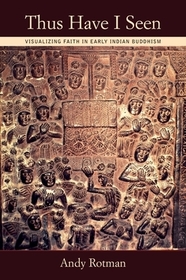
Thus I Have Seen
Visualizing Faith in Early Indian Buddhism
-
10% KEDVEZMÉNY?
- A kedvezmény csak az 'Értesítés a kedvenc témákról' hírlevelünk címzettjeinek rendeléseire érvényes.
- Kiadói listaár GBP 105.00
-
50 163 Ft (47 775 Ft + 5% áfa)
Az ár azért becsült, mert a rendelés pillanatában nem lehet pontosan tudni, hogy a beérkezéskor milyen lesz a forint árfolyama az adott termék eredeti devizájához képest. Ha a forint romlana, kissé többet, ha javulna, kissé kevesebbet kell majd fizetnie.
- Kedvezmény(ek) 10% (cc. 5 016 Ft off)
- Kedvezményes ár 45 147 Ft (42 998 Ft + 5% áfa)
Iratkozzon fel most és részesüljön kedvezőbb árainkból!
Feliratkozom
50 163 Ft

Beszerezhetőség
Megrendelésre a kiadó utánnyomja a könyvet. Rendelhető, de a szokásosnál kicsit lassabban érkezik meg.
Why don't you give exact delivery time?
A beszerzés időigényét az eddigi tapasztalatokra alapozva adjuk meg. Azért becsült, mert a terméket külföldről hozzuk be, így a kiadó kiszolgálásának pillanatnyi gyorsaságától is függ. A megadottnál gyorsabb és lassabb szállítás is elképzelhető, de mindent megteszünk, hogy Ön a lehető leghamarabb jusson hozzá a termékhez.
A termék adatai:
- Kiadó OUP USA
- Megjelenés dátuma 2008. december 25.
- ISBN 9780195366150
- Kötéstípus Keménykötés
- Terjedelem336 oldal
- Méret 236x155x25 mm
- Súly 599 g
- Nyelv angol 0
Kategóriák
Rövid leírás:
This book offers a new approach to understanding Buddhist lay and monastic practice by recognizing the crucial role that visual practices played in Indian Buddhism in the early centuries of the Common Era. In the genre of Indian Buddhist narratives known as avadana, most lay religious practice consists not of reading, praying, or meditating, but of visually engaging with certain kinds of objects. The key for understanding the Buddhist conceptualization about the world and the ways it should be navigated is found, in these stories, in ways of seeing and the results of seeing.
TöbbHosszú leírás:
This book offers a new approach to understanding Buddhist lay and monastic practice by recognizing the crucial role that visual practices played in Indian Buddhism in the early centuries of the Common Era. In the genre of Indian Buddhist narratives known as avadana, most lay religious practice consists not of reading, praying, or meditating, but of visually engaging with certain kinds of objects. The key for understanding the Buddhist conceptualization about the world and the ways it should be navigated is found, in these stories, in ways of seeing and the results of seeing. His analysis is based primarily on stories from the Divyavadana ('Divine Stories') -- one of the largest and most important collections of ancient Buddhist stories written in Sanskrit from the early centuries of the Common Era-that have since spread throughout Asia, leaving an indelible mark on Buddhist thought and practice. Rotman examines the functioning in these stories of the mental states of sraddha and prasada-terms often, though problematically, translated as 'faith.' In particular, he analyzes how these mental states relate to practices of 'seeing' (darsana) and 'giving' (dana), and what this configuration of seeing, believing, and giving can tell us about Buddhist doctrine, the power of images, the logic of pilgrimage, and the market-based morality of early Indian Buddhism.
This book is a significant contribution to the field of Buddhist Studies on at least three counts: it explores the neglected literary genre of Sanskrit legends (the ?vad?nas, in particular the collection known as the Divy?vad?na); in so doing, it emphasizes the importance of the visual dimensions of the experience of the Buddha, in contradistinction to the aural (Thus Have I Seen instead of Thus Have I Heard); and it unpacks various typologies of Buddhist faith and devotion, paying attention to their experiential but also their sociological contexts. I highly recommend this work to anyone interested in the religious dimensions of Indian Buddhism.
Tartalomjegyzék:
Acknowledgments
Introduction
Part I: The Practice of ?raddh?
Seeing and Knowing
Getting and Giving
Part II: The Practice of pras?da
Agency and Intentionality
Participation and Exclusion
Proximity and Presence
Politics and Aesthetics
Part III: Seeing the Buddha
Past and Present
Images and Imagination
Epilogue
Appendix: Contents of the Divy?vad?na
Bibliography

