

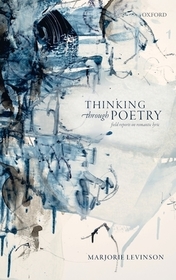
Thinking Through Poetry
Field Reports on Romantic Lyric
-
10% KEDVEZMÉNY?
- A kedvezmény csak az 'Értesítés a kedvenc témákról' hírlevelünk címzettjeinek rendeléseire érvényes.
- Kiadói listaár GBP 96.00
-
45 864 Ft (43 680 Ft + 5% áfa)
Az ár azért becsült, mert a rendelés pillanatában nem lehet pontosan tudni, hogy a beérkezéskor milyen lesz a forint árfolyama az adott termék eredeti devizájához képest. Ha a forint romlana, kissé többet, ha javulna, kissé kevesebbet kell majd fizetnie.
- Kedvezmény(ek) 10% (cc. 4 586 Ft off)
- Kedvezményes ár 41 278 Ft (39 312 Ft + 5% áfa)
Iratkozzon fel most és részesüljön kedvezőbb árainkból!
Feliratkozom
45 864 Ft

Beszerezhetőség
Megrendelésre a kiadó utánnyomja a könyvet. Rendelhető, de a szokásosnál kicsit lassabban érkezik meg.
Why don't you give exact delivery time?
A beszerzés időigényét az eddigi tapasztalatokra alapozva adjuk meg. Azért becsült, mert a terméket külföldről hozzuk be, így a kiadó kiszolgálásának pillanatnyi gyorsaságától is függ. A megadottnál gyorsabb és lassabb szállítás is elképzelhető, de mindent megteszünk, hogy Ön a lehető leghamarabb jusson hozzá a termékhez.
A termék adatai:
- Kiadó OUP Oxford
- Megjelenés dátuma 2018. augusztus 2.
- ISBN 9780198810315
- Kötéstípus Keménykötés
- Terjedelem344 oldal
- Méret 242x163x26 mm
- Súly 687 g
- Nyelv angol
- Illusztrációk 5 Illustrations 0
Kategóriák
Rövid leírás:
Thinking Through Poetry is a work of and about literary criticism. It offers new readings of poems from the canon of British Romanticism and it narrates, enacts, and theorizes the arc of the scholarship on that field from the 1980s through the present.
TöbbHosszú leírás:
Thinking through Poetry: Field Reports on Romantic Lyric pursues two goals. The title signals the contribution to debates about reading. Do we think 'through' - 'by means of', 'with'- poems, sympathetically elaborating their surfaces? Is this compatible with a second meaning: 'thinking through' poems to their end-solving a problem, getting to its root, its deep truth? Third, can we square these surface and depth readings with a speculative, philosophical criticism to which the poem carries us, where 'through' denotes a 'going beyond?' All three meanings of 'through' are in play throughout.
The subtitle applies 'field' first to Romantic studies since the 1980s, a field that this project reflects upon from beginning to end. Examples are drawn especially from Wordsworth, but also from Coleridge and, in assessing Romanticism's afterlife, from Stevens. 'Field' also characterizes the shift from a unitary to a field-concept of form during that time-span, a shift pursued through prolonged engagement with Spinoza. 'Field' thus underscores the synthesis of form and history, the importance of analytic scale to that synthesis, and the displacement of entity (text) by 'relation' as the object of investigation.
While the book historically connects early nineteenth-century intellectual trends to twentieth- and twenty-first-century scientific revolutions, its focuses on introducing new models to literary criticism. Unlike accounts of the influence of science on literature, or various 'literature + X' approaches (literature and ecology, literature and cognitive science), it constructs its object of inquiry in a way cognate with work in non-humanities disciplines, thus highlighting a certain unity to human knowledge. The claim is that specialists in literature should think the way distinguished scientists think, and vice versa.
It is always a wonder to get to read and think with Marjorie Levinson. And Thinking through Poetry is a big idea book. I was inspired by the ways the forms of the individual chapters increasingly experiment with the field theory of forms the book describes. ...Thinking through Poetry derives a new theoretical model for poetry and offers us a chance to think through poetry anew, with more rigorous attention to fields of differences and the ways poetry still matters.
Tartalomjegyzék:
Introduction: Crooked Lines and Moving Targets
Part 1. Theory: Materialism against Itself
The New Historicism: Back to the Future
Romantic Poetry: The State of the Art
Pre- and Post-Dialectical Materialism: Modeling Praxis Without Subjects and Objects
A Motion and a Spirit: Romancing Spinoza
What is New Formalism?
Part 2. Criticism: Field Theories of Form
Of Being Numerous
Notes and Queries on Names and Numbers
Parsing the Frost: The Growth of a Poet's Sentence in “Frost at Midnight”
The Plain Sense of Things
Conclusion: Lyric-The Idea of this Invention

