

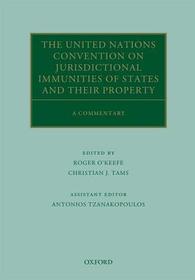
The United Nations Convention on Jurisdictional Immunities of States and Their Property
A Commentary
Sorozatcím: Oxford Commentaries on International Law;
-
10% KEDVEZMÉNY?
- A kedvezmény csak az 'Értesítés a kedvenc témákról' hírlevelünk címzettjeinek rendeléseire érvényes.
- Kiadói listaár GBP 135.00
-
64 496 Ft (61 425 Ft + 5% áfa)
Az ár azért becsült, mert a rendelés pillanatában nem lehet pontosan tudni, hogy a beérkezéskor milyen lesz a forint árfolyama az adott termék eredeti devizájához képest. Ha a forint romlana, kissé többet, ha javulna, kissé kevesebbet kell majd fizetnie.
- Kedvezmény(ek) 10% (cc. 6 450 Ft off)
- Kedvezményes ár 58 047 Ft (55 283 Ft + 5% áfa)
Iratkozzon fel most és részesüljön kedvezőbb árainkból!
Feliratkozom
64 496 Ft

Beszerezhetőség
Megrendelésre a kiadó utánnyomja a könyvet. Rendelhető, de a szokásosnál kicsit lassabban érkezik meg.
Why don't you give exact delivery time?
A beszerzés időigényét az eddigi tapasztalatokra alapozva adjuk meg. Azért becsült, mert a terméket külföldről hozzuk be, így a kiadó kiszolgálásának pillanatnyi gyorsaságától is függ. A megadottnál gyorsabb és lassabb szállítás is elképzelhető, de mindent megteszünk, hogy Ön a lehető leghamarabb jusson hozzá a termékhez.
A termék adatai:
- Kiadó OUP Oxford
- Megjelenés dátuma 2013. március 21.
- ISBN 9780199601837
- Kötéstípus Keménykötés
- Terjedelem508 oldal
- Méret 247x179x32 mm
- Súly 1020 g
- Nyelv angol 0
Kategóriák
Rövid leírás:
Providing article-by-article commentary on this crucial convention and a number of cross-cutting analytical chapters, this book will be highly useful for anyone working in general international law and state responsibility. Each article's commentary draws on its drafting history, state practice, and relevant national and international case law.
TöbbHosszú leírás:
State immunity, the idea that a state, including its individual organs, officials and other emanations, may not be proceeded against in the courts of another state in certain instances, has long been and remains a source of international controversy. Although customary international law no longer recognizes the absolute immunity of states from foreign judicial process, the evolution of the contemporary notion of restrictive state immunity over the past fifty years has been an uncoordinated and contested process, leading to disputes between states. The adoption, in 2004, of the United Nations Convention on Jurisdictional Immunities of States and Their Property has significantly contributed to reaching consensus among states on this fundamental question of international law.
This book provides article-by-article commentary on the text of the Convention, complemented by a small number of cross-cutting chapters highlighting general issues beyond the scope of any single provision, such as the theoretical underpinnings of state immunity, the distinction between immunity from suit and immunity from execution, the process leading to the adoption of the Convention, and the general understanding that the Convention does not extend to criminal matters. It presents a systematic analysis of the Convention, taking into account its drafting history, relevant state practice (including the considerable number of national statutes and judicial decisions on state immunity), and any international judicial or arbitral decisions on point.
The Commentary edited by O'Keefe and Tams represents a useful tool in offering a quick response to the queries that an interpretation of the provisions might raise. The propos that The Commentary aims to clarify and not complicate the issues is maintained and the book constitutes a valuable contribution for scholars and practitioners.
Tartalomjegyzék:
General introduction
Historical Introduction
Preamble
Article 1
Article 2(1)(a) and (b)
Article 2(1)(c), (2) and (3)
Article 3
Article 4
Article 5
Article 6
Article 7
Article 8
Article 9
Introduction to Part III
Article 10
Article 11
Article 12
Article 13
Article 14
Article 15
Article 16
Article 17
Article 18
Article 19
Article 20
Article 21
Article 22
Article 23
Article 24
Article 25
Article 26
Article 27
Article 28
Article 29
Article 30
Article 31
Article 32
Article 33

