

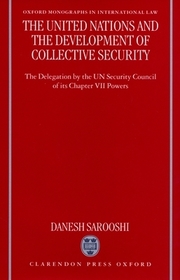
The United Nations and the Development of Collective Security
The Delegation by the UN Security Council of its Chapter VII Powers
Sorozatcím: Oxford Monographs in International Law;
-
10% KEDVEZMÉNY?
- A kedvezmény csak az 'Értesítés a kedvenc témákról' hírlevelünk címzettjeinek rendeléseire érvényes.
- Kiadói listaár GBP 82.00
-
37 023 Ft (35 260 Ft + 5% áfa)
Az ár azért becsült, mert a rendelés pillanatában nem lehet pontosan tudni, hogy a beérkezéskor milyen lesz a forint árfolyama az adott termék eredeti devizájához képest. Ha a forint romlana, kissé többet, ha javulna, kissé kevesebbet kell majd fizetnie.
- Kedvezmény(ek) 10% (kb. 3 702 Ft)
- Kedvezményes ár 33 321 Ft (31 734 Ft + 5% áfa)
Iratkozzon fel most és részesüljön kedvezőbb árainkból!
Feliratkozom
37 023 Ft

Beszerezhetőség
Megrendelésre a kiadó utánnyomja a könyvet. Rendelhető, de a szokásosnál kicsit lassabban érkezik meg.
Why don't you give exact delivery time?
A beszerzés időigényét az eddigi tapasztalatokra alapozva adjuk meg. Azért becsült, mert a terméket külföldről hozzuk be, így a kiadó kiszolgálásának pillanatnyi gyorsaságától is függ. A megadottnál gyorsabb és lassabb szállítás is elképzelhető, de mindent megteszünk, hogy Ön a lehető leghamarabb jusson hozzá a termékhez.
A termék adatai:
- Kiadó OUP Oxford
- Megjelenés dátuma 2000. augusztus 3.
- ISBN 9780198299349
- Kötéstípus Puhakötés
- Terjedelem334 oldal
- Méret 234x157x19 mm
- Súly 483 g
- Nyelv angol 0
Kategóriák
Rövid leírás:
This book provides a legal analysis of the institutional mechanisms and processes which the UN employs to use force to maintain or restore peace.
TöbbHosszú leírás:
This book examines one of the most important challenges facing the United Nations today: the effective and lawful use of force by or under the authority of the UN to maintain or restore peace. In particular, the book provides a legal analysis of the institutional mechanisms and processes which the UN employs to use force to maintain or restore peace.
The UN Security Council is the main organ of the UN entrusted with the responsibility for the maintenance or restoration of peace. It is given broad powers of enforcement under Chapter VII of the UN Charter in order to achieve this objective. However, the Charter provision which was intended to provide the Council with a standing military force to carry out enforcement action has not as yet been implemented. In response, the Council has sought to deal with an increasing demand for military enforcement action by delegating its powers in this area to other UN organs (e.g. the UN Secretary-General in Somalia, and the War Crimes Tribunals for Rwanda and the former Yugoslavia), UN Member States (e.g. the coalition against Iraq), and regional and collective self-defence organizations (e.g. NATO in Bosnia). It is this process of delegation of military enforcement powers by the Council which is the focus of the book. By examining the legal framework which governs the process of a delegation by the Council of its Chapter VII powers; the practice relating to the exercise of these powers by each of the delegates concerned; and the policy issues relating to such delegations, the book makes a significant contribution to the content of the law pertaining to the use of force by the UN and provides guidance as to the likely future developments in the legal framework governing collective action to maintain peace under the auspices of the United Nations.
The strength of the study lies in the thoroughness of analysis demonstrated throughout the work.....an impressively constructed piece of scholarly research.....a practitioner's guide for both academics and diplomats on the subject of Chapter VII delegationsof power. With sweeping efficiency, Sarooshi makes sense out of a previously nebulous corpus of Security Council practice, in the process creating a comprehensive benchmark for the comparison of all future Chapter VII delegations.
Tartalomjegyzék:
Introduction
The General Legal Framework Governing the Process of a Delegation by the UN Security Council of its Chapter VII Powers
I. The Nature of the Process of a Delegation of Chapter VII Powers
II. The General Competence of the Security Council to Delegate its Chapter VII Powers
III. Limitations on the General Competence of the Security Council to Delegate its Chapter VII Powers
IV. The ICJ and the Justiciability of a Delegation of Chapter VII Powers
The Delegation of Powers to the UN Secretary-General
I. The Competence of the Council to Delegate Chapter VII Powers to the Secretary-General
II. The Legal Framework Governing the Exercise of Delegated Chapter VII Powers by the Secretary-General
III. The Practice of the Secretary-General in Exercising Delegated Chapter VII Powers
The Delegation of Powers to UN Subsidiary Organs
I. UN Subsidiary Organs: Issues of Definition
II. The Authority of UN Principal Organs to Establish Subsidiary Organs: the Competence of the Council to Delegate Chapter VII Powers to Subsidiary Organs
III. Preconditions for the Lawful Establishment of UN Subsidiary Organs
The Legal Framework Governing the Delegation of Powers to UN Member States
I. The Competence of the Council to Delegate Chapter VII Powers to UN member States
II. Limitations on the Competence of the Council to Delegate Chapter VII Powers to Member States
III. Responsibility for the Acts of A Force Carrying Out UN Authorised Military Enforcement Action
The Delegation of Powers to UN Member States
I. A Delegation of Powers to Counter a Use of Force by a State or Entities Within a State
II. A Delegation of Powers to Carry Out a Naval Interdiction
III. A Delegation of Powers to Achieve Humanitarian Objectives
IV. A Delegation of Powers to Enforce a Council Declared No-Fly Zone: The Case of Iraq
V. A Delegation of Powers to Ensure Implementation by Parties of an Agreement which The Council Has Deemed is Necessary for the Maintainance or Restoration of Peace
The Delegation of Powers to Regional Arrangements
I. The Competence of the Council to Delegate Chapter VII Powers to Regional Arrangements
II. The Delegation of Powers to NATO
III. The Policy of Delegating Chapter VII Powers to Regional Arrangements
Concluding Remarks
Bibliography
Index

