

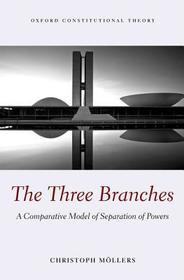
The Three Branches
A Comparative Model of Separation of Powers
Sorozatcím: Oxford Constitutional Theory;
-
10% KEDVEZMÉNY?
- A kedvezmény csak az 'Értesítés a kedvenc témákról' hírlevelünk címzettjeinek rendeléseire érvényes.
- Kiadói listaár GBP 125.00
-
59 718 Ft (56 875 Ft + 5% áfa)
Az ár azért becsült, mert a rendelés pillanatában nem lehet pontosan tudni, hogy a beérkezéskor milyen lesz a forint árfolyama az adott termék eredeti devizájához képest. Ha a forint romlana, kissé többet, ha javulna, kissé kevesebbet kell majd fizetnie.
- Kedvezmény(ek) 10% (cc. 5 972 Ft off)
- Kedvezményes ár 53 747 Ft (51 188 Ft + 5% áfa)
Iratkozzon fel most és részesüljön kedvezőbb árainkból!
Feliratkozom
59 718 Ft

Beszerezhetőség
Megrendelésre a kiadó utánnyomja a könyvet. Rendelhető, de a szokásosnál kicsit lassabban érkezik meg.
Why don't you give exact delivery time?
A beszerzés időigényét az eddigi tapasztalatokra alapozva adjuk meg. Azért becsült, mert a terméket külföldről hozzuk be, így a kiadó kiszolgálásának pillanatnyi gyorsaságától is függ. A megadottnál gyorsabb és lassabb szállítás is elképzelhető, de mindent megteszünk, hogy Ön a lehető leghamarabb jusson hozzá a termékhez.
A termék adatai:
- Kiadó OUP Oxford
- Megjelenés dátuma 2013. március 14.
- ISBN 9780199602117
- Kötéstípus Keménykötés
- Terjedelem276 oldal
- Méret 240x162x24 mm
- Súly 572 g
- Nyelv angol 0
Kategóriák
Rövid leírás:
The idea of the separation of powers is still popular in much political and constitutional discourse, though its meaning for the modern state remains unclear and contested. This book develops an original account of the principle and its implications for modern national and transnational public bodies.
TöbbHosszú leírás:
The idea of the separation of powers is still popular in much political and constitutional discourse, though its meaning for the modern state remains unclear and contested. This book develops a new, comprehensive, and systematic account of the principle. It then applies this new concept to legal problems of different national constitutional orders, the law of the European Union, and international institutional law. It connects an argument from normative political theory with phenomena taken from comparative constitutional law. The book argues that the conflict between individual liberty and democratic self-determination that is characteristic of modern constitutionalism is proceduralized through the establishment of different governmental branches.
A close analysis of the relation between individual and collective autonomy on the one hand and the ways lawmaking through public institutions can be established on the other hand helps us identify criteria for determining how legislative, administrative, and judicial lawmaking can be distinguished and should be organized. These criteria define a common ground in the confusing variety of western constitutional traditions and their diverse use of the notion of separated powers. They also enable us to establish a normative framework that throws a fresh perspective on problems of constitutional law in different constitutional systems: constitutional judicial review of legislation, limits of legislative delegation, parliamentary control of the executive, and standing. Linking arguments from comparative constitutional law and international law, the book then uses this framework to offer a new perspective on the debate on constitutionalism beyond the state. The concept permits certain institutional insights of the constitutional experiences within states to be applied at the international level without falling into any form of methodological nationalism.
Tartalomjegyzék:
Introduction: Constitutional Theory and Political Philosophy
Division of Powers: Traditions and Meanings
The traditional division of powers: a comparative sketch on France, England, the United States, and Germany
The separation of powers - functions and meanings of a concept
Conclusions
Self-Determination as the Source of Separated Powers
Self-determination as the basic concept of legitimacy
Self-determination through law
The three powers: a model from legitimacy
Conclusions
Problems of Separated Powers in the Constitutional State
Parliament and Government
Constitutional Review
Limits of judicial control of the administration
Conclusions
Separation of Powers Beyond the State
Introduction: The internationalization of law, an analysis from legitimacy
The internationalized constitutional state
European integration
International law
Hybrid organizations
Outlook: Governance - Constitutionalization - A Fourth Branch?

