

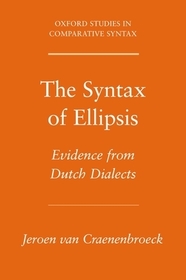
The Syntax of Ellipsis
Evidence from Dutch Dialects
Sorozatcím: Oxford Studies in Comparative Syntax;
-
10% KEDVEZMÉNY?
- A kedvezmény csak az 'Értesítés a kedvenc témákról' hírlevelünk címzettjeinek rendeléseire érvényes.
- Kiadói listaár GBP 44.99
-
20 312 Ft (19 345 Ft + 5% áfa)
Az ár azért becsült, mert a rendelés pillanatában nem lehet pontosan tudni, hogy a beérkezéskor milyen lesz a forint árfolyama az adott termék eredeti devizájához képest. Ha a forint romlana, kissé többet, ha javulna, kissé kevesebbet kell majd fizetnie.
- Kedvezmény(ek) 10% (kb. 2 031 Ft)
- Kedvezményes ár 18 281 Ft (17 411 Ft + 5% áfa)
Iratkozzon fel most és részesüljön kedvezőbb árainkból!
Feliratkozom
20 312 Ft

Beszerezhetőség
Megrendelésre a kiadó utánnyomja a könyvet. Rendelhető, de a szokásosnál kicsit lassabban érkezik meg.
Why don't you give exact delivery time?
A beszerzés időigényét az eddigi tapasztalatokra alapozva adjuk meg. Azért becsült, mert a terméket külföldről hozzuk be, így a kiadó kiszolgálásának pillanatnyi gyorsaságától is függ. A megadottnál gyorsabb és lassabb szállítás is elképzelhető, de mindent megteszünk, hogy Ön a lehető leghamarabb jusson hozzá a termékhez.
A termék adatai:
- Kiadó OUP USA
- Megjelenés dátuma 2010. március 4.
- ISBN 9780195375657
- Kötéstípus Puhakötés
- Terjedelem328 oldal
- Méret 152x231x22 mm
- Súly 454 g
- Nyelv angol
- Illusztrációk 44 black and white line illustrations 0
Kategóriák
Hosszú leírás:
The Syntax of Ellipsis investigates a number of elliptical constructions found in Dutch dialects within the framework of the Minimalist Program. Using two case studies, Van Craenenbroeck argues that both the PF-deletion and the pro-theory of ellipsis are needed to account for the full range of elliptical phenomena attested in natural language.
The first case study focuses on instances of stranding to the right of a sluiced wh-phrase: prepositions in English (What about?) and demonstrative pronouns in southern Dutch dialects (Wie dat? 'who that'). Van Craenenbroeck gives both of these phenomena a PF-deletion analysis, which turns out to have considerable repercussions for the structure of the left periphery and the syntax of wh-movement. Specifically, while minimal wh-phrases move from their IP-internal base position to specCP, complex ones are base-generated in the (split) left periphery.
The second case study is concerned with Short Do Replies in southern Dutch dialects, a type of contradictory reply that at first sight bears a close resemblance to English VP-ellipsis. Van Craenenbroeck shows that in this case the ellipsis site is best represented as a null, structureless proform that is licensed by the head of a high PolP. Moreover, this pronominal is argued to occur in two other dialectal constructions as well: contradictory replies of the type Da's nie 'that is not' found in Brabant Dutch, and the occurrence of subject clitics and agreement endings on the words for yes and no in Southern Dutch dialects (e.g. Ja-n-s 'yes-PLURAL-they').
The Syntax of Ellipsis will be of interest to scholars of the left periphery, wh-movement, and Dutch dialects.
Tartalomjegyzék:
Introduction
Part 1
First Case Study: Stranding under Sluicing as PF-Deletion
Introduction: Stranding under Sluicing
The Data
Theoretical Background: Splitting up CP
The Analysis
When Swiping Met Spading: The Case of Frisian
Previous Analyses
Expanding the Data Set
Conclusion and Theoretical Implications
Part 2
Second Case Study: Short Do Replies as TP-Proforms
Short Do Replies: Introduction
The Data
Theoretical Background
The Analysis
Spelling out the Proform: Da's Nie and Da's Wel
Conjugated 'Yes' and 'No' in SDR-Dialects
Conclusion and Theoretical Implications
General Conclusions
Notes
References

