

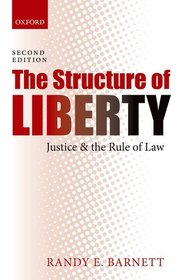
The Structure of Liberty
Justice and the Rule of Law
-
10% KEDVEZMÉNY?
- A kedvezmény csak az 'Értesítés a kedvenc témákról' hírlevelünk címzettjeinek rendeléseire érvényes.
- Kiadói listaár GBP 21.99
-
10 505 Ft (10 005 Ft + 5% áfa)
Az ár azért becsült, mert a rendelés pillanatában nem lehet pontosan tudni, hogy a beérkezéskor milyen lesz a forint árfolyama az adott termék eredeti devizájához képest. Ha a forint romlana, kissé többet, ha javulna, kissé kevesebbet kell majd fizetnie.
- Kedvezmény(ek) 10% (cc. 1 051 Ft off)
- Kedvezményes ár 9 455 Ft (9 005 Ft + 5% áfa)
Iratkozzon fel most és részesüljön kedvezőbb árainkból!
Feliratkozom
10 505 Ft

Beszerezhetőség
Megrendelésre a kiadó utánnyomja a könyvet. Rendelhető, de a szokásosnál kicsit lassabban érkezik meg.
Why don't you give exact delivery time?
A beszerzés időigényét az eddigi tapasztalatokra alapozva adjuk meg. Azért becsült, mert a terméket külföldről hozzuk be, így a kiadó kiszolgálásának pillanatnyi gyorsaságától is függ. A megadottnál gyorsabb és lassabb szállítás is elképzelhető, de mindent megteszünk, hogy Ön a lehető leghamarabb jusson hozzá a termékhez.
A termék adatai:
- Kiadás sorszáma 2
- Kiadó OUP Oxford
- Megjelenés dátuma 2014. február 6.
- ISBN 9780198700920
- Kötéstípus Puhakötés
- Terjedelem400 oldal
- Méret 234x153x21 mm
- Súly 586 g
- Nyelv angol 0
Kategóriák
Rövid leírás:
This provocative book outlines a powerful and original theory of liberty structured by the liberal conception of justice and the rule of law. Drawing on insights from philosophy, political theory, economics, and law, he shows how this new conception of liberty can confront, and solve, the central societal problems of knowledge, interest, and power.
TöbbHosszú leírás:
In this book, legal scholar Randy Barnett elaborates and defends the fundamental premise of the Declaration of Independence: that all persons have a natural right to pursue happiness so long as they respect the equal rights of others, and that governments are only justly established to secure these rights.
Drawing upon insights from philosophy, economics, political theory, and law, Barnett explains why, when people pursue happiness while living in society with each other, they confront the pervasive social problems of knowledge, interest and power. These problems are best dealt with by ensuring the liberty of the people to pursue their own ends, but this liberty is distinguished from "license" by certain fundamental rights and procedures associated with the classical liberal conception of "justice" and "the rule of law." He then outlines the constitutional framework that is needed to put these principles into practice.
In a new Afterword to this second edition, Barnett elaborates on this thesis by responding to several important criticisms of the original work. He then explains how this "libertarian" approach is more modest than either the "social justice" theories of the left or the "legal moralism" of the right.
Review from previous edition The Structure of Liberty is that rare creature, a book that delivers on most of the promises it makes. Already the book is on its way to becoming a contemporary classic, the successor in interest to Robert Nozick's Anarchy, State and Utopia as a source of ideas and arguments for the revitalization of an important intellectual tradition that has long stood at the periphery of legal and political theory.
Tartalomjegyzék:
Introduction: Liberty vs. License
Part I: The Problems of Knowledge
Using Resources: The First-Order Problem of Knowledge
Two Methods of Social Ordering
The Liberal Conception of Justice
Communicating Justice: The Second-Order Problem of Knowledge
Specifying Conventions: The Third-Order Problem of Knowledge
Part II: The Problems of Interest
The Partiality Problem
The Incentive Problem
The Compliance Problem
Part III: The Problems of Power
The Problem of Enforcement Error
Fighting Crime Without Punishment
The Problem of Enforcement Abuse
Constitutional Constraints on Power
Imagining a Polycentric Constitutional Order: A Short Fable
Part IV: Responses to Objections
Beyond Justice and the Rule of Law?
Afterword

