

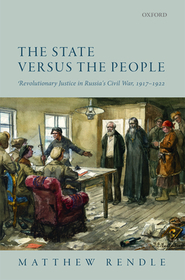
The State versus the People
Revolutionary Justice in Russia's Civil War, 1917-1922
-
10% KEDVEZMÉNY?
- A kedvezmény csak az 'Értesítés a kedvenc témákról' hírlevelünk címzettjeinek rendeléseire érvényes.
- Kiadói listaár GBP 99.00
-
44 698 Ft (42 570 Ft + 5% áfa)
Az ár azért becsült, mert a rendelés pillanatában nem lehet pontosan tudni, hogy a beérkezéskor milyen lesz a forint árfolyama az adott termék eredeti devizájához képest. Ha a forint romlana, kissé többet, ha javulna, kissé kevesebbet kell majd fizetnie.
- Kedvezmény(ek) 10% (kb. 4 469 Ft)
- Kedvezményes ár 40 229 Ft (38 313 Ft + 5% áfa)
Iratkozzon fel most és részesüljön kedvezőbb árainkból!
Feliratkozom
44 698 Ft

Beszerezhetőség
Becsült beszerzési idő: A Prosperónál jelenleg nincsen raktáron, de a kiadónál igen. Beszerzés kb. 3-5 hét..
A Prosperónál jelenleg nincsen raktáron.
Why don't you give exact delivery time?
A beszerzés időigényét az eddigi tapasztalatokra alapozva adjuk meg. Azért becsült, mert a terméket külföldről hozzuk be, így a kiadó kiszolgálásának pillanatnyi gyorsaságától is függ. A megadottnál gyorsabb és lassabb szállítás is elképzelhető, de mindent megteszünk, hogy Ön a lehető leghamarabb jusson hozzá a termékhez.
A termék adatai:
- Kiadó OUP Oxford
- Megjelenés dátuma 2020. augusztus 11.
- ISBN 9780198840428
- Kötéstípus Keménykötés
- Terjedelem334 oldal
- Méret 238x163x25 mm
- Súly 672 g
- Nyelv angol 11
Kategóriák
Rövid leírás:
The State versus the People provides the first detailed account of the important role played by law and revolutionary tribunals in securing the Bolsheviks' hold on power after the October Revolution. The study offers a novel perspective on justice and the politics of civil war during the Russian Revolution.
TöbbHosszú leírás:
The State versus The People provides the first detailed account of the role of revolutionary justice in the early Soviet state. Law has often been dismissed by historians as either unimportant after the October Revolution amid the violence and chaos of civil war, or, in the absence of written codes and independent judges, little more than another means of violence alongside the secret police (Cheka). This is particularly true of the most revolutionary aspect of the new justice system, revolutionary tribunals--courts inspired by the French Revolution and established to target counter-revolutionary enemies.
Yet the evidence put forward in this book paints a more complex picture. The Bolsheviks invested a great deal of effort and scarce resources in building an extensive system of tribunals that spread across the country and operated within the military and the transport network. At their peak, hundreds of tribunals heard hundreds of thousands of cases every year. Not all, though, ended in harsh sentences: some were dismissed through lack of evidence; others given a wide range of sentences; and others still, suspended sentences. Instances of early release and amnesty were also common.
This book argues that law played a distinct and multi-faceted role for the Bolsheviks. Tribunals, in particular, stood at the intersection between law and violence, offering various advantages to the Bolsheviks by strengthening state control, providing a more effective means of educating the population about counter-revolution, and enabling a more flexible approach to punishing the state's enemies. All of this challenges traditional understandings of the early Soviet state, adding to our knowledge of the civil war and, ultimately, how the Bolsheviks held on to power.
This clearly written work by Rendle is based on thorough archival research.
Tartalomjegyzék:
Introduction
Creating Revolutionary Justice
Extending State Authority
Categorizing Counter-Revolution
The Trial
The Logic of Mercy
Publicizing Revolutionary Justice
Conclusion

