

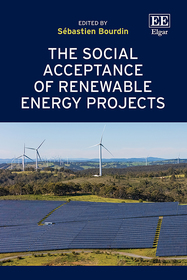
The Social Acceptance of Renewable Energy Projects
-
10% KEDVEZMÉNY?
- A kedvezmény csak az 'Értesítés a kedvenc témákról' hírlevelünk címzettjeinek rendeléseire érvényes.
- Kiadói listaár GBP 130.00
-
58 695 Ft (55 900 Ft + 5% áfa)
Az ár azért becsült, mert a rendelés pillanatában nem lehet pontosan tudni, hogy a beérkezéskor milyen lesz a forint árfolyama az adott termék eredeti devizájához képest. Ha a forint romlana, kissé többet, ha javulna, kissé kevesebbet kell majd fizetnie.
- Kedvezmény(ek) 10% (kb. 5 870 Ft)
- Kedvezményes ár 52 826 Ft (50 310 Ft + 5% áfa)
Iratkozzon fel most és részesüljön kedvezőbb árainkból!
Feliratkozom
58 695 Ft

Beszerezhetőség
Becsült beszerzési idő: A Prosperónál jelenleg nincsen raktáron, de a kiadónál igen. Beszerzés kb. 3-5 hét..
A Prosperónál jelenleg nincsen raktáron.
Why don't you give exact delivery time?
A beszerzés időigényét az eddigi tapasztalatokra alapozva adjuk meg. Azért becsült, mert a terméket külföldről hozzuk be, így a kiadó kiszolgálásának pillanatnyi gyorsaságától is függ. A megadottnál gyorsabb és lassabb szállítás is elképzelhető, de mindent megteszünk, hogy Ön a lehető leghamarabb jusson hozzá a termékhez.
A termék adatai:
- Kiadó Edward Elgar Publishing
- Megjelenés dátuma 2026. január 23.
- ISBN 9781035348749
- Kötéstípus Keménykötés
- Terjedelem364 oldal
- Méret 234x156 mm
- Súly 690 g
- Nyelv angol 739
Kategóriák
Rövid leírás:
This timely book analyses why various communities support or oppose low-carbon projects in light of the global shift towards renewable energy. It presents a wide range of cases and disciplinary perspectives to explore how trust, fairness and meaningful participation shape public responses to wind, solar, hydro and bioenergy.
TöbbHosszú leírás:
This timely book analyses why various communities support or oppose low-carbon projects in light of the global shift towards renewable energy. It presents a wide range of cases and disciplinary perspectives to explore how trust, fairness and meaningful participation shape public responses to wind, solar, hydro and bioenergy.
Leading scholars examine how community approval depends not only on technical design or environmental performance, but on how projects align with local values and regional identities. They explore the key levers of social acceptance, including participation, governance and justice alongside controversies, resistance and territorial anchoring. By drawing on empirical case studies across diverse technologies and locations, this book demonstrates how successful sustainable energy transitions require more than just consent: they require a form of shared involvement that gives communities a real role in shaping outcomes.
This book is beneficial to scholars and students in the fields of environmental and energy studies, as well as human geography, sociology and political science. It is also an essential resource for policymakers, researchers and energy professionals looking to understand the social dimensions of renewable energy.
‘Far more than a book devoted to renewable energy, this volume is exceptionally stimulating because it encourages us to reflect upon several issues facing our society. This book helps us to understand the mechanisms that lead to the success or failure of many projects, mechanisms to which too little attention is often paid and which should frequently be considered upstream of the implementation process.’
Tartalomjegyzék:
Contents
List of contributors vii
Introduction to The Social Acceptance of Renewable Energy Projects xii
Sébastien Bourdin
PART I UNDERSTANDING THE FOUNDATIONS OF SOCIAL
ACCEPTANCE: VALUES, NORMS, AND IMAGINARIES
1 Public perception dynamics in renewable energy: theoretical
framework and comparative insight 2
John A. Paravantis, Niκoletta Kontoulis, and Giouli Mihalakakou
2 Social acceptance of renewable energy technologies: a
multidisciplinary approach. The role of contextual and
psychological factors in promoting justice and equity 29
Marco Modica and Andrea Rampa
3 The social acceptance of wind energy projects 50
Alessandra Motz
4 Mapping diverse stakeholder imaginaries: using Participatory
GIS to capture the critical-spatial dimensions of social
acceptance 77
Adam Peacock and Patrick Devine-Wright
PART II THE LEVERS OF SOCIAL ACCEPTANCE:
PARTICIPATION, GOVERNANCE, AND JUSTICE
5 Arnstein’s ladder of citizen participation revisited: 50 years on,
what have we learned? 104
Katinka Johansen and Paul Upham
6 Objects of Value framework for identifying conditioning factors
for community acceptance in renewable energy development 122
Cristián Escobar-Avaria, Katherinne Silva-Urrutia, and Rodrigo Fuster
7 From the power plant to the consumers: the rise of energy
communities 141
Louis Lasnon
8 Emerging social norms and etiquette around the use of public
EV chargers 163
Lora Denkovic-Kraljev and Christopher R. Jones
9 Establishing acceptability: wind energy and community in the
energy transition 180
Breffní Lennon
PART III CONTROVERSIES, RESISTANCE, AND
TERRITORIAL ANCHORING
10 Anticipating the dynamics of domestic hydrogen acceptance:
empirical evidence from the UK 196
Joel A. Gordon and Nazmiye Balta-Ozkan
11 Territorial value sharing of renewable energies: critical
analysis of the French mechanism introduced by the 2023
Law on Accelerating the Production of Renewable Energies 230
Louis de Fontenelle
12 Social acceptability of geothermal drilling: an empirical
investigation 250
John A. Paravantis, Niκoletta Kontoulis, and Vasileios Papakostas
13 Contentious narratives and innovative action in the heat
transition: insights from municipalities in Brandenburg 276
Germán Bersalli, Yves Perillard, and Franziska Mey
14 The ontological politics of public acceptance surveys:
performing NIMBY and the local opposition despite public
acceptance paradox 298
Jacob A. E. Nielsen
15 Measuring the social acceptability of renewable energy
projects: an overview 313
Alice Friser, Corinne Gendron, and Stéphanie Yates
Index 330

