

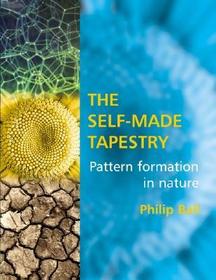
The Self-Made Tapestry
Pattern Formation in Nature
-
10% KEDVEZMÉNY?
- A kedvezmény csak az 'Értesítés a kedvenc témákról' hírlevelünk címzettjeinek rendeléseire érvényes.
- Kiadói listaár GBP 78.00
-
37 264 Ft (35 490 Ft + 5% áfa)
Az ár azért becsült, mert a rendelés pillanatában nem lehet pontosan tudni, hogy a beérkezéskor milyen lesz a forint árfolyama az adott termék eredeti devizájához képest. Ha a forint romlana, kissé többet, ha javulna, kissé kevesebbet kell majd fizetnie.
- Kedvezmény(ek) 10% (cc. 3 726 Ft off)
- Kedvezményes ár 33 538 Ft (31 941 Ft + 5% áfa)
Iratkozzon fel most és részesüljön kedvezőbb árainkból!
Feliratkozom
37 264 Ft

Beszerezhetőség
Megrendelésre a kiadó utánnyomja a könyvet. Rendelhető, de a szokásosnál kicsit lassabban érkezik meg.
Why don't you give exact delivery time?
A beszerzés időigényét az eddigi tapasztalatokra alapozva adjuk meg. Azért becsült, mert a terméket külföldről hozzuk be, így a kiadó kiszolgálásának pillanatnyi gyorsaságától is függ. A megadottnál gyorsabb és lassabb szállítás is elképzelhető, de mindent megteszünk, hogy Ön a lehető leghamarabb jusson hozzá a termékhez.
A termék adatai:
- Kiadó OUP Oxford
- Megjelenés dátuma 2001. július 5.
- ISBN 9780198502432
- Kötéstípus Puhakötés
- Terjedelem296 oldal
- Méret 247x189x18 mm
- Súly 634 g
- Nyelv angol
- Illusztrációk 24 plates, numerous halftones and line figures 0
Kategóriák
Rövid leírás:
This book explains how nature's patterns -- the markings on animals, windblown ripples of sand, the forms of water in motion -- are woven by self-organization, through simple, local interactions between their component parts. The products of self-organization are universal patterns: spirals, spots, and stripes, branches, honeycombs. This beautifully illustrated book will appeal to anyone who has ever wondered about the patterns and symmetries that appear all around us in nature, in science, even in our own bodies.
TöbbHosszú leírás:
Why do similar patterns and forms appear in nature in settings that seem to bear no relation to one another? The windblown ripples of desert sand follow a sinuous course that resembles the stripes of a zebra or a marine fish. In the trellis-like shells of microscopic sea creatures we see the same angles and intersections as for bubble walls in a foam. The forks of lightning mirror the branches of a river or a tree. This book explains why these are no coincidences. Nature commonly weaves its tapestry by self-organization, employing no master plan or blueprint but by simple, local interactions between its component parts - be they grains of sand, diffusing molecules or living cells. And the products of self- organization are typically universal patterns: spirals, spots, and stripes, branches, honeycombs. This book explains, in non-technical language, and with profuse illustrations, how nature's patterns are made.
Philip Ball has produced a superb book... countless examples give rise to fascinating reflections on the astounding order that exists amid chaos. Lavishly illustrated, this is a stunning book. John Cornwell, The Sunday Times, 29/11/98
Tartalomjegyzék:
Foreword
Preface
Patterns
Bubbles
Waves
Bodies
Branches
Breakdowns
Fluids
Grains
Communities
Principles
Appendices
Bibliography

