

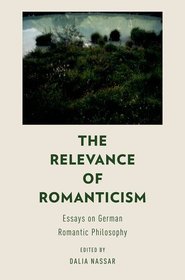
The Relevance of Romanticism
Essays on German Romantic Philosophy
-
10% KEDVEZMÉNY?
- A kedvezmény csak az 'Értesítés a kedvenc témákról' hírlevelünk címzettjeinek rendeléseire érvényes.
- Kiadói listaár GBP 145.00
-
65 467 Ft (62 350 Ft + 5% áfa)
Az ár azért becsült, mert a rendelés pillanatában nem lehet pontosan tudni, hogy a beérkezéskor milyen lesz a forint árfolyama az adott termék eredeti devizájához képest. Ha a forint romlana, kissé többet, ha javulna, kissé kevesebbet kell majd fizetnie.
- Kedvezmény(ek) 10% (cc. 6 547 Ft off)
- Kedvezményes ár 58 921 Ft (56 115 Ft + 5% áfa)
Iratkozzon fel most és részesüljön kedvezőbb árainkból!
Feliratkozom
65 467 Ft

Beszerezhetőség
Megrendelésre a kiadó utánnyomja a könyvet. Rendelhető, de a szokásosnál kicsit lassabban érkezik meg.
Why don't you give exact delivery time?
A beszerzés időigényét az eddigi tapasztalatokra alapozva adjuk meg. Azért becsült, mert a terméket külföldről hozzuk be, így a kiadó kiszolgálásának pillanatnyi gyorsaságától is függ. A megadottnál gyorsabb és lassabb szállítás is elképzelhető, de mindent megteszünk, hogy Ön a lehető leghamarabb jusson hozzá a termékhez.
A termék adatai:
- Kiadó OUP USA
- Megjelenés dátuma 2014. május 15.
- ISBN 9780199976201
- Kötéstípus Keménykötés
- Terjedelem362 oldal
- Méret 155x236x22 mm
- Súly 706 g
- Nyelv angol 0
Kategóriák
Rövid leírás:
The Relevance of Romanticism considers the reasons why philosophers have recently become deeply interested in romantic thought. Through historical and systematic reconstructions, the collection offers greater understanding of romanticism as a philosophical movement and deeper insight into the role that romantic thought plays in contemporary philosophical debates.
TöbbHosszú leírás:
Since the early 1990s, there has been a resurgence of interest in philosophy between Kant and Hegel, and in early German romanticism in particular. Philosophers have come to recognize that, in spite of significant differences between the contemporary and romantic contexts, romanticism continues to persist, and the questions which the romantics raised remain relevant today. The Relevance of Romanticism: Essays on Early German Romantic Philosophy is the first collection of essays that offers an in-depth analysis of the reasons why philosophers are (and should be) concerned with romanticism. Through historical and systematic reconstructions, the collection offers a deeper understanding and more encompassing picture of romanticism as a philosophical movement than has been presented thus far, and explicates the role that romanticism plays -- or can play -- in contemporary philosophical debates.
The volume includes essays by a number of preeminent international scholars and philosophers -- Karl Ameriks, Frederick Beiser, Richard Eldridge, Michael Forster, Manfred Frank, Jane Kneller, and Paul Redding -- who discuss the nature of philosophical romanticism and its potential to address contemporary questions and concerns. Through contributions from established and emerging philosophers, discussing key romantic themes and concerns, the volume highlights the diversity both within romantic thought and its contemporary reception. Part One consists of the first published encounter between Manfred Frank and Frederick Beiser, in which the two major scholars directly discuss their vastly differing interpretations of philosophical romanticism. Part Two draws significant connections between romantic conceptions of history, sociability, hermeneutics and education and explores the ways in which these views can illuminate pressing questions in contemporary social-political philosophy and theories of interpretation. Part Three consists in some of the most innovative takes on romantic aesthetics, which seek to bring romantic thought into dialogue, with, for instance, contemporary Analytic aesthetics and theories of cognition/mind. The final part offers one of the few rigorous engagements with romantic conceptions science, and demonstrates ways in which the romantic views of nature, scientific experimentation and mathematics need not be relegated to historical curiosities.
Tartalomjegyzék:
Acknowledgements
Abbreviations
Introduction
Part 1. German Romanticism as a Philosophical Movement
Chapter 1. Manfred Frank, What is Early German Romantic Philosophy?
Chapter 2. Frederick Beiser, Romanticism and Idealism
Part 2. History, Hermeneutics and Sociability
Chapter 3. Karl Ameriks, History and German Romanticism
Chapter 4. Michael N. Forster, Romanticism and Language
Chapter 5. Kristin Gjesdal, Hermeneutics, Individuality, and Tradition: Schleiermacher's Idea of Bildung in the Landscape of Hegelian Thought
Chapter 6. Jane Kneller, Sociability and the Conduct of Philosophy: What philosophers can learn from early German Romanticism
Part 3. Literature, Art and Mythology
Chapter 7. Richard Eldridge,"Doch sehnend stehst /Am Ufer du"("But longing you stand on the shore"): Hölderlin, Philosophy, Subjectivity, and Finitude
Chapter 8. Brady Bowman, On the Defense of Literary Value: From Early German Romanticism to Analytic Philosophy of Literature
Chapter 9. Keren Gorodeisky, "No Poetry, No Reality": Schlegel, Wittgenstein, Fiction and Reality
Chapter 10. Laure Cahen-Maurel, "A Simple Wheat Field": A New Picturing of the Sublime in Caspar David Friedrich
Chapter 11. Bruce Matthews, The New Mythology: Romanticism Between Religion and Humanism
Part 4. Science and Nature
Chapter 12. Paul Redding, Mathematics, Computation, Language and Poetry: The Novalis Paradox
Chapter 13. John H. Smith, The Romantic Calculus: Infinity, Continuity, Infinitesimal
Chapter 14. David W. Wood, The Wissenschaftslehre as Mathematics: On a Late Fichtean Reflection of Novalis
Chapter 15. Amanda Jo Goldstein, Irritable Figures: Romantic Philosophy of Science by way of Johann Gottfried Herder
Chapter 16. Dalia Nassar, Romantic Empiricism after the 'End of Nature': Contributions to Environmental Philosophy

