

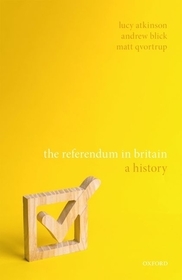
The Referendum in Britain
A History
-
10% KEDVEZMÉNY?
- A kedvezmény csak az 'Értesítés a kedvenc témákról' hírlevelünk címzettjeinek rendeléseire érvényes.
- Kiadói listaár GBP 88.00
-
39 732 Ft (37 840 Ft + 5% áfa)
Az ár azért becsült, mert a rendelés pillanatában nem lehet pontosan tudni, hogy a beérkezéskor milyen lesz a forint árfolyama az adott termék eredeti devizájához képest. Ha a forint romlana, kissé többet, ha javulna, kissé kevesebbet kell majd fizetnie.
- Kedvezmény(ek) 10% (kb. 3 973 Ft)
- Kedvezményes ár 35 759 Ft (34 056 Ft + 5% áfa)
Iratkozzon fel most és részesüljön kedvezőbb árainkból!
Feliratkozom
39 732 Ft

Beszerezhetőség
Becsült beszerzési idő: A Prosperónál jelenleg nincsen raktáron, de a kiadónál igen. Beszerzés kb. 3-5 hét..
A Prosperónál jelenleg nincsen raktáron.
Why don't you give exact delivery time?
A beszerzés időigényét az eddigi tapasztalatokra alapozva adjuk meg. Azért becsült, mert a terméket külföldről hozzuk be, így a kiadó kiszolgálásának pillanatnyi gyorsaságától is függ. A megadottnál gyorsabb és lassabb szállítás is elképzelhető, de mindent megteszünk, hogy Ön a lehető leghamarabb jusson hozzá a termékhez.
A termék adatai:
- Kiadó OUP Oxford
- Megjelenés dátuma 2020. november 26.
- ISBN 9780198823612
- Kötéstípus Keménykötés
- Terjedelem254 oldal
- Méret 242x160x24 mm
- Súly 510 g
- Nyelv angol 41
Kategóriák
Rövid leírás:
This book places the European Referendum of 2016 into a historical context that began in the late nineteenth century through to the present day. It provides a constitutional and international perspective, and ask how far the original ideas lying behind the referendum were fulfilled in practice.
TöbbHosszú leírás:
The European Union referendum of 23 June 2016 proved to be the trigger for the most prolonged period of political turbulence in the peacetime history of the UK; leading to major policy changes and realignments in the party-political system.
This book considers from an historical perspective the democratic device that provided the focus for this upheaval. Beginning in the late nineteenth century, it discusses how the idea of using referendums to resolve major political disputes first came onto the agenda, and why. It considers who advocated it, and in what circumstances. The book describes how referendums eventually came into use from the 1970s onwards, and the different patterns in their deployment in the decades that have followed. Major political figures, from Herbert Henry Asquith and Winston Churchill to Clement Attlee, Harold Wilson and Margaret Thatcher; to Tony Blair, David Cameron, and Boris Johnson form part of the story. Governments have come to power and fallen in the context of demands for referendums or the results they produced.
The authors provide detailed accounts of each of the 13 major referendums that have taken place. Referendums took place at UK and sub-UK level. They were held on the position of Northern Ireland (1973) and Scotland (2014) within the UK; on devolution to Wales (1979; 1997; 2011) and Scotland (1979; 1979); on the Belfast/Good Friday Agreement (1998); on devolution to London (1998) and North East England (2004); on the parliamentary voting system (2011); and on UK participation in European integration (1975; 1975). The book provides a constitutional and international perspective, and ask how far the original ideas lying behind the referendum were fulfilled in practice.
The strength of this book is its nuanced examination of the promotion, reception, and use of political referenda to show how, though once skeptically viewed, they became commonly accepted as a part of British democratic practice.
Tartalomjegyzék:
Introduction
Emergent Democracy: the period up to 1945
Pressure and Experimentation: 1945-1979
Reform and Europe: the period since 1979
Conclusion
Appendix: Major Referendums in the UK, 1973-2014)

