

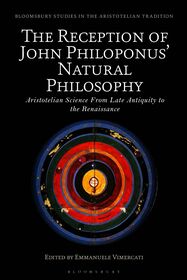
The Reception of John Philoponus’ Natural Philosophy
Aristotelian Science From Late Antiquity to the Renaissance
Sorozatcím: Bloomsbury Studies in the Aristotelian Tradition;
-
18% KEDVEZMÉNY?
- Kiadói listaár GBP 28.99
-
13 088 Ft (12 465 Ft + 5% áfa)
Az ár azért becsült, mert a rendelés pillanatában nem lehet pontosan tudni, hogy a beérkezéskor milyen lesz a forint árfolyama az adott termék eredeti devizájához képest. Ha a forint romlana, kissé többet, ha javulna, kissé kevesebbet kell majd fizetnie.
- Kedvezmény(ek) 18% (cc. 2 356 Ft off)
- Kedvezményes ár 10 732 Ft (10 221 Ft + 5% áfa)
- A kedvezmény érvényes eddig: 2026. augusztus 31.
10 732 Ft

Beszerezhetőség
Megrendelésre a kiadó utánnyomja a könyvet. Rendelhető, de a szokásosnál kicsit lassabban érkezik meg.
Why don't you give exact delivery time?
A beszerzés időigényét az eddigi tapasztalatokra alapozva adjuk meg. Azért becsült, mert a terméket külföldről hozzuk be, így a kiadó kiszolgálásának pillanatnyi gyorsaságától is függ. A megadottnál gyorsabb és lassabb szállítás is elképzelhető, de mindent megteszünk, hogy Ön a lehető leghamarabb jusson hozzá a termékhez.
A termék adatai:
- Kiadó Bloomsbury Publishing (UK)
- Megjelenés dátuma 2026. június 25.
- ISBN 9781350416314
- Kötéstípus Puhakötés
- Terjedelem264 oldal
- Méret 232x154x16 mm
- Súly 400 g
- Nyelv 698
Kategóriák
Hosszú leírás:
In some of his most famous works, John Philoponus (c. 490-570 CE) confronts numerous aspects of Aristotle's philosophy and science. Yet the influence of these reinterpretations and critiques remains under-examined. This volume fills this gap by uncovering the considerable impact of Philoponus' natural philosophy in both the medieval and Renaissance periods.
Divided into three parts, the first part of the volume introduces central concepts in Philoponus' philosophy. Highlighting the areas of crossover as well as of disagreement with Aristotle, chapters dedicate specific attention to Philoponus' theories of place, matter and vacuum; his ideas of motion; his discussion of the heavens and the fifth element; and his anthropology. This is followed, in parts two and three, by a focus on Philoponus' reception in the Middle Ages and the Renaissance respectively. Shedding light on the scientific ideas circulating in these periods, international experts explore a range of topics from the renewal of Aristotelianism in the Arab world, through the medieval Byzantine and Latin traditions, to Philoponus' appearance in the early works of Galileo.
Engaging with a number of Philoponus' key tracts, The Reception of John Philoponus' Natural Philosophy is both a much-needed study of Philoponus' influence and a revealing analysis of how Aristotelian science was received, adapted, critiqued and mediated throughout the Middle Ages and the Renaissance.
Tartalomjegyzék:
"
Introduction, Emmanuele Vimercati (Pontifical Lateran University, Rome, Italy)
Part I: Late Antiquity (and Its Legacy)
1. John Philoponus' Absolute Place and Its Reception by Francisco of Toledo, Ioannis Papachristou (National and Kapodistrian University, Athens, Greece)
2. Philoponus on Natural and Impressed Power, Emmanuele Vimercati (Pontifical Lateran University, Rome, Italy)
3. Philoponus on the Nature of the Heavens. Revisiting Some Old Debates, Marc-Antoine Gavray (University of Li---ge, Belgium)
4. John Philoponus on Being Human, Mark Edwards (University of Oxford, UK)
Part II: The Medieval Tradition
5. Proclus, Philoponus and the Brethren of Purity on the Eternity of the World, Carmela Baffioni (University of Naples - L'Orientale, Italy)
6. Averroes as Critic and Continuator within the Heritage of Philoponus' Philosophical Theology, David Twetten (Marquette University, USA)
7. Philoponus' Natural Philosophy in the Medieval Byzantine World: Psychological and Cosmological Debates, Tommaso De Robertis (University of Macerata, Italy and University of Toronto, Canada)
8. Philoponus and the Renewal of Aristotelian Cosmology in the Late Latin Middle Ages, Alessandro Ghisalberti (Catholic University, Milan, Italy)
Part III: Renaissance
9. Why Aristotle? Patterns in Renaissance Philosophy, Paul Richard Blum (Loyola University Maryland, USA and Palack--- University Olomouc, Czech Republic)
10. Philoponus' Metaphysical Cosmology in Renaissance Debates, Pietro Daniel Omodeo (University ""Ca' Foscari"", Venice, Italy)
11. Francesco Piccolomini (1523-1607) and Giacomo Zabarella (1533-1589) on Philoponus' Definition of Prime Matter, Antonio Petagine (University of Roma Tre, Italy)
12. Philoponus' Contribution to Copernicus' Doctrine of Gravity, Dilwyn Knox (University College London, UK)
13. Philoponus in Galileo's Early Works, Flavia Marcacci (University of Urbino ""Carlo Bo"", Italy)
Index

