

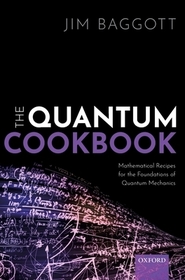
The Quantum Cookbook
Mathematical Recipes for the Foundations of Quantum Mechanics
-
10% KEDVEZMÉNY?
- A kedvezmény csak az 'Értesítés a kedvenc témákról' hírlevelünk címzettjeinek rendeléseire érvényes.
- Kiadói listaár GBP 59.00
-
28 187 Ft (26 845 Ft + 5% áfa)
Az ár azért becsült, mert a rendelés pillanatában nem lehet pontosan tudni, hogy a beérkezéskor milyen lesz a forint árfolyama az adott termék eredeti devizájához képest. Ha a forint romlana, kissé többet, ha javulna, kissé kevesebbet kell majd fizetnie.
- Kedvezmény(ek) 10% (cc. 2 819 Ft off)
- Kedvezményes ár 25 369 Ft (24 161 Ft + 5% áfa)
Iratkozzon fel most és részesüljön kedvezőbb árainkból!
Feliratkozom
28 187 Ft

Beszerezhetőség
Megrendelésre a kiadó utánnyomja a könyvet. Rendelhető, de a szokásosnál kicsit lassabban érkezik meg.
Why don't you give exact delivery time?
A beszerzés időigényét az eddigi tapasztalatokra alapozva adjuk meg. Azért becsült, mert a terméket külföldről hozzuk be, így a kiadó kiszolgálásának pillanatnyi gyorsaságától is függ. A megadottnál gyorsabb és lassabb szállítás is elképzelhető, de mindent megteszünk, hogy Ön a lehető leghamarabb jusson hozzá a termékhez.
A termék adatai:
- Kiadó OUP Oxford
- Megjelenés dátuma 2020. január 10.
- ISBN 9780198827856
- Kötéstípus Keménykötés
- Terjedelem320 oldal
- Méret 251x175x19 mm
- Súly 770 g
- Nyelv angol
- Illusztrációk 39 illustrations 0
Kategóriák
Rövid leírás:
The book combines popular and textbook presentation. It aims not to teach readers how to do quantum mechanics but rather helps them understand how to think about quantum mechanics. The real source of confusion in quantum mechanics does not originate in the mathematics, but in our understanding of what a scientific theory is supposed to represent.
TöbbHosszú leírás:
Quantum mechanics is an extraordinarily successful scientific theory. But it is also completely mad. Although the theory quite obviously works, it leaves us chasing ghosts and phantoms; particles that are waves and waves that are particles; cats that are at once both alive and dead; lots of seemingly spooky goings-on; and a desperate desire to lie down quietly in a darkened room. The Quantum Cookbook explains why this is. It provides a unique bridge between popular exposition and formal textbook presentation, written for curious readers with some background in physics and sufficient mathematical capability. It aims not to teach readers how to do quantum mechanics but rather helps them to understand how to think about quantum mechanics. Each derivation is presented as a 'recipe' with listed ingredients, including standard results from the mathematician's toolkit, set out in a series of easy-to-follow steps. The recipes have been written sympathetically, for readers who - like the author - will often struggle to follow the logic of a derivation which misses out steps that are 'obvious', or which use techniques that readers are assumed to know.
TöbbTartalomjegyzék:
Planck's Derivation of E = hn: The Quantisation of Energy
Einstein's Derivation of E = mc2: The Equivalence of Mass and Energy
Bohr's Derivation of the Rydberg Formula: Quantum Numbers and Quantum Jumps
De Broglie's Derivation of /\ = h/p: Wave-particle Duality
Schrödinger's Derivation of the Wave Equation: Quantisation as an Eigenvalue Problem
Born's Interpretation of the Wavefunction: Quantum Probability
Heisenberg, Bohr, Robertson, and the Uncertainty Principle : The Interpretation of Quantum Uncertainty
Heisenberg's Derivation of the Pauli Exclusion Principle: The Stability of Matter and the Periodic Table
Dirac's Derivation of the Relativistic Wave Equation: Electron Spin and Antimatter
Dirac, Von Neumann, and the Derivation of the Quantum Formalism: State Vectors in Hilbert Space
Von Neumann and the Problem of Quantum Measurement: The 'Collapse of the Wavefunction'
Einstein, Bohm, Bell, and the Derivation of Bell's Inequality: Entanglement and Quantum Non-locality

