

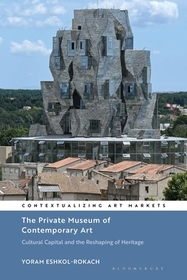
The Private Museum of Contemporary Art
Cultural Capital and the Reshaping of Heritage
Sorozatcím: Contextualizing Art Markets;
-
18% KEDVEZMÉNY?
- Kiadói listaár GBP 85.00
-
38 377 Ft (36 550 Ft + 5% áfa)
Az ár azért becsült, mert a rendelés pillanatában nem lehet pontosan tudni, hogy a beérkezéskor milyen lesz a forint árfolyama az adott termék eredeti devizájához képest. Ha a forint romlana, kissé többet, ha javulna, kissé kevesebbet kell majd fizetnie.
- Kedvezmény(ek) 18% (kb. 6 907 Ft)
- Kedvezményes ár 31 470 Ft (29 971 Ft + 5% áfa)
- A kedvezmény érvényes eddig: 2026. október 31.
31 470 Ft

Beszerezhetőség
Még nem jelent meg, de rendelhető. A megjelenéstől számított néhány héten belül megérkezik.
Why don't you give exact delivery time?
A beszerzés időigényét az eddigi tapasztalatokra alapozva adjuk meg. Azért becsült, mert a terméket külföldről hozzuk be, így a kiadó kiszolgálásának pillanatnyi gyorsaságától is függ. A megadottnál gyorsabb és lassabb szállítás is elképzelhető, de mindent megteszünk, hogy Ön a lehető leghamarabb jusson hozzá a termékhez.
A termék adatai:
- Kiadó Bloomsbury Publishing (UK)
- Megjelenés dátuma 2026. augusztus 6.
- ISBN 9781350511231
- Kötéstípus Keménykötés
- Terjedelem208 oldal
- Méret 236x156x16 mm
- Súly 560 g
- Nyelv 700
Kategóriák
Hosszú leírás:
What is the purpose of private museums? Who do they benefit and what threat do they pose to their public counterparts? This book examines the global phenomenon of the private museum of contemporary art, assessing the benefits gained by founder-owners of such institutions, and the impact they have on canon formation and art history.
The public museum, long considered a pillar of civic society, has for centuries been the manager and keeper of national collections and narratives, the guardian of cultural patrimony. This important role is now being compromised. Private museums, with their ever-expanding collections and often-unlimited financial resources, contribute considerably to this erosion. When it comes to contemporary art, the most sought-after commodity on the art market, this shift of ownership from public to private is at its most pronounced. Thus, control over the creation and safeguarding of future heritage is increasingly in private hands.
In this book art dealer and critic Yoram Eshkol-Rokach investigates the political, social and economic circumstances which have created the conditions behind the rise in this phenomenon, addressing ten case studies across the US, France and China. A former gallery owner himself, Eshkol-Rokach utilises his unique position to explore the business histories of each of the individual museum owners and reveals the returns they reap in political, social and economic spheres: benefits that transcend those of traditional art philanthropy.
Employing ideas from political and economic theory, art market studies, art sociology, consumer and critical luxury scholarship, and art and fashion histories, The Private Museum of Contemporary Art reveals the interlocking relationship of the museum sector with the art market and the impact of philanthrocapitalism, a venture capitalist gifting ideology, on the museum model.
Tartalomjegyzék:
Acknowledgements
Series Editor Introduction
Part One: Introduction
Approach, Structure, and Scope
The Choice of Jurisdictions and Examples
The Allure of Art
Private Museums, Ethics and the Public Trust
What Does it Take to Make or Break a Museum?
The Co-Dependency Between the Private Museum and the Art Market
Social Capital Gain and Spheres of Influence
Part Two: National Models
1. The American Model: The Long Shadow of the Museum Owner
Introduction
Contemporary Patrons and Their 'Court Artists'
The American Museum and Philanthropy
The Broad: The Reinvention of the American Museum
The Rubell Museums: The Midas Touch Effect on Art and the Art Market
Reflections
2. The French Model: The New Cultural Hegemony
Introduction
Art as a Branding Tool in the Luxury Industries
Fondation Louis Vuitton: Different Process, Same Language
Pinault Collection: Museum Owner of the American Mould
LUMA Arles: A Strive for Cultural Dominance in Provincial France
Afterthoughts
3. The Chinese Model: From Socialism to Nationalism
Introduction
A Brief History of Public and Private Museums in China
Art, Artists and Culture Policy Under the CCP
The Creative Industries in Shanghai
The Long Museums: Private in the Service of the State
The Times Museums: Corporate China's Unsteady Leap Forward
Reflections
Conclusion: The Volatility of Privatized Culture
Notes
Index

