

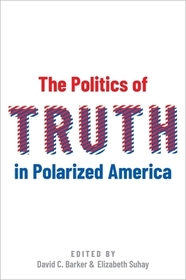
The Politics of Truth in Polarized America
-
10% KEDVEZMÉNY?
- A kedvezmény csak az 'Értesítés a kedvenc témákról' hírlevelünk címzettjeinek rendeléseire érvényes.
- Kiadói listaár GBP 69.00
-
31 153 Ft (29 670 Ft + 5% áfa)
Az ár azért becsült, mert a rendelés pillanatában nem lehet pontosan tudni, hogy a beérkezéskor milyen lesz a forint árfolyama az adott termék eredeti devizájához képest. Ha a forint romlana, kissé többet, ha javulna, kissé kevesebbet kell majd fizetnie.
- Kedvezmény(ek) 10% (kb. 3 115 Ft)
- Kedvezményes ár 28 038 Ft (26 703 Ft + 5% áfa)
Iratkozzon fel most és részesüljön kedvezőbb árainkból!
Feliratkozom
31 153 Ft

Beszerezhetőség
A kiadó fontolgatja a könyv utánnyomását, de bizonytalan, hogy ez mikor következik be.
Why don't you give exact delivery time?
A beszerzés időigényét az eddigi tapasztalatokra alapozva adjuk meg. Azért becsült, mert a terméket külföldről hozzuk be, így a kiadó kiszolgálásának pillanatnyi gyorsaságától is függ. A megadottnál gyorsabb és lassabb szállítás is elképzelhető, de mindent megteszünk, hogy Ön a lehető leghamarabb jusson hozzá a termékhez.
A termék adatai:
- Kiadó OUP USA
- Megjelenés dátuma 2022. január 5.
- ISBN 9780197578384
- Kötéstípus Keménykötés
- Terjedelem448 oldal
- Méret 164x239x32 mm
- Súly 757 g
- Nyelv angol 0
Kategóriák
Rövid leírás:
This volume provides the first comprehensive empirical examination of the "politics of truth" -- its context, causes, and potential correctives. Combining insights from the fields of political science, political theory, communication, and psychology, the experts in this volume draw compelling -- if sometimes competing -- conclusions regarding this rising democratic threat.
TöbbHosszú leírás:
In American politics, the truth is rapidly losing relevance. The public square is teeming with misinformation, conspiracy theories, cynicism, and hubris. Why has this happened? What does it mean? What can we do about it? In this volume, leading scholars offer multiple perspectives on these questions, and many more, to provide the first comprehensive empirical examination of the "politics of truth" -- its context, causes, and potential correctives. With experts in social science weighing in, this volume examines different drivers such as the dynamics of politically motivated fact perceptions.
Combining insights from the fields of political science, political theory, communication, and psychology and offering substantial new arguments and evidence, these chapters draw compelling -- if sometimes competing -- conclusions regarding this rising democratic threat.
Tartalomjegyzék:
Introduction
The Politics of Truth in Polarized America: Contexts, Concepts, Causes, and Correctives.
Elizabeth Suhay, David C. Barker, and Ryan DeTamble
Part I: Context & Concepts
1. Neither Dogmatism Nor Relativism: Lessons from the Politics of Truth in Western Philosophy
Alan Levine
2. Lies, Damn Lies, and Democracy
Robert Shapiro
3. The Social Function of News and (Mis)Information Use
Benjamin Toff
4. The Expressive Value of Answering Survey Questions
Matthew H. Graham and Gregory A. Huber
5. American Hubris: The Politics of Unwarranted Epistemic Certitude in the United States
David C. Barker, Morgan Marietta, and Ryan DeTamble
Part II: Causes
6. The Psychology of Groups and the Politics of Misinformation
Michael Bang Petersen, Mathias Osmundsen, and John Tooby
7. Political Sub-Groups, Knowledge, and Information: Gun Issues and Gun Ownership
Donald Haider-Markel, Abigail Vegter, and Patrick Gauding
8. Value Projection and the Marketplace of Realities
David C. Barker and Morgan Marietta
9. Conspiracy Theories and Political Identities
Adam Enders and Joseph Uscinski
10. Conspiracy Stress or Relief? Learned Helplessness and Conspiratorial Thinking
Christina E. Farhart, Joanne M. Miller, and Kyle L. Saunders
Part III: Correctives
11. Opinion Formation in Light of the Facts: How Correcting Mistaken Beliefs about Income Inequality Affects Public Support for Redistribution
Cheryl Boudreau and Scott A. MacKenzie
12. Can Facts Change Minds? The Case of Free Trade
Ethan Porter and Thomas Wood
13. Do Facts Change Public Attitudes toward Fiscal Policy?
John Sides
14. Authoritarianism, Fact-Checking, and Citizens' Response to Presidential Election Information
Amanda Wintersieck
15. Combatting the Anti-Muslim Rhetoric of the 2016 Presidential Campaign: An Experimental Investigation of the Impact of Corrective News
Kim Fridkin and Jilian Courey
16. Citizen Deliberation as a Correction: The Role of Deliberative Mini-Publics in Addressing Political Misperceptions
Justin Reedy, Chris Anderson and Paole Conte
17. Intuitive Politics and Why Thinking Isn't Guaranteed to Save Us
Kevin Arceneaux and Ryan J. Vander Wielen

