

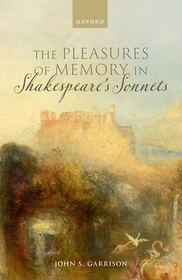
The Pleasures of Memory in Shakespeare's Sonnets
-
10% KEDVEZMÉNY?
- A kedvezmény csak az 'Értesítés a kedvenc témákról' hírlevelünk címzettjeinek rendeléseire érvényes.
- Kiadói listaár GBP 73.00
-
32 959 Ft (31 390 Ft + 5% áfa)
Az ár azért becsült, mert a rendelés pillanatában nem lehet pontosan tudni, hogy a beérkezéskor milyen lesz a forint árfolyama az adott termék eredeti devizájához képest. Ha a forint romlana, kissé többet, ha javulna, kissé kevesebbet kell majd fizetnie.
- Kedvezmény(ek) 10% (kb. 3 295 Ft)
- Kedvezményes ár 29 664 Ft (28 251 Ft + 5% áfa)
Iratkozzon fel most és részesüljön kedvezőbb árainkból!
Feliratkozom
32 959 Ft

Beszerezhetőség
Megrendelésre a kiadó utánnyomja a könyvet. Rendelhető, de a szokásosnál kicsit lassabban érkezik meg.
Why don't you give exact delivery time?
A beszerzés időigényét az eddigi tapasztalatokra alapozva adjuk meg. Azért becsült, mert a terméket külföldről hozzuk be, így a kiadó kiszolgálásának pillanatnyi gyorsaságától is függ. A megadottnál gyorsabb és lassabb szállítás is elképzelhető, de mindent megteszünk, hogy Ön a lehető leghamarabb jusson hozzá a termékhez.
A termék adatai:
- Kiadó OUP Oxford
- Megjelenés dátuma 2023. október 13.
- ISBN 9780198857716
- Kötéstípus Keménykötés
- Terjedelem206 oldal
- Méret 242x160x16 mm
- Súly 446 g
- Nyelv angol
- Illusztrációk 12 black and white illustrations 428
Kategóriák
Rövid leírás:
This imaginative and richly detailed study explores the deep connection between desire and recollection in Shakespeare's poetry. Drawing on cognitive science, the early modern memory arts, and psychoanalysis, as well as works by contemporary authors, the book shows how Shakespeare's Sonnets treat memory as a form of poetic narrative.
TöbbHosszú leírás:
The Pleasures of Memory in Shakespeare's Sonnets uses Shakespeare's poetry as a case study for the mutually formative relationship between desire and recollection. Through a series of close readings that are both historically situated and informed by recent theory, it traces how the speaker of the poems strives for a more agential relationship to his own memory by treating recollection as a form of narrative.
Drawing together insights from cognitive science, the early modern memory arts, and psychoanalysis, John S. Garrison connects the Sonnets to the larger Renaissance project of conceiving memory as a faculty to be developed and managed through self-discipline and rhetoric. In doing so, he reveals how early modern thought presaged many theories that have emerged in contemporary neuroscientific and psychoanalytic understandings of the self and its longing for pleasure. The Sonnets emerge as a collection that contemplates the affective dimensions and conceptual overlaps that bind anticipation to retrospection in the fraught pursuit of erotic pleasure.
Indispensable for students and scholars working on Shakespeare's poetry, this study appeals also to a broader audience of readers interested in affect, memory, and sexuality studies. Shakespeare's most beloved sonnets are discussed, as well as less familiar ones, alongside contemporary adaptations of the poems. Garrison brings the Sonnets further into the present by comparing them with treatments of pleasure and memory by modern authors such as C.P. Cavafy, Toni Morrison, William Faulkner, and Michael Ondaatje.
Garrison's book will be enjoyed and remembered for years to come.[This book] profits from not only Shakespeare's but also Garrison's robust memory, which culls, from what must be a voracious commonplace book, a treasure trove of [...] far-flung quotations, including- to name but a few of the strange bedfellows that Garrison acquaints the Sonnets with-Constantine Cavafy, Arthur Schopenhauer, the film Brokeback Mountain, Antonio Damasio, Melanie Klein, Michael Ondaatje, Annie Lennox, William Faulkner, John Lyly, and Jorge Luis Borges. Garrison capitalizes on the promiscuity, even the polyamory, of intertextual memory, since his quotations engender at times the thrill of unexpected encounters, quick couplings, and new combinations, furnishing him with a unique shorthand for composing smart close readings of the Sonnets.
Tartalomjegyzék:
List of Figures
Acknowledgments
Introduction: Remembering the Sonnets
Time, Hope, and Desire
The Pleasure of the Sonnets
Embracing Absence
Body, Remember
Scenographies of Waiting
Remembering, Repeating, and Writing-Through
Contagious Memory
Bibliography
Index

