

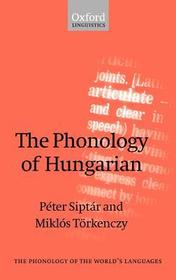
The Phonology of Hungarian
Sorozatcím: The Phonology of the World's Languages;
-
10% KEDVEZMÉNY?
- A kedvezmény csak az 'Értesítés a kedvenc témákról' hírlevelünk címzettjeinek rendeléseire érvényes.
- Kiadói listaár GBP 91.00
-
41 086 Ft (39 130 Ft + 5% áfa)
Az ár azért becsült, mert a rendelés pillanatában nem lehet pontosan tudni, hogy a beérkezéskor milyen lesz a forint árfolyama az adott termék eredeti devizájához képest. Ha a forint romlana, kissé többet, ha javulna, kissé kevesebbet kell majd fizetnie.
- Kedvezmény(ek) 10% (cc. 4 109 Ft off)
- Kedvezményes ár 36 978 Ft (35 217 Ft + 5% áfa)
Iratkozzon fel most és részesüljön kedvezőbb árainkból!
Feliratkozom
41 086 Ft

Beszerezhetőség
Megrendelésre a kiadó utánnyomja a könyvet. Rendelhető, de a szokásosnál kicsit lassabban érkezik meg.
Why don't you give exact delivery time?
A beszerzés időigényét az eddigi tapasztalatokra alapozva adjuk meg. Azért becsült, mert a terméket külföldről hozzuk be, így a kiadó kiszolgálásának pillanatnyi gyorsaságától is függ. A megadottnál gyorsabb és lassabb szállítás is elképzelhető, de mindent megteszünk, hogy Ön a lehető leghamarabb jusson hozzá a termékhez.
A termék adatai:
- Kiadó OUP Oxford
- Megjelenés dátuma 2000. július 6.
- ISBN 9780198238416
- Kötéstípus Keménykötés
- Terjedelem336 oldal
- Méret 242x162x24 mm
- Súly 638 g
- Nyelv angol
- Illusztrációk linguistic tree diagrams 0
Kategóriák
Rövid leírás:
This book is the first comprehensive account of the phonology of Hungarian to appear in English. Hungarian (Magyar) is a Finno-Ugric language spoken by over thirteen million people in Central Europe. P--ter Sipt--r and Mikl--s T--rkenczy here place the emphasis on descriptive coverage rather than theoretical issues, therefore ensuring that the book will be of interest not only for phonology specialists, but also for a much wider audience interested in Hungarian.
TöbbHosszú leírás:
This is the first comprehensive account of the phonology of Hungarian to have been published in English. Hungarian is a Uralic (Finno-Ugric) language. It is unlike other European languages, and atypical among the members of the Uralic family. The lexicon reflects the country's history, with the earliest layers of loanwords coming from Iranian, various Turkic and Slavonic languages, and German.
The book is divided into three parts. Part I introduces the general features of the language and its major dialects. Part II examines its vowel and consonant systems, and its phonotactics (syllable structure constraints, transsyllabic constraints, and morpheme structure constraints). In Part III the authors describe the phonological processes that vowels, consonants, and syllables undergo and/or trigger. They provide a new analysis of vowel harmony, as well as discussions of palatalization, voice assimilation, and processes targetting nasals and liquids. The final chapters of the work are devoted to processes conditioned by syllable structure, and to surface phenomena.
The book concludes with a full list of references and a comprehensive index. The authors have framed their discussions within a rule-based, non-linear framework to achieve optimum accessibility and concision. Their authoritative account of the sound-system of this unique language will interest phonologists and their advanced students throughout the world.
Achieves its goal splendidly ... The book has the quality of being extremely clear: it has been well proof-read, the glosses are reliable, the symbols/fonts are used consistently throughout the text. I believe that the book will become the key reference for Hungarian phonology for many years
Tartalomjegyzék:
Part I: Background
Chapter 1: Introduction
Chapter 2: Preliminaries
Part II: Systems
Chapter 3: The Vowel System
Chapter 4: The Consonant System
Chapter 5: Phonotactics: Syllable structure
Part III: Processes
Chapter 6: Processes Involving Vowels
Chapter 7: Processes Involving Consonants
Chapter 8: Processes Conditioned by Syllable Structure
Chapter 9: Surface Processes

