

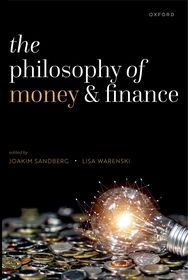
The Philosophy of Money and Finance
-
10% KEDVEZMÉNY?
- A kedvezmény csak az 'Értesítés a kedvenc témákról' hírlevelünk címzettjeinek rendeléseire érvényes.
- Kiadói listaár GBP 25.00
-
11 287 Ft (10 750 Ft + 5% áfa)
Az ár azért becsült, mert a rendelés pillanatában nem lehet pontosan tudni, hogy a beérkezéskor milyen lesz a forint árfolyama az adott termék eredeti devizájához képest. Ha a forint romlana, kissé többet, ha javulna, kissé kevesebbet kell majd fizetnie.
- Kedvezmény(ek) 10% (kb. 1 128 Ft)
- Kedvezményes ár 10 159 Ft (9 675 Ft + 5% áfa)
Iratkozzon fel most és részesüljön kedvezőbb árainkból!
Feliratkozom
11 287 Ft

Beszerezhetőség
Becsült beszerzési idő: A Prosperónál jelenleg nincsen raktáron, de a kiadónál igen. Beszerzés kb. 3-5 hét..
A Prosperónál jelenleg nincsen raktáron.
Why don't you give exact delivery time?
A beszerzés időigényét az eddigi tapasztalatokra alapozva adjuk meg. Azért becsült, mert a terméket külföldről hozzuk be, így a kiadó kiszolgálásának pillanatnyi gyorsaságától is függ. A megadottnál gyorsabb és lassabb szállítás is elképzelhető, de mindent megteszünk, hogy Ön a lehető leghamarabb jusson hozzá a termékhez.
A termék adatai:
- Kiadó OUP Oxford
- Megjelenés dátuma 2025. augusztus 28.
- ISBN 9780198978725
- Kötéstípus Puhakötés
- Terjedelem336 oldal
- Méret 235x156x20 mm
- Súly 520 g
- Nyelv angol
- Illusztrációk Two black-and-white illustrations 616
Kategóriák
Rövid leírás:
The Philosophy of Money and Finance presents sixteen original essays providing a comprehensive introduction to questions concerning the nature of money and monetary value, the epistemology of markets, and the ethics of financial systems.
TöbbHosszú leírás:
Most people use money almost every day, and financial assets have become so important to modern life that they determine our fate both as individuals and as societies. Yet we seldom stop to think about what all of this means, how it works, and how it ought to work. How can a small piece of paper in your wallet have value? How can so much power be vested in the numbers that roll across bankers' computer screens? What role should financial assets and financial institutions play in our lives and in society?
The Philosophy of Money and Finance seeks to answer these types of questions by taking a look "under the hood" to examine the nature of money and the normative foundations of finance. Although philosophical theorizing about money and finance dates back to antiquity, the topic has only recently emerged as a central research focus. Economic globalization, technological innovation, the events of the 2008 financial crisis, and the Covid pandemic have brought new urgency to a broad array of questions in this field.
This book brings together sixteen original chapters that provide a comprehensive introduction to this exciting new field. It is divided into four parts, covering metaphysics, epistemology, ethics, and political philosophy. Within each part, questions that are central to the topic are presented and discussed by leading scholars. The chapters are written in a clear and straightforward manner and without presupposing any background in either philosophy or finance.
Questions relating to the monetary and financial systems have begun to receive serious attention from philosophers in recent years. In this landmark collection, Joakim Sandberg and Lisa Warenski have brought together an impressive array of contributors, who together advance the state-of-the-art in philosophical debates on money and finance, encompassing issues from metaphysics and epistemology to ethics and political philosophy. The collection thereby does an impressive job of deepening philosophy's engagement with these crucially important aspects of our shared social and economic lives—ranging over issues from financial crises to green finance, and from central banking to cryptocurrency.
Tartalomjegyzék:
Introduction
I METAPHYSICS
The Social Ontology of Money
Cryptocurrency: Commodity or Credit?
How Many People Does It Take to Make a Dollar?
Truth in Financial Accounting
II EPISTEMOLOGY
Are Financial Markets Epistemically Efficient?
Financial Economics: What Kind of Science Is It?
JPMorgan Chase's London Whale Trading Losses: A Tale of Human Fallibility
Climate Change and Reflexive Law: The EU Sustainable Finance Action Plan
III ETHICS
Is the Pursuit of Money Incompatible with Morality? Some Historical and Philosophical Reflections
Virtue Theory and the Ethics of Finance
On the Wrongfulness of Bank Contributions to Financial Crises
Money in the Social Contract
IV POLITICAL PHILOSOPHY
Credit and Distributive Justice
Freedom and Financial Market Reform
Green Central Banking
Bitcoins Left and Right: A Normative Assessment of a Digital Currency

